
A linen dress is a dress cut from linen, the cloth woven from the fibres of the flax plant. It is a one-piece garment, usually sleeveless or short-sleeved, that hangs from the shoulders and falls to the knee, the calf or the ankle.
It is one of the oldest kinds of dress in the world, and also one of the most misunderstood. People buy a linen dress expecting it to behave like cotton, then feel cheated when it creases by lunchtime, or they avoid linen altogether because they assume it always looks crumpled and rough. Neither view is fair. A linen dress has a character of its own: cool, dry, slightly textured, and relaxed in a way no other fabric quite manages.
This is an explainer, not a shopping list. It sets out what a linen dress is, what the fibre and the weaves do, which cuts exist and why, when the dress works and when it does not, and the care basics that keep one wearable for years.
Key takeaways
- A linen dress is a one-piece dress made from linen cloth, woven from flax fibres.
- Linen is exceptionally breathable and quick to dry, which is why the dress suits hot weather.
- The fibre has almost no elasticity, so a linen dress creases wherever it bends, and those creases are normal.
- Weave, weight and finish change the dress more than the label does: plain weave, twill and washed linen all behave differently.
- No linen dress stays smooth all day, and a dress that claims to be wrinkle-free is almost certainly a heavy blend, not pure linen.
What a linen dress actually is
Strip away the marketing and the definition is simple: a linen dress is a dress whose main cloth is linen, either pure linen or a linen-rich blend. The bodice and the skirt are cut from the same fabric, and the shape comes from the cut itself — a waist seam, a wrap tie, buttons down the front, or a gathered skirt — rather than from stretch in the cloth, because linen barely stretches at all.
That lack of stretch is the first thing to understand. A jersey dress follows the body and forgives a poor cut. A linen dress holds the shape it was cut in, and if that shape is wrong, no amount of tugging will fix it.
The second defining feature is the surface. Real linen has a slightly uneven, slubbed texture: tiny thick-and-thin variations in the yarn that you can see and feel. A perfectly smooth, uniform cloth is probably not linen, or not mostly linen. That texture is the signature of the fibre, and it is also what gives a linen dress its dry, matte look, quite unlike the sheen of silk or the soft nap of cotton.
It helps to contrast it with its nearest relative. A linen suit is a matching two-piece set, jacket and trousers cut from the same cloth, built for warm-weather tailoring; our guide to what a linen suit is explains that matching construction. A linen dress is the opposite idea: a single garment, no matching half, no tailoring canvas, just cloth and cut.
The fibre and the weaves
Linen begins as flax, a plant grown for the long fibres in its stem. Those fibres are hollow, strong and stiff, and when they are spun and woven they produce a cloth that moves air and moisture through it instead of trapping them against the skin.
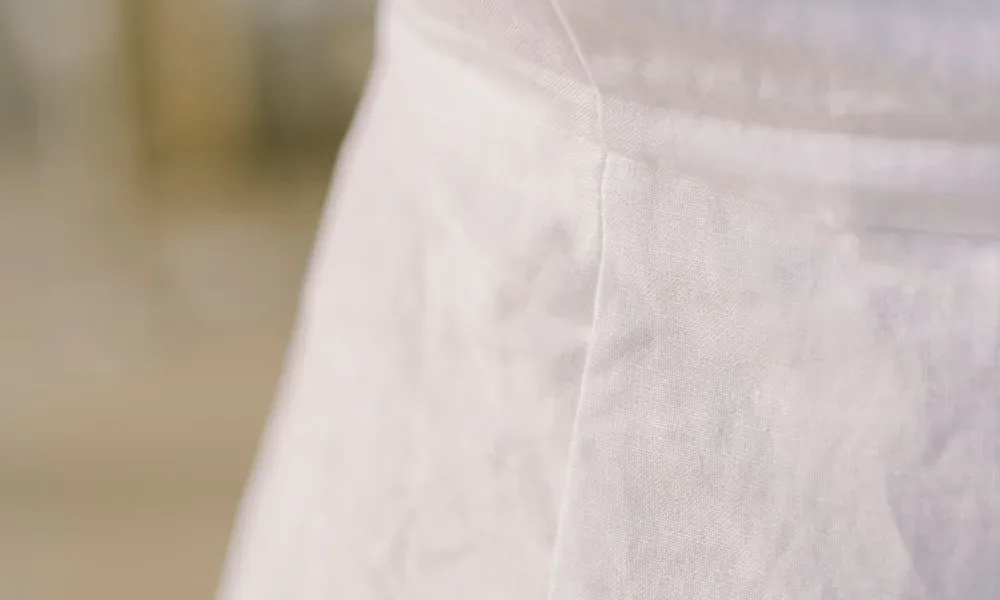
The same stiffness explains the creasing. Flax fibres barely spring back once they are bent, so every fold leaves a mark: at the waist where you sit, at the elbows, at the hem where the fabric gathers. These creases are not damage, and they are not a sign of poor quality.
Weave changes how a dress looks, feels and behaves. A plain weave is the most common: a simple over-and-under pattern that is strong, breathable and stable, and suits shirt dresses, shift dresses and A-line styles. A twill weave has a diagonal rib, feels slightly heavier, and resists creasing a little better, which makes it a good choice for a more structured dress.
Finish matters as much as weave. Raw linen feels crisp and a little rough when new, and softens slowly over many washes. Stone-washed or garment-washed linen has been pre-softened, so it feels relaxed from the first wear and has usually already done most of its shrinking. Blends change the balance too: linen with cotton is softer from the start and creases a little less, though it is slightly warmer, while linen with viscose drapes more fluidly and feels cooler against the skin.
Cuts and silhouettes
A linen dress needs its shape built into the cut, because the cloth will not supply it. The main silhouettes each solve that problem differently. A shirt dress uses buttons and a collar to give structure, and it reads slightly smarter than the rest, which is why it is the most useful linen dress for work or for a lunch that needs to look polished. A wrap dress defines the waist with its tie and suits most figures, because the wrap can be adjusted tighter or looser through the day.
An A-line dress flares gently from the shoulders or the waist, and it is the most forgiving cut in linen: the fabric falls away from the body, so it shows fewer creases and stays cool. A shift dress is straight from shoulder to hem, and it depends entirely on being cut well; too narrow and it pulls, too wide and it looks like a sack.
Length matters as much as shape. A midi, ending between the knee and the ankle, is the most useful linen dress length: it shows the shoes, keeps the hem out of the way, and suits both flat sandals and a low heel. A maxi is beautiful in motion and ideal for holidays, but it needs a defined waist or a slit, or the volume can overwhelm a smaller frame.
Sleeves are part of the definition too. Most linen dresses are sleeveless, short-sleeved or three-quarter sleeved, because the fabric is made for warm weather and long sleeves defeat the point. Sleeveless styles show the weave at its best but need a well-cut armhole, since linen does not stretch around the shoulder. For the detail of choosing between these cuts, our guide to choosing the perfect linen dress covers weight, lining and quality signs in full.
When a linen dress works — and when it does not
A linen dress works best where its strengths matter: heat, humidity and long days outdoors. Holidays, garden lunches, summer weddings with a relaxed dress code, market mornings and warm evenings are its natural ground. The fabric breathes, dries fast after a sudden shower, and looks at ease in sunlight in a way heavier cloths never do.
It works less well where a smooth, formal finish is expected. A linen dress is the wrong choice for a black-tie event, a formal office, or any occasion where you will be photographed sitting down for hours and want to look pressed. It is also a poor choice in cold weather: linen offers almost no insulation, so the dress feels thin and looks out of place once the temperature drops.
Colour and weight shift the balance. A mid-weight linen, roughly 160 to 200 grams per square metre, holds its shape, drapes cleanly and creases less obviously than a very fine linen, while still feeling cool. Very light linen feels airier on the hottest days, but it can look flimsy and show every crease, and it is more likely to be sheer in bright sun.
The caveats that matter
Before deciding a linen dress is for you, the honest trade-offs deserve a plain statement. Linen is strong and long-lasting, but it is not a low-maintenance fabric, and the dress will ask more of its owner than a cotton dress does. The table below sets out the main points at a glance.
| Detail | What is known |
|---|---|
| Creasing | Normal and unavoidable in pure linen; softens with wear but never disappears. |
| Breathability | Excellent; hollow flax fibres move air and moisture through the cloth. |
| Strength | Very strong when dry, but weaker when wet, so handle gently in the wash. |
| Shrinkage | Untreated linen can shrink 5 to 10 percent on the first wash; pre-washed linen mostly will not. |
| Sheerness | Light linen can be see-through in bright sun; check the dress against the light. |
| Stretch | Less than 2 percent, with almost no recovery, so the cut must fit as made. |
| Colour | Natural, undyed linen is cream or oatmeal; dyed linen can fade if washed hot. |
| Warmth | Almost none; a linen dress is a warm-weather garment, not a cold-weather one. |
Two of these matter most in practice. The first is shrinkage: if a dress has not been pre-washed, size up slightly or wash it carefully before relying on the fit.
Care basics in brief
A linen dress lasts for years if it is washed gently, and it is the washing, more than the wearing, that usually ruins one. Wash in cool water, never above 40 degrees, on a gentle cycle with a mild detergent and no bleach. Never wring a linen dress, and never tumble-dry it on high heat, because heat and rough handling cause most shrinkage and stiffness.
Air-dry in the shade, reshaped while damp, and iron or steam while the dress is still slightly damp for the smoothest finish. Our full guide to caring for linen clothes covers stain treatment, drying and storage in detail.
Checklist: before you buy or wear one
- Hold the skirt up to the light to check it is not see-through.
- Check the label: pure linen, or a stated linen blend, with the fibre content given.
- Look for a mid-weight cloth that feels substantial, not thin and papery.
- Make sure the dress skims the body with room to move, and never pulls at the bust or hips.
- Check whether the linen is pre-washed, or allow for shrinkage on the first wash.
- Accept the wrinkles before you buy: if creases will bother you, choose a linen blend instead.
Frequently asked questions
What is a linen dress made of?
Linen, the cloth woven from the fibres of the flax plant. A linen dress is usually pure linen or a linen-rich blend, most often with cotton or viscose.
Is a linen dress the same as a cotton dress?
No. Cotton is softer and smoother, and it creases less, but it holds moisture longer and feels warmer in humidity. Linen is drier, cooler and more textured, and it creases more.
Do linen dresses always wrinkle?
Almost always, yes. Linen fibres have very little elasticity, so folds leave marks within an hour of wearing. The wrinkles soften with wear but never disappear entirely.
Can you wear a linen dress to a wedding?
Yes, at a relaxed or outdoor summer wedding, where a linen dress looks entirely at home.
Is a linen dress only for summer?
Mostly, yes. Linen dresses are designed for late spring to early autumn, when staying cool is the priority.
How should a linen dress fit?
It should skim the body with room to move, never pulling across the bust or the hips. Because linen barely stretches, a dress that is too tight will not ease with wear.
The bottom line
A linen dress is a one-piece dress cut from linen cloth, and its whole character follows from that one fact. The flax fibre makes it the coolest, most breathable dress you can wear in hot weather, and the same fibre makes it crease, drape softly and refuse to hold a sharp line.
If you wear one, wear it for what it is rather than what you wish it were. Choose a mid-weight cloth, a cut with its shape built in, and a length you will actually reach for on hot days, and accept the wrinkles as part of the bargain.
Note: Fabric weights, blend percentages and care labels vary by maker, so always check the label on the individual dress before buying or washing. A specific dress may behave differently depending on its cloth, weave and finish.
Meet Our Experts
Our fashion editors write BrassSmile guides from published specifications, fabric references and editor reviews, and each article is checked against the live site before publication.
Why Trust BrassSmile
We explain garments in plain terms, separate what a fabric does from what marketing claims, and link only to our own published guides so readers can check the detail for themselves.
Sources
Fabric and fibre references: standard textile references on flax and linen weaving; BrassSmile guides to linen suits, linen dress buying and linen care, linked above.