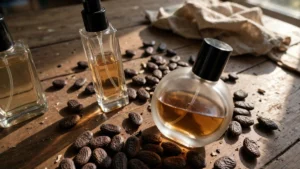
A tonka bean perfume is a fragrance built around one of perfumery’s warmest base notes. The tonka bean is the wrinkled seed of the Dipteryx odorata tree, native to South America, and it smells of vanilla, almond, cinnamon and cut hay. It is not a bean, despite the name, and it is not vanilla, although the two are constantly confused. When a perfume smells warm, sweet and expensive hours after you sprayed it, tonka bean is very often the note doing the work.
The note has been in perfumery for almost two hundred years, since coumarin, the compound that gives tonka its smell, was first isolated in 1820. It was the first fragrance compound ever isolated from a natural source, and it changed how perfumes were made, because for the first time a perfumer could use a single, stable molecule instead of relying on a variable natural material.
This guide explains what a tonka bean perfume is, how the note works, where it comes from, and how to choose and wear one. It covers the facts that matter, the safety limits worth knowing, and the pairings that make tonka shine, so you can tell a good tonka perfume from a merely sweet one.
Key takeaways
- A tonka bean perfume is built around the seed of the Dipteryx odorata tree, which smells of vanilla, almond, cinnamon and hay.
- Tonka is a base note and a fixative, so it appears in the dry-down and makes the whole perfume last longer.
- Its smell comes mainly from coumarin, the first fragrance compound ever isolated, in 1820.
- Natural tonka is limited by safety standards because of coumarin, so many modern perfumes use a synthetic recreation.
- No tonka perfume is the same as another, and coumarin can irritate sensitive skin, so patch-test before wearing one all day.
What a tonka bean perfume is
A tonka bean perfume is any fragrance in which tonka bean plays a defining role, usually in the base. That does not always mean tonka is the loudest note. In some perfumes it leads, and you can smell it clearly from the first hour. In others it works quietly underneath vanilla, tobacco or woods, adding warmth and depth without ever stepping forward. What makes a perfume a tonka bean perfume is that the scent would fall apart, or smell noticeably thinner, without it.
The note itself is easy to recognise once you know it. It is warm and sweet, but drier than vanilla, with a powdery, almond-like quality and a hint of cinnamon and dried hay. On a blotter it smells almost edible, like a cross between a vanilla pod and a marzipan sweet. On skin it softens and warms up, and it tends to stay close to the wearer rather than filling a room.
Tonka bean perfumes are usually eau de parfum or stronger, because the note needs concentration to work, and they are most often worn in autumn and winter. The warmth that feels comforting in cold weather can feel heavy in heat, so most tonka scents are seasonal by nature.
How tonka bean is used in perfumery
Perfumers use tonka bean in two main ways: as a natural absolute, extracted from the seeds, and as synthetic coumarin, the isolated molecule that carries most of the smell. The synthetic is cleaner, more consistent from batch to batch, and easier to dose within safety limits. Most modern perfumes use a blend of the two, or the synthetic alone.

Tonka is almost always a base note, which means it is one of the last things you smell. Perfumers add it to anchor lighter notes, slow their evaporation, and give the dry-down a warm, sweet character. That fixative effect is one of the main reasons it is so widely used. A perfume with tonka in the base will usually last longer on skin than the same scent without it, and it will last longer still on fabric, where the heavy molecules cling to fibres for hours or even days. Our guide to how to make perfume last longer explains how base notes like tonka work alongside application and storage to extend a scent.
Dosage matters more with tonka than with most notes. A small amount adds warmth and roundness. A large amount turns a perfume into a gourmand, sweet and almost edible, and it can overwhelm the other notes entirely.
9 facts about tonka bean perfumes
Tonka bean is a seed, not a bean
What it shows: The name is misleading. Tonka beans are the seeds of the Dipteryx odorata tree, which grows in the rainforests of South America, mainly in Venezuela, Brazil and Guyana. What to consider: The seeds are harvested from the tree’s fruit, then dried and cured, which deepens their smell. Best For: Anyone who wants to understand what is actually in the bottle. Material: Dipteryx odorata seeds, dried and cured. Price Range: The raw material is inexpensive; the cost comes from the perfume around it. Standout Feature: A seed that smells like vanilla, almond and hay at once.
It smells of vanilla, almond, cinnamon and hay
What it shows: Tonka’s smell is a blend of several familiar scents at once, which is why it is so hard to pin down and so easy to love. What to consider: The exact balance changes with the source and the extraction, so one tonka absolute can lean more almond, another more hay. Best For: Learning to recognise the note in a perfume. Material: Coumarin, the main scent compound, with smaller amounts of other natural molecules. Price Range: Recognising the note costs nothing; a sample set is the cheapest way to learn it. Standout Feature: Four familiar smells in a single note.
Coumarin was the first fragrance compound ever isolated
What it shows: In 1820, coumarin was isolated from tonka beans, making it the first single scent molecule ever identified from a natural source. What to consider: That discovery opened the door to modern perfumery, because perfumers could finally work with stable, repeatable molecules. Best For: Understanding why tonka has such a long history in fragrance. Material: Coumarin, first isolated in 1820. Price Range: Synthetic coumarin is one of the cheapest fragrance materials available. Standout Feature: The molecule that started modern perfumery.
Tonka is a base note and a fixative, which is why tonka perfumes last
What it shows: Tonka sits in the base of a perfume and evaporates slowly, holding the other notes in place and extending the life of the whole scent. What to consider: That longevity is a double-edged sword: a tonka perfume you dislike will linger just as long as one you love. Best For: Anyone who wants a perfume that lasts all day without reapplying. Material: Tonka bean absolute or coumarin, used in the base. Price Range: Longevity is free; it comes with the note, not the price tag. Standout Feature: Eight to twelve hours on skin, longer on fabric.
Natural tonka is limited by safety standards
What it shows: Coumarin is restricted in food and limited in fragrance, because high doses can affect the liver and irritate skin. What to consider: The limits apply to the finished perfume, not to a single sniff, and regulated perfumes stay well within them. Best For: Anyone with sensitive skin or a fragrance allergy. Material: Coumarin, regulated by industry safety standards. Price Range: Safety compliance is built into the price of every regulated perfume. Standout Feature: A beloved note with a real, sensible limit.
This is also why many perfumes use synthetic coumarin instead of the natural absolute. It is easier to dose precisely, and it keeps the scent within the safe range.
Most modern tonka is a synthetic recreation
What it shows: The majority of tonka perfumes today use synthetic coumarin, sometimes blended with a small amount of natural absolute for complexity. What to consider: Synthetic does not mean inferior. It is more consistent, more stable, and often smells cleaner than the natural material. Best For: Anyone who wants a reliable, repeatable scent from bottle to bottle. Material: Synthetic coumarin, sometimes with natural tonka absolute. Price Range: Synthetic coumarin keeps tonka perfumes affordable. Standout Feature: The same smell, with better consistency.
Tonka pairs best with vanilla, tobacco, rum, amber and woods
What it shows: Tonka is at its best alongside other warm, dark notes, which is why so many tonka perfumes are built around those pairings. What to consider: The pairing changes the tonka completely: vanilla makes it sweeter, tobacco makes it darker, woods make it drier. Best For: Choosing a tonka perfume by the notes around it, not just the tonka itself. Material: Tonka bean with vanilla, tobacco leaf, rum, amber or cedarwood. Price Range: The pairing does not change the price; the brand does. Standout Feature: One note, many personalities.
If you know which family you like, the choice gets simple. Vanilla and tonka for sweetness, tobacco and tonka for darkness, woods and tonka for a dry, wearable warmth. The same idea applies to other warm base notes, and our guide to the best costus perfumes shows how another animalic, skin-like note changes a perfume in a similar way.
Tonka and vanilla are different, and easy to confuse
What it shows: The two notes smell similar because they share a sweet, warm character, but vanilla is creamier and simpler, while tonka is drier, spicier and more complex. What to consider: Many perfumes use both together, which blurs the line further, and marketing rarely helps. Best For: Anyone who has wondered why two vanilla-scented perfumes smell so different. Material: Tonka bean and vanilla, often used together. Price Range: Vanilla is usually the more expensive raw material. Standout Feature: The most commonly confused pair in perfumery.
How to test a tonka perfume before buying
What it shows: Tonka only reveals itself in the dry-down, so a quick sniff in a shop tells you almost nothing about the note you are buying. What to consider: Spray once on skin, once on fabric, and wait at least an hour before deciding, then check both again the next morning. Best For: Avoiding an expensive mistake. Material: A sample or a blotter, plus an hour of patience. Price Range: Samples cost a few pounds; a full bottle costs far more. Standout Feature: The cheapest insurance against a bad purchase.
How to wear a tonka bean perfume
Wear tonka in cold weather first. Autumn and winter are its natural seasons, when the sweetness reads as warming rather than heavy, and when the longevity is a genuine advantage. One spray on the chest and one on the wrist is usually enough, because tonka perfumes are strong and the note builds as it dries down. Two sprays too many is the most common mistake with this note, and it is hard to undo once the scent has settled on skin and clothes.
Match the style to the occasion. A dark, sweet tonka belongs in the evening, at dinner, or at a winter event. A light, skin-like tonka works in the daytime and in the office, where it reads as warm and clean rather than sweet. If you only own one tonka perfume, choose a middleweight one, something with woods or myrrh alongside the tonka, so it works in more situations.
Store it well and it will reward you. Keep the bottle away from light and heat, and use it within a year or two of opening, because even a fixative-rich perfume changes as it oxidises. A tonka perfume that has gone off will smell sharper and thinner, with the sweetness turning sour. If that happens, it is time to replace it, not to spray more.
The caveats that matter
Tonka bean is a generous, forgiving note, but it has limits. Its sweetness can turn cloying in heat, and its staying power means a scent you dislike will be with you all day. Coumarin can irritate sensitive skin, and people with eczema or a known fragrance sensitivity should patch-test any new tonka perfume on the inner arm for a full day before wearing it properly. That is not over-cautious. It is the sensible way to test a note that is designed to last.
| Detail | What is known |
|---|---|
| What it is | A perfume built around the seed of the Dipteryx odorata tree |
| What it smells like | Vanilla, almond, cinnamon and cut hay, warm and slightly powdery |
| Key compound | Coumarin, first isolated from tonka beans in 1820 |
| Where it sits | The base, so it shows most in the dry-down, hours after spraying |
| Best season | Autumn and winter, when cold air keeps the sweetness in check |
| Best pairings | Vanilla, tobacco, rum, amber and warm woods |
| Who should patch-test first | Sensitive skin, eczema-prone skin, and anyone with a fragrance sensitivity |
| What it is not | Not vanilla, not a bean, and not the same in every perfume |
If you are pregnant, breastfeeding, or using prescription skincare, check with your clinician before wearing a new fragrance heavily, especially one with a high concentration of coumarin. For most people, a normal amount of a regulated perfume is fine, but it is worth knowing where the limits sit. The green, resinous side of perfumery offers a useful contrast to tonka’s warmth, and our guide to the best galbanum perfumes covers a note that does the opposite job, adding freshness where tonka adds warmth.
Checklist: choosing and wearing a tonka bean perfume honestly
Use these checks before you buy, and again after a full day of wear.
- Test the dry-down, not the first spray: wait at least an hour, because tonka only shows itself properly later.
- Spray once on skin and once on fabric, and check both the next morning.
- Patch-test on the inner arm for a full day if your skin is sensitive or reactive.
- Decide how sweet you want it: gourmand, dark and smoky, or light and skin-like.
- Match it to the season: save the darkest tonka for autumn and winter.
- Start with one spray: tonka perfumes are strong, and two sprays are often too many.
Frequently asked questions
What is a tonka bean perfume?
It is a fragrance built around tonka bean, the seed of the Dipteryx odorata tree, usually in the base. It smells warm and sweet, of vanilla, almond, cinnamon and hay, and it makes the perfume last longer.
Is tonka bean the same as vanilla?
No. Vanilla is softer, creamier and simpler. Tonka bean is drier and spicier, with almond and hay notes that vanilla does not have. Many perfumes use both together, which is why they are easy to confuse.
Is tonka bean safe in perfume?
Yes, at the levels used in regulated perfumery. Coumarin is limited by industry safety standards, and most modern perfumes use low levels or a synthetic recreation. Patch-test if your skin is sensitive.
Why do tonka perfumes last so long?
Because tonka is a base note and a fixative. Its heavy molecules evaporate slowly and slow down the other notes around them, so the scent stays on skin for eight to twelve hours and longer on fabric.
Can I wear a tonka perfume in summer?
A light one, yes, especially one built around myrrh, cedarwood or musk. The dark, sweet gourmands are better saved for cold weather, when the sweetness feels warming rather than heavy.
Is tonka bean a men’s or women’s note?
Neither. It appears in perfumes marketed to men, to women, and to everyone, and the note itself has no gender. The sweetness and the spice around it matter far more than the label on the bottle.
The bottom line
A tonka bean perfume is a warm, long-lasting fragrance built around one of perfumery’s oldest and most useful notes. It is not vanilla, it is not a bean, and it does not smell the same in every bottle, but it does one thing reliably: it makes a perfume warmer, sweeter and longer-lived. Once you learn to recognise it, you will start noticing it everywhere, from affordable designer scents to the most expensive private collections.
Test the dry-down, start with one spray, and choose the style of tonka that fits you, gourmand, dark or light. Do that, and a tonka bean perfume becomes one of the easiest bottles to love: warm in winter, generous with its longevity, and honest about what it is.