



Amethyst earrings are one of the easiest ways to wear colour. Amethyst is the violet variety of quartz, coloured by trace iron and natural irradiation, and it rates 7 on the Mohs hardness scale, tough enough for earrings you actually wear. Because the stone is abundant next to ruby or sapphire, you pay for colour, cutting and craftsmanship rather than rarity.
The catch is that not all purple is equal. Two pairs can look identical in a shop window and very different in daylight and on the ear. One may be a saturated reddish purple with an even tone, while the other is pale at the centre, streaked with colour zoning, or so dark it reads almost black indoors.
This guide covers the check in the order that matters: colour, clarity and cut, natural or lab-grown stone, setting, metal, comfort, price and care. It is about earrings specifically, because a stone that works as a pendant does not always work as a drop.
Key takeaways
- Colour decides value more than size: look for a saturated reddish purple that holds indoors, with no brown tones and no obvious pale or dark bands.
- Amethyst rates 7 on the Mohs scale with good toughness, so it suits daily wear, but it can chip on a hard knock and fade after long exposure to strong light.
- Ask whether the stone is natural, lab-grown, heated or dyed, and get the answer in writing for higher-value pairs.
- Bezel and sturdy prong settings protect the stone best, and secure backs and comfortable weight matter more than they seem.
- Clean with warm soapy water and a soft brush, store each pair in its own pouch, and keep it out of prolonged sunlight, steam cleaners and sudden temperature changes.
Colour comes first
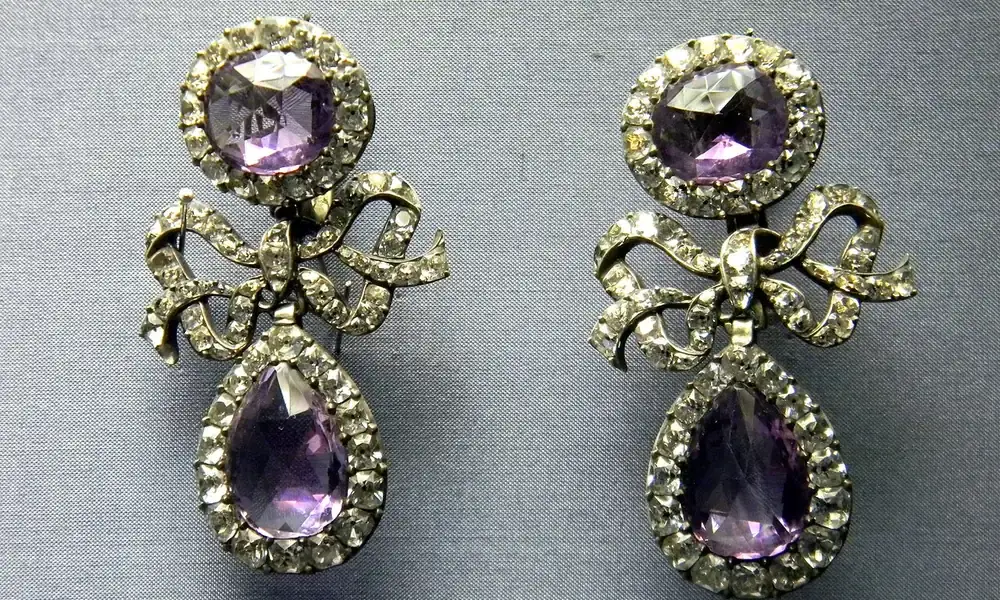
Colour is the most important factor in an amethyst earring. The most prized stones are a saturated royal purple or reddish purple, vivid without being so dark that they go black in a dim room. A flash of rose red or blue under direct light is a good sign; a murky brown undertone is not. Judge the pair in natural light, because warm shop lighting can make a pale stone look richer than it is.
Hold the earrings at arm’s length and look at them face-up, the way other people will see them. If the centre looks washed out while the edges look dark, the cut is not balancing the colour well. Bands of lighter and darker violet are colour zoning, a natural feature a good cutter minimises; a bold stripe across the middle is a reason to keep looking. Be wary of a pair that is perfectly uniform and ink-dark with no zoning at all: natural amethyst almost always shows some variation.
Clarity, cut and size
Fine amethyst should be eye-clean, meaning no inclusions or fractures visible to the naked eye. Hold the earring up to the light and look through the stone, not just at its face. A few tiny internal features are normal, but cloudy patches, visible cracks or a milky veil will dull the stone and should bring the price down sharply.
Cut is what makes the colour behave. Coloured stones are cut to enhance colour rather than brilliance, so a good amethyst cut balances depth and spread: deep enough to hold the purple, shallow enough that the centre does not go pale. Oval and cushion cuts are most common; round suits studs, pear and teardrop suit drops. Compare the two earrings side by side: a matched pair should have stones of the same size, depth of colour and cut. The same discipline helps with any gemstone purchase, and our diamond buying guide for 2027 explains how to weigh colour, clarity and cut before you pay. Size matters least here: large amethyst rough is common, so weight does not multiply value the way it does in a diamond.
Natural, heated, lab-grown or imitation
Most amethyst has been through some treatment, and the honest question is not whether a stone is treated but whether you were told. Heating can deepen the colour, and heating it further turns it yellow or orange-brown, which is how much of the citrine sold as jewellery is made. Much of what is sold as green amethyst is also heat-treated, so ask before you assume.
Lab-grown amethyst is real quartz, grown in a laboratory rather than in the ground, and it can look almost identical to natural stone. It is often cleaner, more evenly coloured and far cheaper, and there is nothing wrong with buying it, as long as it is labelled lab-grown and priced accordingly. Imitations are a different matter: glass and synthetic spinel can mimic amethyst, and dyed quartz also circulates. Glass often has round bubbles and feels warmer than quartz, and a dyed stone may show colour gathered along cracks. For a significant purchase, ask for a written description of the stone and its treatment, plus a fair return policy.
Settings and metals that suit amethyst
A bezel setting, where a rim of metal wraps the edge of the stone, is the most protective choice, because it guards the edges that chip first. A prong setting shows more of the stone and lets more light in, which flatters the colour, but the prongs must be sturdy and even, with no gaps and no wobble when you press the stone gently. Four prongs are standard for a stud; six give extra security for a larger stone. Halo settings add sparkle, but they also add weight and more places for dirt to collect.
Yellow gold warms the purple and suits vintage designs; white gold and platinum give a cooler, more modern frame; rose gold softens it. Sterling silver is the most affordable frame, but it is softer than gold and can tarnish if stored badly. For sensitive ears, look for nickel-free posts, or surgical steel, titanium or solid gold if you react to plated metals. Our guide to gold jewellery for everyday wear in 2027 covers which karats and finishes hold up best to daily use.
| Style | Best for | Stone size | Watch out for |
|---|---|---|---|
| Stud | Daily wear, work, sensitive ears | 5 to 8 mm | Loose backs; mismatched stones |
| Drop | Evenings, weddings, statement looks | 8 to 12 mm | Weight pulling on the lobe |
| Dangle | Movement and colour in motion | 6 to 10 mm | Thin links that kink |
| Hoop with stone | Smart casual, weekends | 4 to 7 mm | Heavy hoops stretching the piercing |
| Halo stud | Extra sparkle, smaller centre stone | 5 to 7 mm | Small stones loosening |
| Cluster | Vintage looks, bold colour | Mixed, 3 to 6 mm | Uneven colour across the cluster |
| Chandelier | Occasions, formal dress | Mixed, 5 to 10 mm | Weight and tangling |
| Lever-back drop | Secure everyday drop | 6 to 10 mm | Lever spring weakening over time |
Comfort, weight and backs
Comfort is the test most buyers skip and regret. Wear the pair for at least ten minutes in the shop, moving your head and looking down at your phone. Heavy drops pull on the lobe and can make the piercing ache or stretch; if you are aware of the weight after ten minutes, it is too heavy for all-day wear.
Backs matter as much as hooks. For studs, a secure screw back or a large clutch stays put better than a small butterfly back that slides off in a handbag. For hooks, a lever-back or a hook with a small silicone stopper keeps the earring from slipping out unnoticed. Check that the posts are straight and the stones sit level rather than tilting forward, a common fault when the stone is heavy for its setting. Our roundup of the best diamond earrings of 2027 shows how the same settings behave with a different stone.
What is a fair price in 2027
Amethyst itself is affordable, so the price of a pair is mostly metal, craftsmanship and brand. Simple sterling silver studs can cost less than a dinner out, while 18-karat gold drops with large, deeply coloured stones and a diamond halo can run into four figures. Compare like with like: same metal, same stone size and colour, same setting. Be cautious with the inflated original price carrying a permanent discount, and with a price so low it cannot cover the metal it claims to be. Look for a hallmark stating the metal and its fineness, and for higher-value pairs ask for a written description of the stone, its treatment and the metal.
Caring for amethyst earrings
The Gemological Institute of America advises cleaning amethyst with warm soapy water, notes ultrasonic cleaners are usually safe except where a stone is dyed or fracture-filled, and advises against steam cleaning and heat. Sudden temperature changes can fracture the stone, and prolonged strong light can fade the colour, so do not leave earrings on a sunny windowsill. Put them on last, after perfume and hairspray, and take them off before the gym, the pool or cleaning with harsh chemicals. Store each pair in its own soft pouch, because amethyst at hardness 7 will scratch softer stones.
Before you buy checklist
- Check the colour in natural light: saturated reddish purple, no brown tone, no bold zoning, and the pair matches.
- Look through each stone for cloudiness, cracks or a milky veil, and confirm the pair is eye-clean.
- Ask in writing whether the stone is natural, lab-grown, heated or dyed, and keep the answer with the receipt.
- Test the setting: prongs firm and even, bezel smooth, no wobble, and both earrings sit level.
- Wear the pair for ten minutes and check the weight, the backs and whether the hooks catch on your hair.
- Confirm the metal hallmark, the return policy and a written description of stone, treatment and metal.
Frequently asked questions
Is amethyst good for everyday earrings?
Yes. Amethyst rates 7 on the Mohs scale with good toughness, and earrings are kinder to stones than rings because they rarely hit hard surfaces. Take them off for the gym and swimming, and store them separately.
How can I tell if an amethyst earring is real?
Real amethyst is violet quartz, so it should feel cool to the touch, show no round bubbles inside the stone, and display some natural variation in colour rather than a perfectly flat, ink-dark purple. Glass imitations often contain bubbles, while dyed stones can show colour gathered along cracks. No home test is conclusive.
Does amethyst fade in sunlight?
Yes, prolonged exposure to intense light can fade some amethyst. Occasional daylight wear is fine; what damages the colour is leaving the earrings for weeks on a sunny windowsill or in a car.
What metal goes best with amethyst earrings?
All of them, for different reasons. Yellow gold warms the purple and suits vintage designs, white gold and platinum make the violet look brighter, rose gold softens it, and sterling silver is the most affordable frame. Choose the metal that suits your skin, wardrobe and budget, with nickel-free posts if your ears are sensitive.
Are dark purple amethyst earrings better than light ones?
Usually, but not always. Deeper, more saturated purple commands a higher price, and the finest grade is an intense reddish purple. But a stone so dark that it reads black indoors is less attractive than a medium purple with lively colour. Judge the stone on your ear in ordinary light rather than by darkness alone.
Can I clean amethyst earrings with an ultrasonic cleaner?
Usually yes. The Gemological Institute of America says ultrasonic cleaners are generally safe for amethyst except where a stone is dyed or treated by fracture filling, and it advises against steam cleaning. Warm soapy water and a soft brush are the safest routine for most pairs.
The bottom line
The best amethyst earrings are not the biggest or the most expensive pair in the shop. They are the pair with a lively, saturated purple that holds up in ordinary light, two stones that match, a setting that protects the stone and feels comfortable after ten minutes, and a seller who will say plainly whether the stone is natural, lab-grown or treated. Check colour first, then clarity and cut, then the setting and the weight on your ear, and buy the pair you will actually wear.
Note: Colour and treatment claims should be confirmed with the seller in writing before you buy, especially for higher-value pairs. This guide is general buying advice, not a gemmological certificate.



