

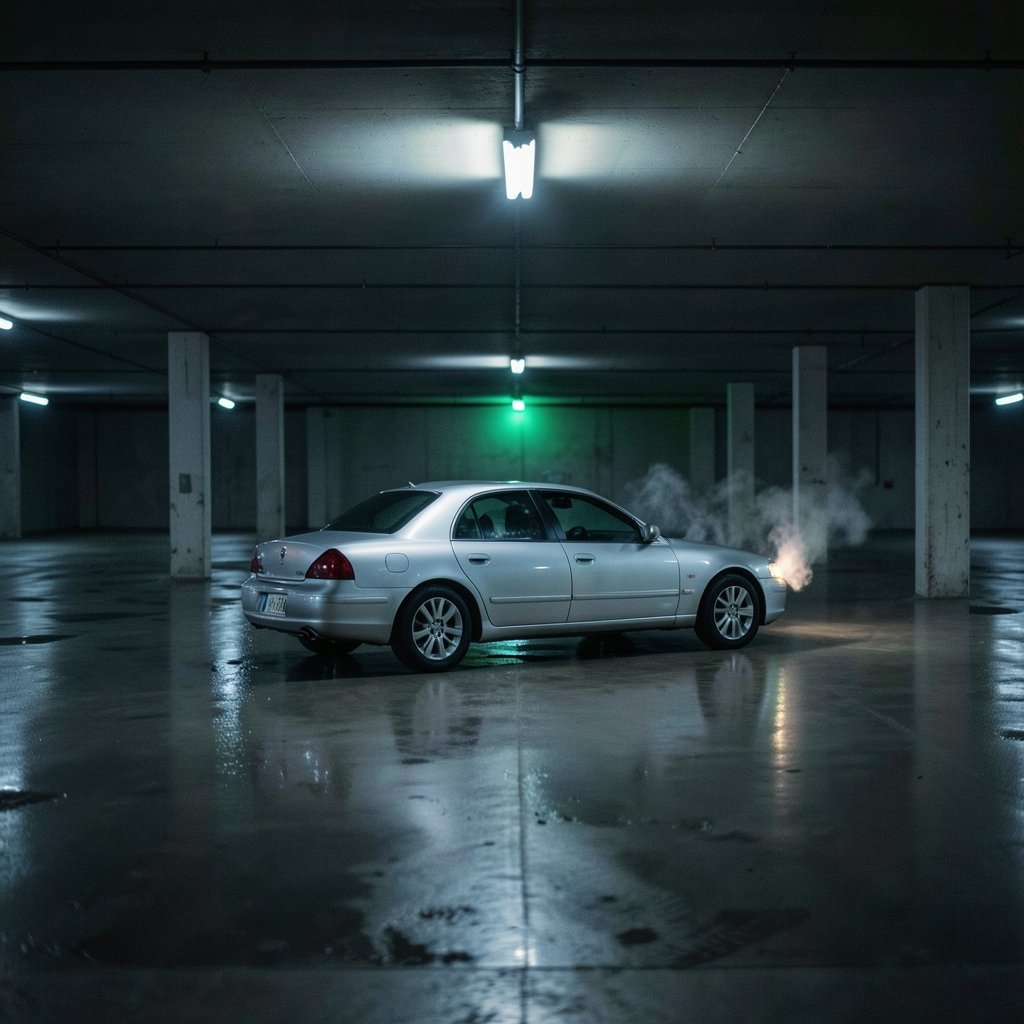
Quick Answer: Why is white smoke coming from my exhaust?
White smoke from an exhaust is usually water vapor, and in most cases it is harmless condensation burning off as the engine and exhaust system warm up. The real question is how long it lasts and how thick it looks, because thin vapor that fades within a few minutes points to normal moisture while thick, persistent white smoke points to coolant leaking into the combustion chamber.
The distinction matters because the two look similar at a glance but behave differently. Condensation appears on cold starts, in damp weather, and after a car has sat for a while, then disappears once everything heats up. Coolant burning in the cylinders produces dense smoke that keeps coming while driving and often carries a sweet smell.
Before acting, check when the smoke appears, how long it lingers, whether the coolant level is dropping, whether the engine temperature gauge climbs, whether the exhaust smells sweet, and whether any warning light has come on.
Why White Smoke Appears at All

A car engine burns fuel and air, and the main byproducts leaving the tailpipe are gases and water vapor. Water is a normal part of combustion, so a little visible vapor is baked into how engines work. The confusion starts because water vapor, steam, and burned coolant all show up as white clouds, and the untrained eye cannot separate them in the first thirty seconds.
The color of exhaust smoke is the biggest single clue to what is happening. White, blue, and black each point in a different direction, and white splits into two very different stories: harmless moisture and a cooling system failure. Learning to read that split saves a lot of unnecessary panic and, occasionally, a lot of money.
The Harmless Version: Condensation Burning Off
Thin white vapor that shows up when the engine is cold and fades as it warms is normal. Water builds up inside the exhaust system over time, especially when a car sits overnight or in cool, humid weather. When the engine starts, that water turns to steam and exits as a small white plume.
A few practical checks separate condensation from a real problem:
- Watch the clock. Vapor that thins out and disappears within a few minutes of driving is condensation.
- Check the weather. Cold, damp mornings make condensation far more visible.
- Note the history. A car that has not run for days or weeks will often puff more white on the first start.
- Look at the volume. A faint wisp is normal; a rolling cloud is not.
This is the version most drivers see and worry about needlessly. A small amount of white smoke on a cold day or at startup is likely water vapor and nothing more.
The Serious Version: Coolant Entering the Combustion Chamber
Thick, dense white smoke that does not clear once the engine is warm is the warning sign worth taking seriously. It usually means coolant is leaking into the combustion chamber and burning along with the fuel. Coolant is not supposed to be there, and the smoke it produces is heavier and more persistent than steam.
The usual culprits are a blown head gasket, a cracked cylinder head, or a damaged engine block. The head gasket seals the gap between the engine block and the cylinder head, keeping coolant passages, oil passages, and combustion chambers separate. When that seal fails, coolant finds its way into places it does not belong.
Two sensory clues help. First, the smoke often has a sweet smell, a signature of burning coolant. Second, the smoke continues while driving rather than fading. A driver who sees white smoke in the rearview mirror at highway speed, long after warm-up, is looking at a different problem than morning condensation.
The stakes are real. Even a small coolant leak can lead to overheating, and coolant mixing with oil can cause serious damage to engine internals. Left alone, a head gasket issue can turn a moderate repair into an engine replacement.
Steam, Coolant, or Something Else? A Comparison
| What you see | When it happens | Likely cause | What to do |
|---|---|---|---|
| Thin white vapor | Cold start, cold or damp weather | Condensation in the exhaust | Nothing; it clears as the engine warms |
| Thick white smoke, sweet smell | While driving, engine warm | Coolant leak, often head gasket | Stop driving and get it diagnosed |
| White smoke plus rising temperature | After warm-up, under load | Cooling system failure | Pull over and let the engine cool |
| Blue smoke | Acceleration, sustained driving | Burning oil | Check oil level and book a diagnosis |
| Black smoke | Hard acceleration | Excess fuel | Check fuel and air systems |
The table is a starting point, not a diagnosis. A mechanic confirms the cause with a pressure test on the cooling system and a check for combustion gases in the coolant.
What to Check Before You Panic
A short, calm inspection tells most drivers which scenario they are in. None of it requires tools beyond a flashlight and a glance at the dashboard.
- Coolant level. Check the reservoir when the engine is cold. A level that keeps dropping with no visible puddle underneath is a strong hint of an internal leak.
- Temperature gauge. A needle that climbs above normal, especially alongside white smoke, points to the cooling system.
- Smell. Sweet exhaust is a red flag. So is a sweet, syrupy smell under the hood.
- Oil condition. Milky or frothy oil on the dipstick suggests coolant and oil are mixing.
- When it happens. Morning-only vapor is very different from smoke that appears at operating temperature.
- Warning lights. A check engine light paired with white smoke moves the issue from “watch” to “diagnose now.”
Drivers who track these details before calling a shop get faster, cheaper answers, because the mechanic is not starting from zero.
Common Mistakes Drivers Make
The most frequent error is assuming every white cloud is a blown head gasket. That leap causes unnecessary stress and, sometimes, unnecessary spending. The opposite mistake is just as common and more expensive: waving off thick white smoke as “just steam” and continuing to drive while the coolant level quietly drops.
A second trap is topping up coolant and calling it fixed. Adding coolant treats the symptom, not the leak, and the level will fall again. A third is checking the coolant reservoir while the engine is hot, which is both inaccurate and dangerous because the system is pressurized.
There is also a timing mistake. Many drivers wait for the temperature gauge to spike before acting, but overheating is often the last stage of a problem that started with smoke. Smoke is the early warning; the gauge is the alarm.
For anyone who likes comparing visual signals before acting, the same logic of reading small surface clues applies elsewhere, from spotting white spots on nails to judging a milky white chrome nail finish. The principle is identical: a subtle change in appearance usually has a specific, findable cause. (Milky white nail designs)
How a Shop Confirms the Diagnosis
Diagnosis is more systematic than guesswork. A technician typically starts with a cooling system pressure test, which pressurizes the system and watches for a drop that indicates a leak. Next comes a check for combustion gases in the coolant, which can confirm that exhaust is pushing into the cooling system through a failed gasket.
From there, a compression test or a cylinder leak-down test shows whether a specific cylinder is losing pressure. Some shops use a borescope to look inside a cylinder for steam-cleaned pistons or coolant residue. Oil analysis can reveal coolant contamination. The combination narrows the fault to a gasket, a cracked head, or a cracked block.
Costs vary widely by engine and vehicle, so the honest answer is that a quote beats a guess. The one universal rule is that early diagnosis is cheaper than late diagnosis.
What Actually Works in Practice
The practical advice that holds up across most vehicles is simple. Watch the smoke for a full drive cycle rather than the first minute. If it clears, relax. If it persists, stop driving and get it looked at.
Keep the coolant topped up to the correct mark and check it cold, once a week, until the question is settled. Note any sweet smell and mention it to the mechanic, because that detail speeds up diagnosis. Do not add stop-leak products as a first move; they can clog passages and complicate a proper repair.
Finally, treat white smoke as information rather than a verdict. It is the engine telling the driver something, and the driver’s job is to notice the pattern: when it starts, how long it lasts, and what else changes alongside it. That pattern, not the smoke alone, is what points to the fix.
Conclusion
White smoke from an exhaust is a question with two answers, and they are separated by time and thickness. Thin vapor that vanishes as the engine warms is condensation, a normal part of how combustion works and nothing to worry about. Thick white smoke that lingers, smells sweet, and comes with a falling coolant level is coolant burning in the cylinders, and it deserves prompt attention.
The drivers who handle this best are not the ones who know the most about engines. They are the ones who observe carefully, check the simple things first, and act on the pattern rather than the first puff. A little white smoke on a cold morning is weather. A lot of white smoke on a warm afternoon is a conversation with a mechanic.
Frequently Asked Questions
Is white smoke from the exhaust always a bad sign?
No. Thin white vapor on a cold start or in cool, damp weather is usually condensation and clears as the engine warms. It only becomes a concern when the smoke is thick, persistent, and continues while driving.
How long should white smoke last before I worry?
Vapor that fades within a few minutes of driving is normal condensation. White smoke that continues after the engine reaches operating temperature, or that gets heavier under acceleration, is the pattern worth investigating.
What does white smoke smell like when it is coolant?
Burning coolant typically produces a sweet smell, distinct from the sharper smell of burning oil. If the exhaust smells sweet and the smoke is thick, a coolant leak into the combustion chamber is the leading suspect.
Can I keep driving with thick white smoke?
It is risky. Coolant leaking into the engine can cause overheating, and coolant mixing with oil can damage internal components. The safer choice is to stop driving and have the vehicle diagnosed before the damage spreads.
Why does white smoke appear only in the morning?
Morning-only smoke usually reflects moisture that collected in the exhaust overnight. Cold, humid air makes that water vapor more visible, and the smoke disappears once the exhaust system heats up and burns the moisture off.
Does a blown head gasket always cause white smoke?
Not always, but it is one of the most common causes of thick, persistent white smoke. A cracked cylinder head or a damaged engine block can produce the same symptom, which is why a pressure test and a combustion gas check are used to confirm the source.











