


What if the most dramatic wardrobe change in history happened not in a single season but across a hundred years, and you could watch it unfold one portrait at a time? That is exactly what the 1600s offer. Walk into any gallery hung with Van Dyck, Velázquez, or Rembrandt and you are looking at a century of fashion in motion: stiff ruffs giving way to soft collars, wheel farthingales collapsing into flowing gowns, and men trading tight doublets for the long coat that would eventually become the modern suit.
It helps to be precise about the term first. “1600s” can mean the decade 1600 to 1609 or the whole 17th century, roughly 1600 to 1699. In fashion writing, it usually means the full century, and that is how this guide uses it. The story is one of loosening: a slow release from the armor-like formality of the late Renaissance into something softer, more comfortable, and surprisingly familiar.
The century had two very different dress phases
Western European dress in the 1600s did not change at a steady pace. It moved in two broad phases. The early decades continued late-16th-century silhouettes: stiff bodices, starched ruffs, and structured farthingale skirts. Then, from roughly the 1620s and 1630s, softer and looser lines took over, with falling collars replacing the ruff. From the 1660s, the mantua gown and the periwig dominated elite wardrobes.
That periodization is standard in costume-history surveys, but it is approximate. The timing varied by country, and it differed sharply depending on whether you mean court dress, city dress, or rural dress. A Spanish courtier and a Dutch merchant in 1640 might look like they lived in different centuries.
The ruff’s long goodbye
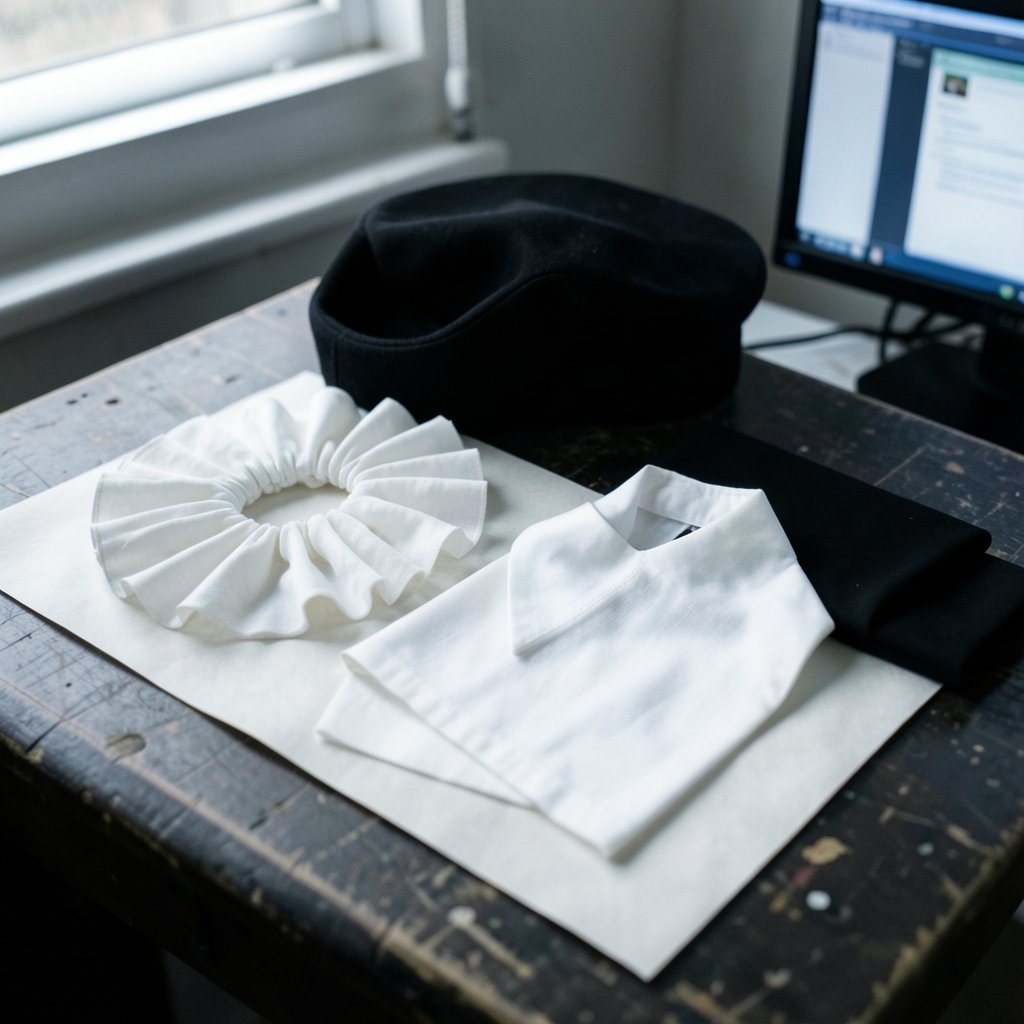
The ruff was the signature accessory of the late 1500s and early 1600s: a starched, pleated collar that framed the face like a porcelain plate. It was expensive to maintain, required specialist laundering and setting, and signaled that the wearer did not do manual work. In that sense, it was a status object as much as a garment.
By the 1620s and 1630s, the ruff had largely lost its place in everyday elite dress to the flat falling band, a wide collar that draped over the shoulders. It looked relaxed. It was comfortable. It also framed the face and chest in a way that portrait painters loved, which is one reason falling bands appear everywhere in mid-century art.
The ruff did not vanish overnight. It persisted in formal contexts, in some regional dress, and in the wardrobes of older or more conservative wearers. Fashion change is rarely a clean break; it is a slow negotiation between generations.
Farthingales out, mantuas in
Women’s skirts tell the same loosening story. The wheel, or French, farthingale of the 1590s and 1610s created a rigid, drum-shaped silhouette. By the 1620s and 1630s, fuller but less structured skirts had taken over. Then came the mantua, a draped gown derived from a loose robe, which became common for women by the middle of the century.
The mantua mattered because it was practical. It required less rigid underpinning, allowed easier movement, and could be draped and pinned in different ways. Its exact origin date is debated. Many costume historians place it in the 1660s and 1670s, though earlier loose gowns clearly existed. What is not debated is the direction of travel: away from architecture and toward fabric.
If you want to see how this instinct for drape and movement echoes through later fashion, the way designers still chase fluid silhouettes, it is worth exploring how Italian luxury fashion has long built its identity around exactly that kind of cloth-led elegance.
Men’s dress: from doublet to the ancestor of the suit
Early in the century, men wore doublets, close-fitting padded jackets, paired with trunk hose or breeches. The look was compact and body-conscious, with a peascod belly shape lingering from the previous century.
By the 1660s, a new ensemble was emerging: the long coat, waistcoat, and breeches. This three-piece combination is the direct ancestor of the modern suit, and it is associated with the courts of Louis XIV in France and Charles II in England. The shift was enormous. Instead of emphasizing the torso and legs separately, the new silhouette wrapped the whole body in a continuous line.
The periwig arrives
From the 1660s, long powdered wigs, known as periwigs, spread through the French and English courts. Charles II of England is often credited with popularizing them in England after 1660. The wig solved several problems at once: it covered hair loss, created a uniformly grand silhouette, and became a visible marker of rank and leisure.
Wigs were costly, and maintaining them was a job in itself. Powdering, curling, and dressing a periwig took time and skill, which is precisely why it worked as a status symbol.
The 1600s fashion timeline at a glance
| Period | Women’s silhouette | Men’s silhouette | Signature detail |
|---|---|---|---|
| c. 1600–1620 | Stiff bodice, wheel farthingale | Doublet with trunk hose | Starched ruff |
| c. 1620–1650 | Fuller, softer skirts | Doublet with breeches | Falling band collar |
| c. 1650–1670 | Draped mantua emerging | Long coat and breeches developing | Softer, longer lines |
| c. 1660–1699 | Mantua established | Coat, waistcoat, breeches | Periwig |
Use this as a rough map, not a rulebook. Regional variation was large. Spanish court dress kept stiff, dark, formal styles longer than French or English dress, and Dutch burgher dress of the 1600s, as seen in paintings, was comparatively sober.
Fabric, dye, and the politics of looking expensive
Wool and linen were the common fabrics of the century. Silk, velvet, and fine lace were elite goods. Dyes carried their own hierarchy: indigo and cochineal, the latter a major New World import, were prized colorants, and deep, saturated colors were expensive to achieve and maintain.
Clothing was also regulated. Sumptuary laws restricted luxury fabrics by rank in parts of Europe. England’s sumptuary statutes, including the 1574 proclamation and earlier Tudor acts, limited what people below certain ranks could wear. Enforcement weakened in the early 17th century, and the last English sumptuary act was repealed in 1604, though sources date that repeal differently. If you are writing or researching this point, flag the uncertainty rather than stating a single date as settled fact.
The practical lesson for anyone reconstructing or styling this era: fabric choice does more work than any accessory. A convincing 1600s look lives or dies on weight, sheen, and how the cloth falls.
What paintings show, and what they hide
Portraiture is the main visual evidence for 17th-century dress. Paintings by Van Dyck, Velázquez, and Rembrandt are primary sources, but they show idealized or formal dress, not everyday wear. This is a known limitation in costume history, and it trips up a lot of people who try to recreate the era from gallery walls alone.
A few practical habits help:
- Treat portraits as evidence of what was possible, not what was typical.
- Compare several artists from the same decade to spot shared details.
- Look at the hands, the linen, and the shoes, which are often less idealized than the face and jewels.
- Cross-check with surviving garments and written inventories where you can find them.
The same caution applies to modern fashion research. A runway image is not a census. If you enjoy the way visual media shape what we think people wore, this piece on how Angelica Hicks turns runway moments into sharp, funny drawings makes the point in a very different century.
Common mistakes when recreating or writing about 1600s style
People new to the period make the same handful of errors again and again.
Mixing decades. A ruff with a mantua is a timeline collision. Pick a decade and stay inside it.
Ignoring underwear. The silhouette of the 1600s depends on structural layers, and skipping them flattens the shape.
Over-accessorizing. The century had bold statements, but they were concentrated. One dominant element, such as a ruff or a wig, usually carries the look.
Assuming everyone dressed alike. Court, city, and country dress differed enormously, and so did national styles.
Trusting a single source. Costume history is full of confident claims with thin evidence. Triangulate.
Why the 1600s still shape what we wear
The century’s biggest gift to modern wardrobes is the three-piece suit, born from the long coat, waistcoat, and breeches. Its second gift is the idea that comfort and status can coexist. The falling band was easier to wear than the ruff. The mantua was easier to move in than the farthingale. Fashion did not abandon grandeur; it found a more relaxed way to perform it.
That instinct runs straight through to the present. If you want to trace how the pendulum keeps swinging between structure and ease, the 2026 fashion trends female conversation is a good place to start, and the broader fashion trends 2026 coverage shows how often “new” silhouettes are really old ones returning with better fabric. For a wider view of the season, the 2026 Fashion Trends Guide: What’s In, Out & Worth Wearing is a useful companion read.
There is also a straight line from the 1600s to the way fashion now travels through images. The 2010s fashion athleisure streetwear Instagram rewrote rules piece shows how a new medium reshapes dress, just as portraiture once did. And for anyone who wants to keep up with fashion writing without drowning in it, this guide on how to find best fashion substacks without wasting your inbox is a sensible filter.
Conclusion
The 1600s were a century of quiet revolution in dress. The ruff gave way to the falling band, the farthingale softened into the mantua, and the doublet grew into the long coat that still underpins menswear today. Wigs turned hair into architecture. Sumptuary laws tried, with fading success, to keep luxury in the right hands. And through it all, the direction was consistent: less armor, more cloth.
For modern readers, the period is a reminder that fashion change is rarely sudden. It is a slow loosening, decade by decade, until one day the old silhouette looks like a costume and the new one looks like common sense. That is worth remembering the next time a trend feels like it appeared overnight.
What does “1600s fashion” actually mean?
It usually refers to the whole 17th century, roughly 1600 to 1699, rather than just the decade 1600 to 1609. In fashion writing, the broader meaning is standard. Because the century spans so much change, it is best to specify which part you mean, since a 1610 outfit and a 1690 outfit share almost nothing.
When did the ruff go out of fashion?
The starched ruff was a hallmark of late-16th and early-17th-century dress. By the 1620s and 1630s it had largely been replaced in everyday elite dress by the flat falling band collar. It did not disappear entirely, persisting in some formal and regional contexts, and timing varied by country.
What replaced the farthingale?
The wheel farthingale of the 1590s and 1610s was superseded in the 1620s and 1630s by fuller, less structured skirts. By mid-century, the mantua, a draped gown derived from a loose robe, became common for women. The mantua’s exact origin date is debated, with many historians placing it in the 1660s and 1670s.
Why did men start wearing wigs?
Long powdered periwigs spread through the French and English courts in the 1660s, with Charles II of England often credited with popularizing them in England after 1660. They covered hair loss, created a grand uniform silhouette, and signaled rank and leisure, since maintaining one took real time and money.
Did laws control what people wore in the 1600s?
Yes, in parts of Europe. Sumptuary laws restricted luxury fabrics by rank, and England’s statutes, including the 1574 proclamation and earlier Tudor acts, limited what lower ranks could wear. Enforcement weakened in the early 17th century, and the last English sumptuary act was repealed in 1604, though sources date that repeal differently.
Can paintings be trusted as fashion evidence?
Partly. Portraits by Van Dyck, Velázquez, and Rembrandt are primary sources for 17th-century dress, but they show idealized or formal clothing rather than everyday wear. That is a known limitation in costume history, so the safest approach is to compare multiple portraits from the same decade and cross-check with surviving garments and written inventories.














