Amber is the warmest stone in a jewellery box. A good amber ring glows honey, cognac or milky gold in daylight, and it feels lighter on the finger than almost any other gemstone because it is not a stone at all. The problem is that amber is also one of the easiest gems to fake, press or heat-treat without telling you. Copal, plastic, glass and reconstructed amber all look convincing in a photograph, and a ring that costs very little is usually made of one of them.
That is why this guide is organised by type of amber and by setting, not just by price. Baltic amber, Dominican amber and Burmese amber behave differently, and a soft stone at Mohs 2 to 2.5 needs a protective setting and gentle care. A bezel or a chunky band will keep an amber cabochon safe for years. A high, exposed prong setting on a stone this soft is asking for a scratch on the first week.
Below are nine amber rings worth considering in 2027, from a classic Baltic bead ring to a milky amber signet and a green amber cocktail ring. Each one is described by what it is good at, what to watch for, and who it suits best, so you can choose with the stone in mind, not just the colour.
Key takeaways
- Amber is fossilised tree resin, not a mineral, and at Mohs 2 to 2.5 it is one of the softest materials used in rings.
- Baltic amber is the most common and the best documented; Dominican amber can be blue or green, and Burmese amber is the oldest and often the most expensive.
- Heat treatment and pressing are standard in the trade, but they must be disclosed, and pressed amber should cost less than natural amber.
- Copal, plastic and glass are the common imitations; genuine amber floats in salt water and glows under ultraviolet light.
- Amber has no proven healing properties and is not an investment stone, and it must never go in an ultrasonic or steam cleaner.
What amber actually is
Amber is tree resin that hardened and fossilised over millions of years, usually 30 to 90 million years old for Baltic amber. It is organic, which is why it is warm to the touch and light in the hand, and why it can contain tiny trapped insects and plant matter. Those inclusions are real in a small number of pieces, and they are also widely faked, so an insect inside a cheap ring is more likely to be a modern copy than a prehistoric original.
Colour is the first thing people notice, and it is also the first thing that misleads. Honey and cognac are the classic Baltic colours. Milky amber, sometimes called butterscotch, is cloudy with tiny air bubbles. Green amber is usually Dominican, and blue amber is rare and expensive. A bright, uniform green or blue at a low price is almost always glass or plastic.
Hardness is the practical issue for rings. At Mohs 2 to 2.5, amber scratches more easily than almost any other ring stone. It will mark if it knocks against a metal watch, a key or a worktop, and it can chip if it is dropped on a hard floor. That does not make it unwearable. It makes the setting and the way you wear it matter more than they would for a sapphire or a diamond.
How we chose these rings and what to look for
Look first at the type of amber and whether it has been treated. Natural, untreated amber is the most desirable, and a seller should be able to say where it came from. Heat treatment, which deepens the colour, and pressing, which fuses small pieces of amber together, are both common and legal, but they must be disclosed and they should be reflected in the price. A ring described simply as amber, with no mention of origin or treatment, is a ring to ask questions about.

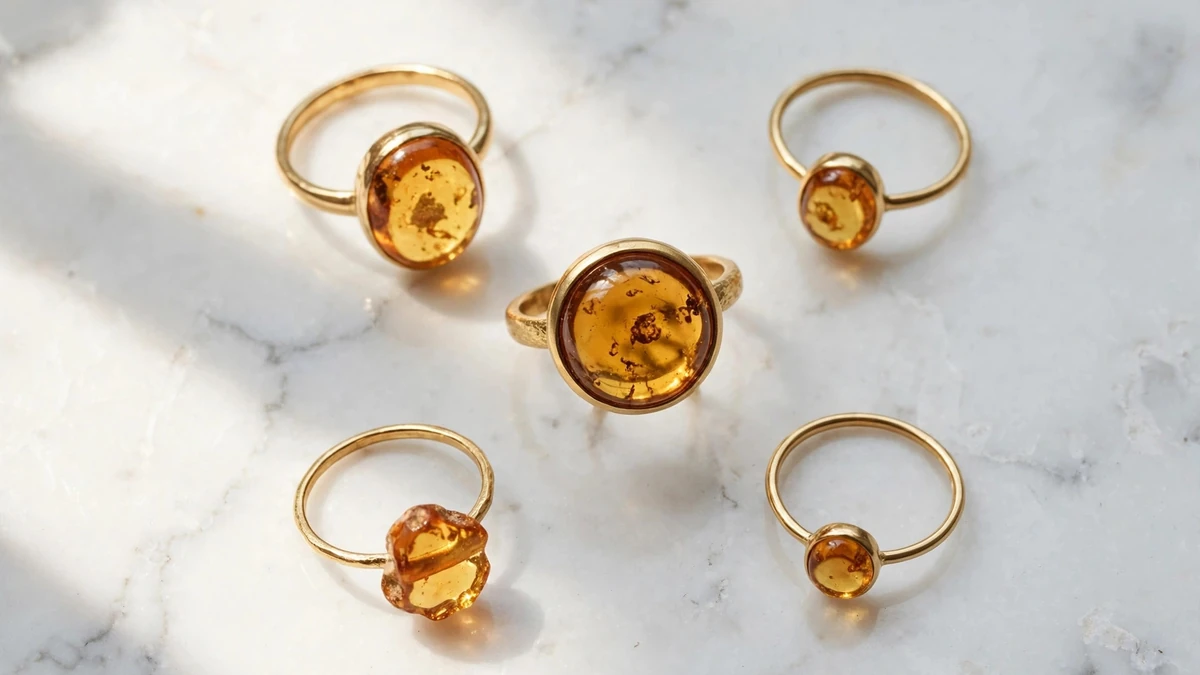
Look next at the setting. A bezel setting, where metal surrounds the stone, protects the edges of a soft cabochon and is the safest choice for everyday wear. A half-bezel or a chunky band is a good second choice. Tall prongs leave the stone exposed, and on amber that is a real risk, not a theoretical one. Silver suits amber well and keeps the price sensible, while gold adds warmth and weight to a piece you plan to wear for years. Our guide to amber bracelets explains the same setting logic for a stone that is just as soft on the wrist as it is on the finger.
Finally, look at the finish and the size. Amber is usually cut as a smooth cabochon, not faceted, because faceting a material this soft is difficult and the facets wear quickly. A well-polished cabochon should be smooth, with no dull patches or cloudy spots unless the stone is deliberately milky. A very large stone in a thin band will feel top-heavy and is more likely to catch on things, so a medium stone in a solid band is the most wearable choice for most people.
The 9 best amber rings of 2027
Tiffany & Co. Amber Bead Ring
What we like: A polished cognac amber cabochon in a solid sterling silver band, with a warm, even colour and a smooth, high polish. What to consider: Premium price for a silver setting, and the stone is soft, so it needs the care every amber ring needs. Stone: Natural Baltic amber, cognac. Setting: Bezel, sterling silver. Best for: Everyday wear and a first amber ring. Price range: High.
Cartier Cognac Amber Ring
What we like: A deep cognac amber cabochon in 18-karat yellow gold, with the warmth of the gold echoing the warmth of the stone. What to consider: A luxury price, and the stone should be removed before swimming or cleaning. Stone: Natural Baltic amber, cognac. Setting: Bezel, 18-karat yellow gold. Best for: A statement piece and special occasions. Price range: Luxury.
David Yurman Amber Cable Ring
What we like: A honey amber cabochon set in the brand’s signature cable band, which gives a soft stone a strong, protective frame. What to consider: The cable texture can catch on fine knitwear, and the stone will show scratches over time. Stone: Natural Baltic amber, honey. Setting: Bezel, sterling silver with 18-karat gold accents. Best for: Everyday wear with a designer signature. Price range: High.
Mejuri Amber Signet Ring
What we like: A milky butterscotch amber cabochon in a clean signet shape, in solid 14-karat gold, with a modern, understated look. What to consider: Milky amber is cloudy by nature, so do not expect the transparency of honey amber. Stone: Natural Baltic amber, milky. Setting: Bezel, 14-karat gold. Best for: Minimalist styling and daily wear. Price range: Mid to high.
Monica Vinader Amber Cocktail Ring
What we like: A large honey amber cabochon in a bold cocktail setting, with a warm glow that reads well in daylight and in the evening. What to consider: A large stone in a cocktail setting is best saved for occasions, not for work with your hands. Stone: Natural Baltic amber, honey. Setting: Bezel, 18-karat gold vermeil over silver. Best for: Evening wear and occasions. Price range: Mid.
Missoma Milky Amber Ring
What we like: A soft milky amber cabochon in a slim gold vermeil band, light on the finger and easy to stack with other rings. What to consider: Gold vermeil wears over time, and the stone is very soft, so this is a gentle-wear ring. Stone: Natural Baltic amber, milky. Setting: Bezel, 18-karat gold vermeil over silver. Best for: Stacking and everyday styling. Price range: Affordable to mid.
Maria Black Amber Sculptural Ring
What we like: An irregular, organic amber cabochon in a sculptural silver setting, with a modern, art-led look that suits the stone’s natural character. What to consider: A sculptural setting leaves more of the stone exposed, so it needs careful handling. Stone: Natural Baltic amber, cognac. Setting: Half-bezel, sterling silver. Best for: Modern styling and collectors. Price range: Mid to high.
Astrid & Miyu Amber Stacking Ring
What we like: A small honey amber cabochon in a slim band, designed to stack, with a warm colour that works well against gold. What to consider: A small stone is harder to see on its own, and the band is slim, so it suits stacking rather than solo wear. Stone: Natural Baltic amber, honey. Setting: Bezel, 18-karat gold vermeil over silver. Best for: Stacking and layering. Price range: Affordable.
Thomas Sabo Green Amber Ring
What we like: A green amber cabochon in a sterling silver setting, with an unusual colour that stands out from the usual honey and cognac. What to consider: Green amber is usually Dominican and should come with a clear origin note; ask before you buy. Stone: Natural Dominican amber, green. Setting: Bezel, sterling silver. Best for: A distinctive, unusual piece. Price range: Mid.
Which amber ring is right for you
For everyday wear, choose a medium honey or cognac amber in a bezel setting, in silver or 14-karat gold. It is the most forgiving combination: the stone is protected, the colour suits most skin tones, and the price is sensible. A signet or a bead ring in this style is the safest first amber ring, and it is the one you are most likely to reach for every day.
For occasions, a large cocktail ring in honey or cognac amber makes a warm, confident statement, and gold suits it better than silver. Keep it for evenings and events, and take it off before you do anything with your hands. A milky amber ring is a softer, more modern choice for the same occasions, and it pairs well with cream, navy and grey. Our guide to amber necklaces shows how the same colours work at the neckline, if you want a matching set.
For collectors, Dominican green or blue amber is the interesting choice, but only with a clear origin note and a price that reflects how rare it is. A very cheap blue or green amber ring is almost certainly glass. Buy from a seller who will put the origin and any treatment in writing, and be wary of any listing that describes the stone only as “natural amber” with no further detail.
Sizing matters more with amber than with harder stones, because the ring cannot simply be resized the way a plain gold band can. A bezel-set amber stone sits in a fixed mount, and resizing the band can stress the setting and loosen the stone, so get the size right before you buy. If you are buying as a gift and you are unsure of the size, choose a slightly larger band rather than a smaller one, and ask the seller whether resizing is possible for that particular setting. A ring that fits comfortably without spinning is the goal, and a soft stone in a loose setting will catch on everything.
The caveats that matter
Amber is beautiful and it is fragile, and the two facts belong together. It scratches, it chips, it softens in heat, and it reacts badly to perfume, hairspray and household chemicals. None of that means you should not wear it. It means you should wear it the way you would wear a silk blouse: often, but with care, and never while you are cleaning, swimming or working with your hands.
| Detail | What is known |
|---|---|
| What it is | Fossilised tree resin, usually 30 to 90 million years old, not a mineral |
| Hardness | Mohs 2 to 2.5, very soft and easy to scratch or chip |
| Best setting | Bezel or half-bezel, which protects the edges of the stone |
| Common treatments | Heat treatment and pressing, standard but must be disclosed |
| Common imitations | Copal, plastic, glass and reconstructed amber |
| Simple tests | Genuine amber floats in salt water and glows under ultraviolet light |
| Care | Warm water and a soft cloth only, never ultrasonic or steam cleaning |
| What it does not do | It has no proven healing properties and is not an investment stone |
If you are buying amber as a gift, or for a child, remember that it is not a hard-wearing everyday stone for rough use. A bezel-set ring in a solid band is the safest choice, and a short note about care, warm water, a soft cloth, no perfume on the stone, will do more for the ring’s life than any box it comes in.
Checklist: choosing an amber ring honestly
Use these checks before you buy, and again when the ring arrives.
- Check the origin: Baltic, Dominican or Burmese should be stated, not just “natural amber”.
- Check the treatment: heat treatment or pressing must be disclosed, and pressed amber should cost less.
- Check the setting: a bezel or half-bezel protects a soft stone far better than tall prongs.
- Check the colour: a bright, uniform green or blue at a low price is almost always glass or plastic.
- Check the finish: a polished cabochon should be smooth, with no dull patches unless the stone is deliberately milky.
- Check the care: warm water and a soft cloth only, and remove the ring before perfume, swimming or cleaning.
Frequently asked questions
How can I tell if my amber ring is real?
Genuine amber floats in a glass of salt water, while glass and most plastics sink. It also glows a blue-green colour under ultraviolet light, and it feels warm to the touch rather than cold like glass. None of these tests is proof on its own, and a seller’s written note on origin and treatment matters more than any home test.
Can I wear an amber ring every day?
Yes, if it is bezel-set in a solid band and you are willing to look after it. Take it off before washing up, cleaning, gardening or the gym, and keep it away from perfume and hairspray. A cocktail ring with a large, exposed stone is better saved for occasions.
What is the difference between Baltic and Dominican amber?
Baltic amber is the most common, usually honey, cognac or milky, and the best documented. Dominican amber can be blue or green and is rarer, which is why it costs more. Burmese amber is the oldest and is often deep red. The origin should be stated by the seller, not guessed from the colour.
Is pressed amber real amber?
Pressed amber is made from genuine amber, fused together under heat and pressure, but it is not the same as a single natural piece, and it should cost less. It must be disclosed by the seller. A ring sold as natural amber that is actually pressed is misdescribed, whatever the price.
Can amber get wet?
Warm water and a soft cloth are fine for cleaning, but amber should not be soaked, and it should never go in an ultrasonic or steam cleaner. Keep it away from swimming pools and hot tubs, and dry it gently after washing your hands. Earrings in the same stone need the same care, as our guide to amber earrings for winter explains.
Is amber a good investment?
No, not in the usual sense. Amber is a beautiful, warm, organic material, but it is soft, widely available, and its value does not rise the way a fine diamond or ruby might. Buy it because you love the colour and the feel, not because you expect it to gain value.
The bottom line
The best amber ring in 2027 is not the biggest or the most expensive. It is the one with genuine, disclosed amber in a protective bezel setting, in a colour you love and a band you will actually wear. For most people that means a medium honey or cognac amber in silver or 14-karat gold, with a solid band and a clear note on origin and treatment.
Choose one ring, wear it often but gently, keep it away from perfume and cleaning products, and judge it on how warm it looks in daylight and how comfortable it feels on your hand. That is the honest way to enjoy amber, without the disappointment of a scratched stone or a fake one.