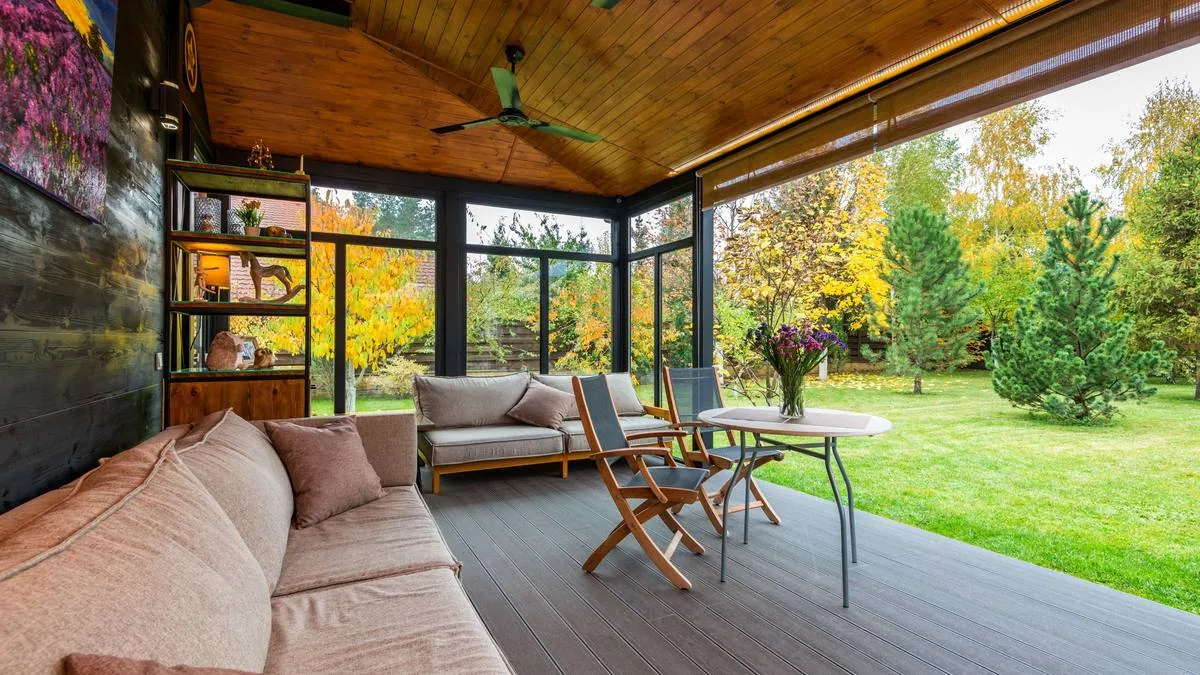

A luxury patio is not the garden with the most expensive furniture in it. It is the outdoor room where an ordinary evening feels like a small occasion — where the chairs invite you to stay, the light flatters everyone at the table, and the air smells faintly of cut grass and woodsmoke.
That feeling is not reserved for grand houses. It comes from decisions made in the right order: layout first, then the floor, furniture, shade, heat, light, planting and storage. Get the order wrong and even beautiful pieces look stranded.
This guide works through each layer in turn, drawing on 2027 directions: warm timber against honed stone, deep low lounge seating, louvred shade, layered evening light, and planting that does the work of walls. A patio is designed against sun, rain and wind, so every choice is tested by the seasons.
Key takeaways
- Start with zones: lounge, dining and a quiet corner — 90 centimetres of clearance around every seat.
- Choose the floor for weather first: porcelain, stone or decking, laid with a 1–2% fall away from the house.
- Buy lounge furniture like an indoor sofa: deep seats, quick-dry cushions, teak or aluminium frames.
- Shade is the roof that makes it a room: a louvred pergola, a sail or a cantilever umbrella, sized to cover the seats at midday.
- Layer light and heat — ambient, task and accent light, plus a heater or fire — so the patio works long after sunset.
Start With the Layout — Zones, Not Furniture
Every luxury patio is built around how you will actually use it, not around a furniture set. Before you buy anything, stand in the garden at three times of day and watch the sun. Morning light belongs to coffee and reading; hard midday sun belongs to shade; low evening sun belongs to the dining table and the fire.
Mark the sunny and shady patches, note where the wind comes from, and sketch three zones: a lounge for sitting, a dining corner for eating, and a quiet edge — a single chair, a bench, a view — for mornings alone. Allow at least 90 centimetres behind every dining chair, with a straight path from the kitchen door. The luxury kitchen in this series follows the same thinking: the plan comes before the pretty.
Flooring: The Surface Everything Stands On
The floor is the largest surface on a patio and the one the weather tests hardest, so it deserves the first share of the budget. In 2027 the direction is calm, large-format and pale enough to stay cool underfoot: porcelain pavers in warm stone tones, honed limestone or sandstone, and hardwood decking in teak or thermally treated ash.
Choose for drainage as much as for looks. A patio needs a fall of 1 to 2% away from the house, so rain runs off instead of pooling against the wall or under the sofa. Porcelain pavers are the practical favourite: they do not stain and barely absorb water. Honed stone needs sealing; decking needs yearly oiling. Run one floor through all three zones so the patio reads as a single room.
Choose the Lounge Furniture Like an Indoor Sofa
The lounge sofa is the anchor of the patio, so buy it the way you would buy an indoor sofa — sit in it first, and buy the best you can afford. In 2027 the direction is deep, low and soft: a modular sectional in powder-coated aluminium or teak, with seats 55 to 65 centimetres deep, backs low enough to keep the view open, and cushions in solution-dyed acrylic.
Comfort outdoors is mostly about cushions. Quick-dry foam lets a cushion survive a shower and be dry by evening, and covers that zip off and wash will do more for the patio in year three than any frame. Keep seat height at 40 to 45 centimetres, with a low coffee table nearby. The luxury dining room in this series follows the same rule: one anchor piece, sized by arithmetic, and everything else arranged around it.

Shade: The Roof That Makes It a Room
A patio without shade is a patio used for one hour a day, so shade is not an accessory — it is the roof. The 2027 favourite is a louvred pergola: slim aluminium or timber blades that tilt open to the sky and close against rain, often with a rain sensor and lights built into the frame.
Size the shade by the sun, not by the furniture. A canopy that covers the seats at noon but leaves them baking at three in the afternoon has failed. As a guide, the shade should extend at least 60 centimetres beyond the furniture on the sun side. A cantilever umbrella suits dining; a shade sail is cheaper but will not keep rain off. A pergola needs footings, not planters.
Heat for the Shoulder Seasons
Heat is what turns a patio from a summer-only space into a three-season room. The most luxurious heat is the kind you barely notice: an infrared heater mounted under the pergola or on a wall, warming people rather than air, silent and instant, with a dimmer for later in the evening. Two 2-kilowatt heaters will cover a lounge group of six; one will not.
A fire is the social alternative. A low gas fire table — flame through glass or stone, no smoke, no sparks — sits in the middle of the lounge group and works as a coffee table by day. A wood fire bowl is more romantic and more work. Keep any open flame at least a metre from cushions, never under an unrated canopy.
Layer the Lighting in Threes
Lighting is the difference between a patio that looks expensive in a photograph and one that feels expensive while you eat outside at dusk. A luxury patio needs three layers: ambient light from festoon lights overhead, task light over the dining table, and accent light at ground level — uplights in planters, a lantern on the table — all warm, around 2200K to 2700K, and dimmable.
Hang festoon lights in a gentle swag, with bulbs 30 to 45 centimetres apart and the lowest point at least 2.1 metres up, so nobody walks into them. A pendant over the dining table should hang 75 to 90 centimetres above the tabletop and span half to two-thirds of its width. Wash planting with ground lights, never eyes, and put everything on a dimmer or dusk timer.
The Outdoor Dining Corner
The dining corner is where the patio earns its keep. Size the table by arithmetic: 60 centimetres of width per person, 30 centimetres of depth per setting, so 180 centimetres seats six and 240 seats eight. A teak or stone-topped table with a powder-coated base survives weather and wipes clean; a glass top shows every fingerprint and every raindrop.
Chairs matter more outdoors than in, because nobody lingers on an uncomfortable seat. Choose dining chairs with a padded or deep woven seat and a back that meets the shoulders. Give the zone a serving surface — a side table or a compact outdoor kitchen run with a grill, a worktop and a small fridge. Invest in one appliance outdoors: a built-in gas grill, not a kettle barbecue.
Planting: The Walls That Grow
Planting is what makes a patio feel like a room rather than a car park with chairs. The 2027 direction is layered and loose: tall grasses and a small multi-stem tree for height, scented planting — lavender, rosemary, jasmine — at nose level near the seats, and trailing plants softening the pergola and the walls. One large tree in a generous planter does more than ten small pots.
Think in three heights. Tall structure first: a tree, a bamboo screen or pleached trees along the boundary, giving privacy without a fence. Middle layer next: grasses and shrubs in large planters — at least 50 litres, because small pots dry out in a day of sun. Ground level last: herbs in a raised bed by the dining table. Choose plants for your aspect, and water on a drip timer.
Weatherproofing, Storage and Palette
A luxury patio is designed for the rain as well as the sun. Every cushion and textile should either survive a downpour or have a home to go to in thirty seconds. A deck box or lift-up bench beside the lounge group is the most useful piece after the sofa — it holds cushions and throws, and doubles as a seat.
Keep the palette warm and restrained so it sits well beside green: mushroom, warm cream, clay and cocoa, with deep green or terracotta as an accent. Test fabric in midday sun and evening light — colours bleach outdoors. Two or three colours, used generously, beat six used sparingly. The luxury bedroom in this series follows the same rule: the room feels luxurious because everything has a place.
| Element | What works in 2027 | Common mistake |
|---|---|---|
| Layout | Three zones, 90–120 cm clearance | One furniture set facing a fence; no path from the kitchen |
| Flooring | Porcelain pavers or honed stone, 1–2% fall away from the house | Flat floor; water pools against the wall and under the sofa |
| Lounge furniture | Deep sectional, 55–65 cm seats, quick-dry cushions | Indoor-style sofa; cotton cushions that soak and stain |
| Shade | Louvred pergola or umbrella, 60 cm beyond the seats | Shade that covers the seats only at noon |
| Heating | Infrared heaters under the pergola, or a low gas fire table | One small heater for six people; open flame under a canopy |
| Lighting | Three layers, 2200K–2700K, festoons at 2.1 m, dimmable | One bright floodlight; bulbs shining into eyes |
| Dining | 60 cm per person, teak or stone top, grill and serving surface nearby | Glass top showing every mark; chairs with no back support |
| Planting | Three heights, large planters, herbs by the table, drip timer | Ten small pots; plants chosen for a photo, not the aspect |
Your luxury patio checklist
- ☐ Zones sketched: lounge, dining, quiet corner; sun and wind mapped
- ☐ Floor chosen for weather: porcelain or honed stone, 1–2% fall away from the house
- ☐ Lounge furniture tested: deep seats, quick-dry cushions, frames that survive a wet winter
- ☐ Shade sized beyond the seats: louvred pergola, sail or cantilever umbrella, properly fixed
- ☐ Heat and light layered: infrared heaters or a fire table, three warm dimmable light layers
- ☐ Planting in three heights and storage beside the seats, with a home for every cushion
Frequently asked questions
What is the best layout for a luxury patio?
Start with three zones — lounge, dining and a quiet corner — mapped against the sun, with 90 to 120 centimetres of clearance and a straight path from the kitchen door.
What is the best flooring for a luxury patio?
Porcelain pavers are the practical favourite: they do not stain and wipe clean. Honed stone is more beautiful but needs sealing, and decking needs yearly oiling.
How do I make a small patio feel luxurious?
Use one continuous floor, one anchor lounge group, warm dimmable lighting and a single large planter. Keep the floor clear — clutter is what makes a small patio feel cheap.
What shade works best on a patio?
A louvred pergola is the most luxurious: it opens to the sky, closes against rain and can carry heaters and lights. A cantilever umbrella suits a dining table, and a shade sail is the softer, cheaper rival — but it will not keep rain off.
How do I heat a patio in the evening?
Infrared heaters under the pergola warm people, not air — two 2-kilowatt heaters cover six. A low gas fire table is the social alternative; keep flames a metre from cushions.
How much should I budget for a luxury patio?
As a guide: $3,000 to $8,000 for flooring, $4,000 to $12,000 for furniture, $2,000 to $6,000 for shade, $800 to $2,500 for heating, $500 to $2,000 for lighting, and $800 to $3,000 for planting.
The bottom line
A luxury patio is not a shopping list. It is a sequence of calm, deliberate decisions: zones mapped against the sun, a floor that drains, lounge furniture bought like an indoor sofa, shade that makes it a room, heat and light that stretch the evening, and planting that grows the walls.
Start with the sun, buy the sofa second, fix the shade third.
Note: Prices and sizing guidance here reflect widely reported 2027 interior and garden directions and typical retail ranges; they vary by maker and market, so treat them as a starting point and measure your own garden before buying.