Every few years, somebody declares that gold hoops are over. The announcement usually arrives with a list of whatever has replaced them: tiny studs, sculptural cuffs, pearl drops, something angular and new. And every few years, the obituary is quietly withdrawn, because the hoops are still there — on the school run, in the office, at weddings — worn by women who never got the memo.
I have come to think of the gold hoop as fashion’s most honest object. It is a circle of gold, worn close to the face, catching the light every time you turn your head. That is the whole trick, and it has worked for roughly four thousand years.
This is not a guide to wearing hoops, and it is not a history lesson. It is an argument: gold hoops never go out of style because they were never really in style in the first place. They sit underneath fashion, like a good white shirt, and the trends pass over them without dislodging them. Here is why they endure, and what their limits are.
Key takeaways
- Gold hoops have survived for thousands of years because the circle is the simplest, most flattering shape in jewellery — it frames the face.
- Hoops keep returning through every era — ancient gold, seventies disco, nineties hip-hop, and the 2020s revival — because each generation rediscovers them.
- Gold is part of the staying power: it flatters warm and neutral skin, it does not date the way plated trends do, and a solid pair can be worn daily for decades.
- The hoop’s real strength is versatility — the same pair works with a T-shirt, a suit, or an evening dress.
- The staying power has limits: very heavy hoops stretch earlobes, cheap plated hoops tarnish and irritate, and size still matters more than price.
The circle that refuses to close
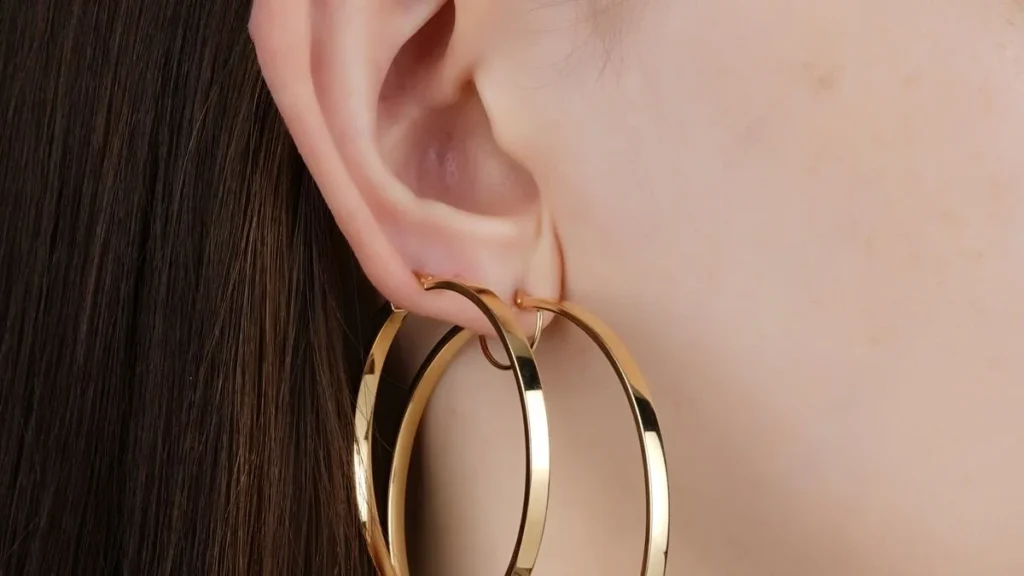
There is a reason the circle keeps winning. A hoop does something no other earring shape does: it creates movement. A stud sits still. A drop hangs and swings in one direction. A hoop moves with you, catching light from different angles as you talk, turn, and walk. It is the only common earring that is visibly alive on the ear, and that movement is what makes a plain outfit look finished without any effort at all.
The geometry helps too. A circle has no beginning and no end, no sharp corner to date it, no detail that belongs to one decade. Compare that with the earring trends that have come and gone: giant plastic hoops, feather earrings, shoulder-dusting chandeliers. Each carried a timestamp. A plain gold hoop carries none.
That timelessness is not an accident of design; it is the design. Hoops are among the oldest jewellery forms in the world, worn in gold in ancient Egypt, Nubia, and Sumer, and they have been worn more or less continuously ever since. When a shape survives four thousand years of changing taste, it stops being a trend and becomes a fact of human adornment, like the ring or the necklace. The question is not whether hoops will come back. It is whether they ever left.
What the street and the runway keep agreeing on

If you want to know whether a piece of jewellery has real staying power, watch what happens when the trend cycle turns against it. Studs had their moment, cuffs had theirs, and statement earrings had a long, loud run in the late 2010s. Each of them faded, and each time, the women who had never stopped wearing gold hoops simply carried on, unbothered.
The seventies gave hoops their first modern mass moment, when disco made big gold hoops part of the uniform of the night. The eighties and nineties gave them a second life through hip-hop, where gold hoops — often large, often bamboo-style — became a signature of confidence and identity. Jennifer Lopez built an entire public image partly on the strength of a pair of hoops. None of that was a fashion editor’s invention.
The 2020s revival followed the same pattern, only quieter. As the hard, sculptural earring moment softened, hoops came back in every size: tiny gold huggies, medium polished hoops, and oversized hoops for evenings. The runways showed them, the high street copied them, and nobody had to be persuaded they were back, because nobody had really believed they were gone. For the longer story of where the shape comes from, our guide to hoop earrings, their history and nine styles to wear in 2027 sets out the background; what matters here is the pattern, which is that the background never really ends.
Why gold, and why not the alternatives
Hoops come in every metal, but gold is the version that endures, and the reasons are practical as well as pretty. Yellow gold flatters warm and neutral skin tones, which is most of us, and it warms up a face in a way silver rarely does. It also ages gracefully: a gold hoop that has been worn for ten years looks loved, not worn out, while a plated hoop worn for ten months often looks tired, its coating thin at the edges, its shine gone patchy.
There is also the matter of value. A solid gold pair costs real money, and that is part of why people keep them. Jewellery you have invested in gets worn, looked after, and repaired; jewellery that cost almost nothing gets lost in a drawer. Gold-filled and good-quality vermeil are sensible middle ground, but the hoop rewards spending a little more than the cheapest option, because the shape is simple enough that the metal itself has to do the talking.
Silver hoops have their place, and rose gold had a long, pretty run, but neither has gold’s range. Silver can look cold against warm skin and needs regular polishing to stay bright. Rose gold, lovely as it is, is unmistakably a product of one era. Yellow gold is the only hoop metal that looks equally at home with denim and with diamonds. If you want to see how gold behaves against its hardest, most formal rival, our roundup of the best diamond earrings for 2027 makes the contrast clear — diamonds dazzle, gold warms, and most days, warmth wins.
The caveats that matter
None of this means every gold hoop is a good buy. The most common mistake is size: a hoop that is too large can overwhelm the face, and a hoop that is too heavy will hurt by lunchtime and stretch earlobes over months. The rule is simple — big hoops should be light, hollow, or tubular, never solid and heavy.
The second mistake is buying plated hoops and expecting them to behave like gold. Plating wears off where earrings rub against hair and scarves, and the base metal underneath can irritate sensitive ears. If your ears are sensitive, solid gold, gold-filled, or vermeil over sterling silver are the honest choices, and nickel is the usual culprit in cheap hoops.
| Detail | What is known |
|---|---|
| The shape is ancient | Worn in Egypt, Nubia, and Sumer thousands of years ago and in use ever since. |
| The circle flatters most faces | A hoop frames the face and adds movement, suiting more face shapes than most earrings. |
| Gold is the enduring metal | Flatters warm and neutral skin, ages well, and suits denim, tailoring, and evening wear. |
| Size matters more than price | A well-chosen medium hoop beats an expensive oversized one that overwhelms the face. |
| Heavy hoops stretch earlobes | Heavy hoops worn daily can stretch piercings, so large hoops should be hollow or light. |
| Plated hoops do not last | Thin plating wears off and can expose nickel or base metal that irritates sensitive ears. |
| Hoops suit most occasions | One pair works day to evening, but very large hoops are poor for the gym or swimming. |
| The trend cycle cannot kill them | Declared out of style repeatedly, hoops have returned every time, most recently in the 2020s. |
Checklist: choosing gold hoops that will last
- Start with a medium hoop, around 30 to 40 millimetres — it suits the most faces and outfits.
- Hold the hoop first: if it feels heavy in your hand, it will feel heavier on your ear.
- Choose solid gold, gold-filled, or vermeil over sterling silver, and check for nickel if your ears are sensitive.
- Check the clasp — a secure latch or hinged closure matters more than shine.
- Match the hoop to your hair: small hoops for short hair and updos, larger hoops when hair is down.
- Buy one good pair before five cheap ones, and wear it for a month before buying another size.
Frequently asked questions
Are gold hoops really never out of style?
Yes, with one qualification: sizes and finishes change, but the hoop itself does not leave. Tiny huggies dominate one year, oversized hoops the next. The plain medium gold hoop is worn through all of it, which is why it is the safest jewellery purchase most women make.
What size gold hoops should I buy first?
A medium hoop, roughly 30 to 40 millimetres across, is the best first pair: large enough to be visible, small enough to wear all day, and it works with short hair, long hair, and hair tied up. Go smaller for the office, and larger only when you know you enjoy the weight.
Are gold hoops suitable for everyday wear?
Yes, and that is their main advantage over statement earrings. A small or medium gold hoop works with a T-shirt, a work suit, and a dinner dress. Very large hoops are the exception: keep those for evenings, and take them off for the gym, for swimming, and for sleep. Our guide to the best gold jewellery for everyday wear in 2027 covers how hoops fit into a daily rotation.
Do gold hoops suit everyone?
Almost everyone, with size as the adjustment. Small hoops suit smaller faces and shorter hair; larger hoops suit longer faces, longer hair, and updos. Yellow gold flatters warm and neutral skin best, while white gold suits very cool skin. Anyone with unhealed or very sensitive piercings should start with small, light, solid-gold huggies.
How do I stop gold hoops from tarnishing?
Solid gold does not tarnish, but it collects skin oils, makeup, and hair products, which dull its shine. Wipe hoops with a soft, dry cloth after wearing, keep them in a lined box or pouch, and clean them occasionally in warm water with a drop of mild soap. Avoid perfume and hairspray on the earrings, and never swim in them.
Are gold hoops worth the money?
A good pair is, because it is worn more than almost any other piece of jewellery you own. Cost per wear is the honest measure: a pair worn three times a week for five years costs very little per outing, while a cheap pair worn twice and abandoned costs far more. Buy the best metal you can afford, in a size you will actually wear.
The bottom line
Gold hoops never go out of style because they were never a style in the first place. They are a shape, a habit, and a small piece of human history that sits very close to the face. Trends will keep arriving with confident announcements, and the hoop will keep outlasting them by being too useful, too flattering, and too simple to replace.
So if you already own a pair, wear them without apology and without waiting for permission from a trend report. If you do not, buy one good pair — medium, gold, light enough to forget you are wearing them — and give them a month. You will likely find that the pair you reach for every morning is the one that never needed to be fashionable at all.
Note: This is a style opinion piece, not buying advice. Gold prices and quality vary widely, so check the metal content, weight, and return policy before buying, and consult a jeweller or dermatologist if you have metal sensitivities or piercing concerns.
Meet Our Experts
BrassSmile’s fashion editors cover jewellery, style, and luxury living, drawing on runway coverage, high-street collections, and reader questions to shape each guide.
Why Trust BrassSmile
Our jewellery guides draw on published runway and retail coverage, with a focus on what lasts and what is worth the money.
Sources
BrassSmile’s hoop earrings history and gold jewellery guides; general reference on hoop earring history and gold jewellery care.