



Choosing a lip gloss shade sounds simple until you stand in front of a wall of pink, nude, coral and berry tubes and realise they all look different on your lips than they do in the tube. The difference is rarely the gloss itself. It is the undertone of your skin, the natural colour of your lips, and the light you are standing in.
That is why this guide starts with your skin, not with a shade chart. A gloss works when its undertone matches yours, when its depth is close to your natural lip colour, and when its finish suits the occasion.
Below are nine steps that take you from a bare lip to a shade you can buy with confidence, plus the mistakes that trip most people up. Each step explains what to do, what to avoid, and how long it takes, so you can choose a gloss shade in 2027 without guessing. The steps below work for any budget, because shade choice matters far more than price.
Key takeaways
- Match the gloss undertone to your skin undertone: warm skin suits warm shades, cool skin suits cool shades.
- Choose a shade close to your natural lip colour, one or two steps deeper, for the most flattering everyday result.
- Always test a shade in daylight and in a photograph, because shop lighting changes how colour reads.
- Test on your lips, not on your hand, because the natural pigment of your lips changes every shade.
- No shade rule works for everyone, and a gloss cannot fix a formula you dislike, so comfort and wear still matter.
What your skin tone actually tells you
Your skin undertone is the colour beneath the surface, and it stays the same even when your skin tans or pales. Warm undertones have a yellow, peachy or golden cast. Cool undertones have a pink, rosy or blue cast. Neutral undertones sit in between, with neither cast standing out.
Once you know your undertone, shade choice gets much easier. Warm skin looks best in warm glosses: peach, coral, warm rose, terracotta and golden nudes. Cool skin looks best in cool glosses: blue-pink, berry, mauve, plum and cool rose. Neutral skin can wear both families, which is why people with neutral undertones often find that almost any gloss looks good on them.
Your natural lip colour matters just as much. Some people have pale, almost colourless lips, and a gloss shows up almost exactly as it looks in the tube. Others have naturally deep, pigmented lips, and a sheer gloss can disappear entirely, or a pale nude can look chalky and grey.
How to test a shade before you buy it
The most common mistake is testing a gloss on the back of your hand. Your hand has a different undertone and a different surface than your lips, and a shade that looks beautiful on your hand can look completely different on your mouth. Always test on your lips. If you are in a shop, use a disposable applicator or a clean cotton bud, apply a thin layer, and then step away from the counter and look at yourself in daylight, ideally near a window.
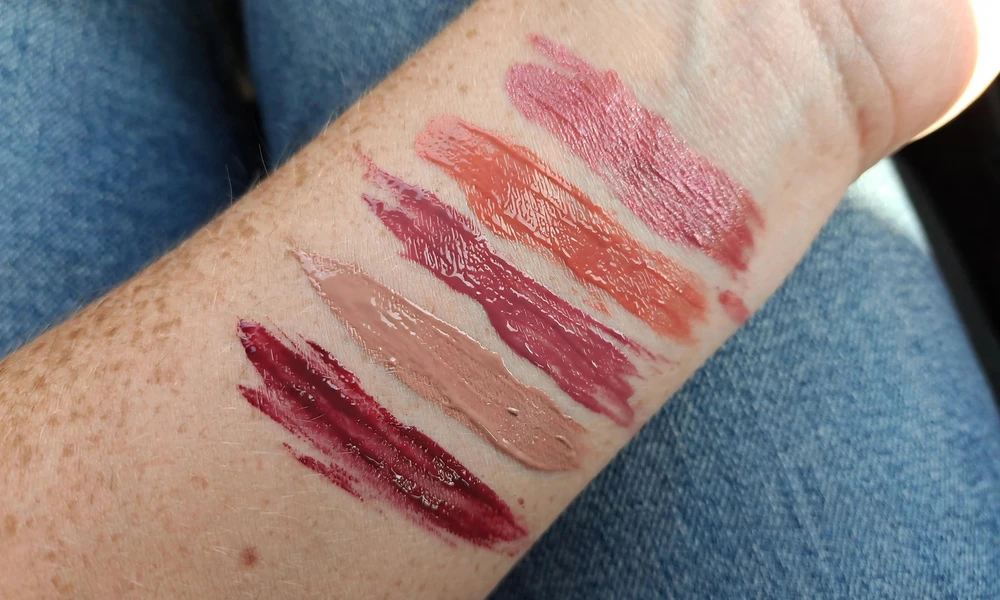
Give the shade a few minutes before you judge it. Some glosses deepen as they settle, and some fade quickly, so the colour you see in the first thirty seconds is not always the colour you will be wearing an hour later. Our guide to how to apply lip gloss covers the layering order that makes a shade look its best, because application changes how a colour reads on the lips.
If you are choosing between two similar shades, wear one on your top lip and one on your bottom lip, then look at yourself in daylight. The difference is usually obvious within seconds. If your lips are often dry, start with the best lip glosses for dry lips, because a hydrating formula makes any shade look smoother and more even.
The 9 steps to choosing your lip gloss shade
Step 1: Find your skin undertone
What to do: Look at the veins on the inside of your wrist in natural daylight, and check whether gold or silver jewellery suits you better. Greenish veins and gold jewellery usually mean warm, bluish veins and silver usually mean cool.
What to avoid: Do not judge your undertone under warm shop lighting or after a sunbed, because both change how your skin looks. Best For: Everyone, before buying any lip colour. Time Needed: Two minutes. Standout Tip: If you cannot decide, you are probably neutral, and most shades will work for you.
Knowing your undertone is the single most useful thing you can do before choosing a gloss.
Step 2: Look at your natural lip colour
What to do: Look at your bare lips in daylight and note whether they are pale pink, deep pink, brownish or mauve. Choose a gloss that is close to that colour, one or two steps deeper.
What to avoid: Do not choose a shade that is much lighter than your natural lip colour, because it can look chalky and grey. Best For: Anyone whose gloss always looks different than expected. Time Needed: One minute. Standout Tip: Your natural lip colour is your best shade guide, better than any chart.
A shade close to your own lip colour is the easiest win in makeup, because it works with your face instead of against it.
Step 3: Pick a shade family, not a single shade
What to do: Decide on a family first: nude, rose, coral, berry or plum. Then choose within that family, using your undertone as the filter.
What to avoid: Do not fall in love with a single tube before you know which family suits you, because you will keep buying shades from the wrong family. Best For: Anyone who owns ten glosses and wears only two. Time Needed: Five minutes. Standout Tip: Most people need only two families: one nude and one deeper shade for evenings.
Thinking in families stops impulse buying.
Step 4: Test on your lips in daylight
What to do: Apply the gloss to your lips with a clean applicator, then look at yourself near a window in natural daylight. Check the colour, the finish and how it sits on your lip lines.
What to avoid: Do not test on your hand, and do not judge a shade under warm shop lighting, which makes everything look warmer than it is. Best For: Every purchase, especially a first gloss in a new shade. Time Needed: Five minutes. Standout Tip: Daylight is the only light that shows a shade honestly.
A shade that looks good in daylight will look good almost everywhere.
Step 5: Take a photograph with flash
What to do: Take a selfie with your phone, with flash on and off, and look at how the shade reads on camera. Check whether it washes you out, looks too bright, or disappears.
What to avoid: Do not rely on a mirror alone, because a mirror shows you what you expect to see, while a photograph shows what others see. Best For: Wedding, event and party shades. Time Needed: Two minutes. Standout Tip: If a shade looks good in a flash photograph, it will look good in real life.
A gloss that looks perfect in the mirror can look very different in a flash photograph.
Step 6: Check the finish, not just the colour
What to do: Decide whether you want a soft shine, a high gloss, a satin finish or a sheer tint, and check how the finish looks on your lips after ten minutes.
What to avoid: Do not choose a very wet, mirror-like finish if you have fine lines around your lips, because shine can settle into them. Best For: Mature lips and anyone who dislikes sticky formulas. Time Needed: Ten minutes. Standout Tip: A soft shine flatters almost everyone, while a very wet finish suits smooth, full lips best.
Colour and finish work together.
Step 7: Match the shade to the occasion
What to do: Choose a sheer nude or soft rose for daytime and work, a deeper rose or coral for evenings, and a berry or plum for formal events. Keep the rest of your makeup in mind.
What to avoid: Do not wear a very bold gloss with a very bold eye, because the two compete, and one of them will lose. Best For: Anyone building a small, useful gloss collection. Time Needed: Two minutes. Standout Tip: One nude and one deeper shade cover almost every occasion.
A shade that is perfect for a wedding may be too much for an office, and a shade that is perfect for work may disappear at a party.
Step 8: Try it over a liner or a stain
What to do: Line your lips with a liner close to your natural lip colour, or apply a light lip stain first, then add the gloss on top. Check how the colour changes and how long it lasts.
What to avoid: Do not use a liner much darker than the gloss, because it will show through as a hard line when the gloss fades. Best For: Long days, events and anyone who wants better wear time. Time Needed: Five minutes. Standout Tip: A stain underneath makes any gloss last longer and fade more evenly.
A liner or stain underneath gives the gloss something to hold on to, so the colour lasts longer.
Step 9: Wear it for a full day before you commit
What to do: Wear the gloss for a full day, through eating, drinking and talking, and notice how it feels, how it fades, and whether you reach for it again or avoid it.
What to avoid: Do not keep a gloss you never reach for, even if the shade looked good in the shop, because an unworn gloss is a wasted purchase. Best For: Anyone deciding between two similar shades. Time Needed: One day. Standout Tip: The gloss you reach for without thinking is the right one.
A full day of wear tells you more than any swatch. If a gloss feels good at hour six, it is a keeper.
Matching a shade to the occasion
For everyday wear, a sheer nude or a soft rose that is close to your natural lip colour is the most useful choice. It goes with any outfit, it does not need a mirror to reapply, and it looks polished without looking made up. For work, the same shades work well, with a slightly deeper rose for days when you want to look more put together. A clear gloss over a lip stain is another good work option, because it adds shine without adding colour.
For evenings and parties, you can go deeper and warmer: a coral, a berry or a plum, depending on your undertone. A deeper shade photographs well in warm evening light, and it balances a smoky eye or a dark outfit. For a wedding, a soft rose or nude with a gentle shine is usually the safest choice, because it looks good in both daylight and flash photography, and it will not dominate the face in photographs.
Season matters too. Spring and summer suit lighter, brighter shades: peach, coral and light rose. Autumn and winter suit deeper, warmer shades: berry, plum and terracotta. If you like a stronger lip, the best matte lipsticks can help you compare finishes, because a gloss and a matte lipstick in the same shade can look like two completely different colours.
The caveats that matter
Shade rules are a starting point, not a law. Some of the most flattering lip colours break the undertone rule completely, and some people look wonderful in a shade that should not suit them. If a gloss makes you feel good when you look in the mirror, that matters more than whether it follows a rule. The rules are there to help you choose faster, not to tell you what you are allowed to wear.
| Detail | What is known |
|---|---|
| Warm skin undertone | Peach, coral, warm rose, terracotta and golden nudes usually look best |
| Cool skin undertone | Blue-pink, berry, mauve, plum and cool rose usually look best |
| Neutral undertone | Most shade families work, which makes choosing easier |
| Best depth | Close to your natural lip colour, one or two steps deeper |
| Best place to test | On your lips, in daylight, not on your hand under shop lighting |
| Best check before buying | A photograph with flash, which shows what others will see |
| What to skip | A shade much lighter than your natural lips, which can look chalky |
| What it does not do | No shade rule works for everyone, and shade cannot fix a formula you dislike |
It is also worth remembering that a gloss shade is only one part of the look. The condition of your lips, the finish of the gloss, and the rest of your makeup all change how a shade reads.
Checklist: choosing a lip gloss shade honestly
Use these checks before you buy, and again before a big event.
- Check your undertone first: warm, cool or neutral, using your wrist veins in daylight.
- Check your natural lip colour, and choose a shade close to it, one or two steps deeper.
- Test on your lips in daylight, never on your hand, and give the shade a few minutes to settle.
- Take a photograph with flash, and check whether the shade washes you out or looks too bright.
- Try the gloss over a liner or a stain, and see how the colour and the wear time change.
- Wear it for a full day before you commit, and keep only the glosses you actually reach for.
Frequently asked questions
How do I know my skin undertone?
Look at the veins on the inside of your wrist in daylight. Greenish veins usually mean a warm undertone, bluish veins usually mean a cool one, and a mix usually means neutral. Gold jewellery suits warm skin best, silver suits cool skin best.
What lip gloss shade suits fair skin?
Fair skin usually looks best in soft pinks, light roses and sheer nudes. Avoid very pale nudes that are lighter than your natural lip colour, because they can look chalky, and test deeper shades in daylight before buying.
What lip gloss shade suits dark skin?
Deep skin looks beautiful in rich berry, plum, warm brown and deep rose glosses. A clear gloss over a berry stain is a reliable way to add shine without losing depth, and very pale nudes are usually the least flattering choice.
Should I match my gloss to my outfit or my skin?
Match it to your skin first. A shade that suits your undertone will work with most outfits, while a shade chosen only to match a dress can look wrong on your face. Use your outfit to choose the depth, not the undertone.
Can I wear a nude gloss if my lips are dark?
Yes, but choose a nude that is close to your natural lip colour, not a pale beige. A nude that is darker and warmer than your lips will look like a polished version of your natural colour, while a pale nude can look grey.
How many lip gloss shades do I actually need?
Two or three cover almost everything: one sheer nude for everyday, one soft rose for work and daytime events, and one deeper berry or plum for evenings. More than that is a collection, not a necessity.
The bottom line
Choosing a lip gloss shade in 2027 is mostly about knowing your own skin. Find your undertone, look at your natural lip colour, choose a shade family that suits both, and test it on your lips in daylight and in a photograph. That process takes less than an hour, and it saves you from a drawer full of glosses you never wear. A gloss you love wearing will always look better than one you chose only because a chart told you to.
Start with one nude that is close to your natural lip colour and one deeper shade for evenings, wear each one for a full day, and keep the ones you reach for without thinking. That is the honest way to build a small gloss collection that actually gets used.



