A button-front cardigan is the most useful knit most wardrobes already own and almost never wear properly. It is a cardigan that closes with a row of buttons down the front, which sounds too simple to need a guide, and that is exactly why it goes wrong. Worn open without thinking, it slides off the shoulders and reads as an afterthought. It is the buttons: how many are done up, where the opening falls, and what sits underneath them.
The appeal is the range. One cardigan can be a top, a layer, and a light jacket. Fully buttoned over bare skin, it is a fitted top for dinner. Half buttoned over a camisole, it is a soft layer for the office. Open over a dress, it is a cover-up for a cool evening. A gaping placket, a button straining at the bust, or a hem that kicks out over the hips will show in every photograph.
This guide walks through the whole routine in nine steps, from choosing the right cardigan to checking the placket before you leave. Each step says what to do, what to avoid, and how long it takes.
Key takeaways
- A button-front cardigan is three pieces in one: a top fully buttoned, a layer half buttoned, and a cover-up open.
- Use the second button as the anchor point.
- Wear a camisole underneath, never a crew-neck tee, so the V stays clean.
- Leave the bottom button undone over skirts and wide trousers, or the hem kicks out at the hips.
- No styling trick fixes a cardigan too small across the bust; if the placket gapes, the size is wrong.
What a button-front cardigan actually is
A button-front cardigan is a knitted top that opens down the front and closes with buttons, usually between four and eight, set into a placket from neckline to hem. The neckline is usually a V, and the sleeves are usually long. The knit can be fine or chunky, plain or patterned, but the defining feature is always the same: the front is a working closure, not a decoration, and the cardigan is designed to be worn done up, half done up, or open.
That working closure is what separates it from its close relatives. An open-front cardigan has no buttons and drapes; a wrap cardigan ties at the waist; a zip-front closes with a zip that sits flat and stiff. A button-front is softer than a zip-front and more structured than an open-front. The buttons themselves — shell, horn, wood, or covered — add a detail that a plain knit does not have.
The style has been in and out of fashion for decades, and it is firmly in at the moment, worn as a top in its own right rather than as a layer over something else. Wearing it as a top, fully buttoned with nothing underneath, is a different skill from wearing it as a layer.
How to choose one and what to look for
Choose the cardigan by the buttons first and the knit second. The buttons should sit flat against the placket when the cardigan is done up, with no pulling between them and no gap showing skin or underlayer through the opening. Hold the cardigan up and look at the placket: the buttons should be evenly spaced, the buttonholes should be neat and reinforced, and the placket itself should be firm enough to hold its shape. A floppy placket will roll and gape no matter how well the rest fits.
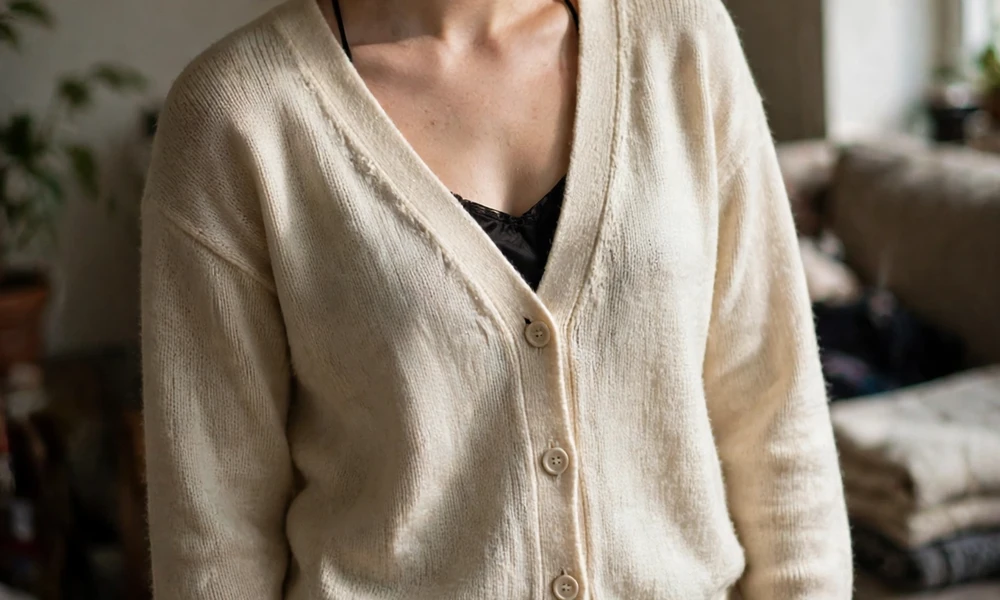
Then look at the knit and the fit. A fine-gauge knit in cotton, merino, or cashmere drapes cleanly and suits the office; a chunky knit is warmer but harder to layer. The shoulders should sit on your shoulder line, and the sleeves should reach your wrist bone. The length matters more than most people think: hip length is the most versatile, cropped length suits high-waisted trousers, and a longer length needs a belt or a tuck to avoid looking shapeless. Our guide to styling a hooded cardigan makes the same point about length.
Finally, check the colour and the buttons together. A neutral colour — cream, navy, grey, black, camel — will be worn far more often than a bright one, and the buttons should suit the jewellery you actually wear. Shell buttons go with silver, horn and wood go with gold, and covered buttons in the same knit disappear into the cardigan, which is useful if you want the knit to do the talking. If the buttons look cheap, the whole cardigan will look cheap, however good the knit is.
How to style a button-front cardigan: 9 steps
Use the second button as the anchor point
What to do: Start open, then do up the second button from the top and leave the rest undone. This holds the cardigan at the chest while the lower half falls open.
What to avoid: Doing up only the top button, which pulls the neckline tight and leaves the rest of the cardigan swinging. Do not do up the top two together, or the V disappears.
Best for: Everyday outfits with jeans or straight-leg trousers. Time needed: Seconds at the mirror. Standout tip: The second button is the anchor; everything below it is drape.
Leave the hem free when you wear a skirt
What to do: With a skirt or wide-leg trousers, leave the bottom button undone so the hem falls past the waistband instead of catching on it.
What to avoid: Buttoning it all the way down over a full skirt, which bunches the knit at the waist. Do not tuck a fully buttoned cardigan into a skirt.
Best for: A-line skirts, pleated skirts, and wide-leg trousers. Time needed: A moment at the mirror. Standout tip: An undone bottom button is what keeps the hem from flaring.
Tuck the front corners in and leave the back out
What to do: With high-waisted trousers, tuck just the front corners in and leave the back hanging. This shows the waist without adding bulk.
What to avoid: Tucking the whole cardigan in, which adds a thick layer of knit around the waist and makes the trousers sit badly. Do not tuck a chunky knit; only fine and mid-weight knits tuck cleanly.
Best for: High-waisted straight-leg and wide-leg trousers. Time needed: A minute at the mirror. Standout tip: Front corners only — the back stays out, and the waist still reads.
Wear a camisole underneath, not a crew-neck tee
What to do: Choose a fine camisole or vest close in colour to the cardigan, with thin straps that sit inside the V. It fills the neckline without adding a second one, so the cardigan stays the star.
What to avoid: A crew-neck tee under a V-neck cardigan, which creates a visible ring of fabric at the neck. Do not wear a patterned top underneath unless the cardigan is plain and dark.
Best for: Office outfits and any look where the cardigan is open at the top. Time needed: A minute to choose the layer. Standout tip: One neckline only — the camisole should disappear into the V.
Match your necklace metal to the buttons
What to do: Shell buttons suit silver; horn, wood, and tortoiseshell suit gold. Covered buttons take either.
What to avoid: Mixing shell buttons with a heavy gold necklace, which makes both look wrong. Do not wear a long pendant across the placket, or it will catch on the buttons.
Best for: Dressed-up outfits where the cardigan is the top layer. Time needed: A minute to check the buttons against your jewellery. Standout tip: The buttons are jewellery too — treat them as part of the outfit’s metal.
Show the forearm for a lighter feel
What to do: Push both sleeves to just below the elbow and let them sit in a soft fold. This shows a bracelet or a watch.
What to avoid: Pushing the sleeves up unevenly, which looks accidental rather than relaxed. Do not push up a sleeve that is tight at the forearm, or it will cut in.
Best for: Weekend outfits and warm rooms where full sleeves feel heavy. Time needed: A few seconds per sleeve. Standout tip: Both sleeves to the same point, or neither — an uneven push looks like a mistake.
Wear a belt instead of doing the buttons up
What to do: Leave the cardigan open and add a slim belt at your natural waist, letting it fall open below the belt. This gives a long cardigan a waist without buttoning it.
What to avoid: A wide belt over a fine knit, which crushes the cardigan. Do not belt a cardigan that is already short.
Best for: Long cardigans and straight dresses worn underneath. Time needed: A minute to place the belt. Standout tip: The belt replaces the buttons — open cardigan, closed waist.
Treat the cardigan as the top itself, fully fastened
What to do: Do up every button and wear it as a top on its own, with high-waisted trousers or a skirt. It only works if the cardigan fits across the bust with no gaping, so sit down in it before you commit.
What to avoid: Wearing a fully buttoned cardigan that pulls between the buttons, which will show in every photograph. Do not wear visible bra straps under a fully buttoned cardigan.
Best for: Evening outfits and warm days when a layer would be too much. Time needed: Two minutes to check the fit sitting down. Standout tip: Sit down before you leave — a cardigan that fits standing up can still gape when you sit.
Finish with a mirror check from the side
What to do: Turn sideways and look at the placket from the side. It should lie flat from neckline to hem, with no bowing at the bust and no twisting. Fix any twist by re-buttoning from the top down.
What to avoid: Checking only from the front, which hides a placket that bows out at the bust. Do not leave with a twisted placket; a twist at the top pulls the whole cardigan off-centre.
Best for: The final check on any button-front outfit. Time needed: A minute at the mirror. Standout tip: The side view tells the truth — the front view hides the bow.
Which button-front cardigan suits your shape and occasion
For a petite frame, a hip-length cardigan in a fine or mid-weight knit is the safest choice, worn half buttoned with slim trousers and a plain camisole. The V lengthens the neck, and the hip length keeps the proportions honest. Avoid long cardigans and chunky knits, which add width where you do not need it. A cropped cardigan with high-waisted trousers is the other good option.
For a tall frame, a longer cardigan works well, belted at the waist or worn open over a dress. For a curvy figure, the key is the fit across the bust: choose a cardigan with enough room that the placket lies flat, and size up rather than down if you are between sizes. A cardigan that is too small will gape, and no styling will fix that. Our guide to styling a belted cardigan makes the same point about sizing up.
For the office, a fine-gauge cardigan in navy, charcoal, or camel, half buttoned over a camisole, is the most reliable choice, with straight-leg trousers. For a weekend, a chunky knit worn open over jeans and trainers is hard to beat. For an evening, a fully buttoned cashmere cardigan with high-waisted trousers and heels is a real outfit. The occasion should decide how many buttons are done up.
The caveats that matter
The biggest caveat is gaping. A cardigan that pulls open between the buttons at the bust will show skin or underlayer through the gaps, and it looks worse in photographs than in the mirror. If the placket gapes when you stand still, it will gape more when you move, and the only fix is a different size. A camisole hides the gap but does not fix it, and a safety pin is a temporary patch. Buy the size that lies flat, even if the number on the label is one higher than you expected.
| Detail | What is known |
|---|---|
| Best everyday buttoning | Second button done up, rest left open |
| Best underlayer | A fine camisole, close in colour to the cardigan |
| Best length for petite frames | Hip length, half buttoned, slim trousers |
| Best length for tall frames | Mid-thigh or longer, belted or worn open |
| Bottom button rule | Leave it undone over skirts and wide trousers |
| Best shoes | Flat ankle boots, loafers, or clean trainers |
| Signs the size is wrong | Placket gapes at the bust or bows out |
| When to wear it as a top | Only when every button lies flat, sitting included |
The second caveat is the buttons themselves. Cheap buttons crack, loosen, and fall off, and a missing button is far more visible here than anywhere else, because the placket is the front of the outfit. Check the buttons before you buy, keep the spare button, and sew a loose button back on as soon as it wobbles.
Checklist: styling a button-front cardigan honestly
- Check the placket lies flat from the side, with no bowing at the bust.
- Check the second button is the one done up, not the top one.
- Check the underlayer is a camisole, with no second neckline showing.
- Check the bottom button is undone over a skirt or wide trousers.
- Check the buttons match the metal in your jewellery.
- Check every button is present and sewn on firmly before you leave.
Frequently asked questions
Does a button-front cardigan work over a dress?
Yes, and it is one of the best pairings. Wear it open over a dress, or half buttoned at the second button, and keep it shorter than the dress. Leave the bottom button undone so the cardigan does not catch on the dress.
How do I keep the buttons from pulling across the chest?
Size up, or choose a cardigan with a looser cut through the bust. The placket should lie flat standing and sitting, and if it pulls in either position the size is wrong. A camisole hides the gap but does not fix the pull. Our guide to styling a cowl-neck cardigan gives the same sizing advice.
Which shoes suit a button-front cardigan and jeans best?
Flat ankle boots and loafers suit it best. Clean trainers work for a weekend look, and a low heel works if the cardigan is fine-gauge and the jeans are dark. Avoid heavy boots with a fine cardigan.
Will a button-front cardigan leave me too hot in summer?
Yes, if the knit is fine enough. A lightweight cotton or linen-blend cardigan, worn open over a camisole and linen trousers, is a good summer layer for air-conditioned rooms and cool evenings. A wool or cashmere cardigan is too warm for summer, however light it feels.
How do I give a long button-front cardigan some shape?
Belt it at the waist, or tuck the front corners into high-waisted trousers. A long cardigan needs a waist to anchor it, and without one it hangs straight down and hides your shape. Keep the layer underneath slim, so the cardigan is the only loose piece.
Do I match the cardigan to my trousers, or go for contrast?
Contrast is usually better. A cardigan in a different colour from your trousers shows where one piece ends and the other begins, which gives the outfit structure. The same colour can work if the textures differ, but a matching knit and trouser in one shade will read as a suit that was never meant to be one.
The bottom line
A button-front cardigan earns its place when the buttons are treated as the design, not as an afterthought. Button it to the second button, leave the bottom undone over a skirt, wear a camisole underneath, and check the placket from the side. Those four habits cover most of what can go wrong.
Buy the size that lies flat, keep the spare button, and let the occasion decide how many buttons are done up. A cardigan that fits and is buttoned with intent will look deliberate in every photograph. The buttons are the whole outfit — get them right and the rest follows.