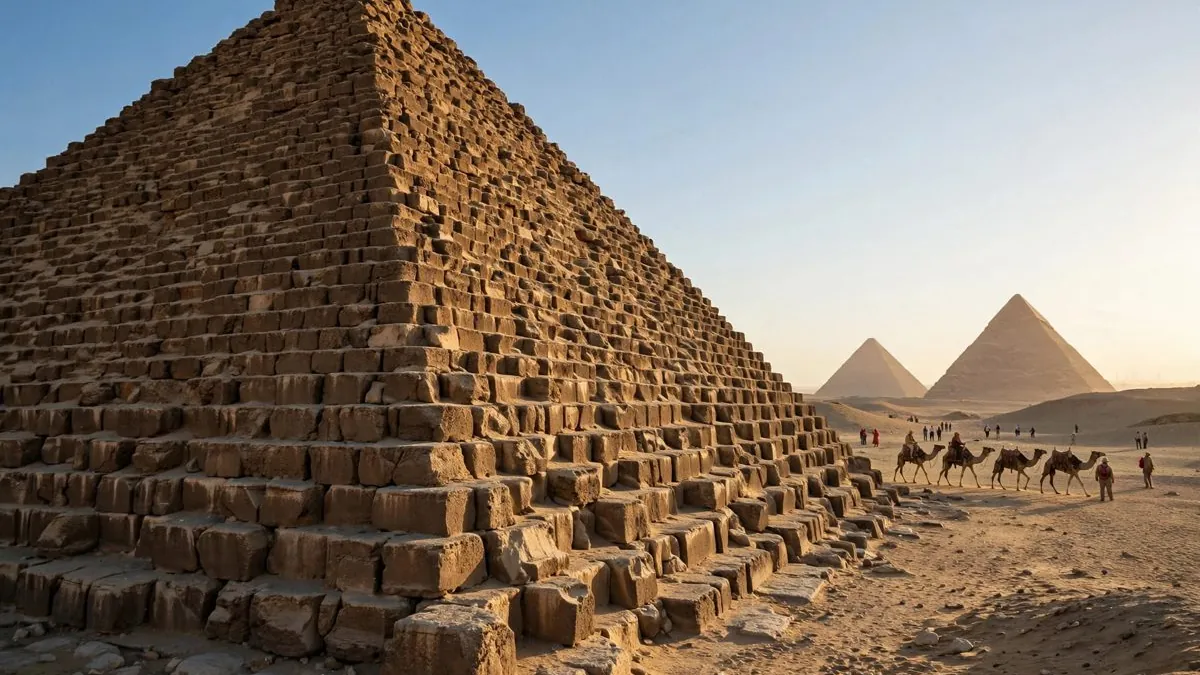
The Pyramids of Giza are the last surviving wonder of the ancient world, and they are even more striking in person than in photographs. This guide covers the three pyramids, the Great Sphinx, how to plan a visit, and the other famous pyramids worth knowing. How should you plan a trip to the pyramids? Go early, allow a full morning, wear sun protection, and take time at the panoramic viewpoint as well as up close.
The pyramids stand on a desert plateau west of Cairo, close to the edge of the city, and they have watched over the Nile valley for about 4,500 years. They were built as tombs for pharaohs of the Old Kingdom, and they remain the most famous monuments in Egypt.
Key takeaways:
- The Giza plateau holds three main pyramids: Khufu, the largest; Khafre, which looks the tallest; and Menkaure, the smallest.
- The pyramids were built about 4,500 years ago, during the Old Kingdom, as tombs for pharaohs.
- Go early in the morning, allow a full morning, and carry water, sun protection and comfortable shoes.
- See the pyramids up close, from the panoramic viewpoint, and at the Great Sphinx.
- Other famous pyramids include the Step Pyramid at Saqqara, the Pyramid of the Sun in Mexico and El Castillo at Chichen Itza.
What are the Pyramids of Giza?
The Pyramids of Giza are three large pyramids on a plateau west of Cairo, built during the Fourth Dynasty of the Old Kingdom, around 2580 to 2510 BC. They were tombs for the pharaohs Khufu, Khafre and Menkaure, father, son and grandson, and each was part of a larger complex with temples and smaller pyramids for queens. The plateau also holds the Great Sphinx, workers’ tombs and the remains of a city where the builders lived.
The Great Pyramid of Khufu is the largest and oldest of the three. It was originally about 146 metres high and is now about 139 metres, after the loss of its outer casing and capstone. For thousands of years it was the tallest human-made structure in the world, and it is the only one of the Seven Wonders of the Ancient World still standing.
The Pyramid of Khafre, the middle pyramid, looks taller than Khufu’s because it stands on higher ground, and it is the only one that still keeps some smooth limestone casing at the top. The Pyramid of Menkaure is the smallest, at roughly half the height of the others, and its complex includes three smaller pyramids for queens.
How were the pyramids built?
The pyramids were built from limestone blocks, with finer limestone for the outer casing, which once made them shine white in the sun. Most stone came from quarries nearby, and blocks were moved on sledges and by boat along the Nile, which once flowed much closer to the plateau. Ramps, levers and a large, organised workforce made the work possible.
The builders were not slaves, as older stories often claimed. Archaeological evidence shows they were skilled Egyptian workers, organised into crews, who lived in a settlement near the plateau. The work took decades for each pyramid, and it was planned with care: the sides of the Great Pyramid are aligned closely with the points of the compass, and its base is almost perfectly square.
Inside, the pyramids hold narrow passages and chambers, including the King’s Chamber in the Great Pyramid, which holds a stone sarcophagus. The passages are steep, low and warm. You do not need to go inside to enjoy Giza, but if you do, go slowly and be ready for the climb back out.
The Great Sphinx

The Great Sphinx sits at the eastern edge of the plateau, in front of the Pyramid of Khafre, and it is one of the most famous statues in the world. It has the body of a lion and the head of a human, carved from a single ridge of limestone bedrock. It faces east, towards the rising sun.
The Sphinx has been buried in sand for much of its history and uncovered many times. Its nose is missing and its beard has broken away, but the face is still clear, and the scale is hard to grasp until you stand beside it. The best view is from the viewing area in front, where you can see the Sphinx with the Pyramid of Khafre behind it.
Next to the Sphinx stands the Valley Temple, built from large blocks of limestone and granite, where the pharaoh’s body was prepared for burial. It is one of the best-preserved temples at Giza. The Sphinx, the temple and the causeway linking them to the pyramid form a single complex, and walking between them helps the whole site make sense.
Planning your visit to the pyramids
Allow a full morning for Giza, and arrive early if you can. The light is softer, the heat is kinder, and the site is quieter before the middle of the day. Most visitors spend two to four hours on the plateau, enough for the three pyramids, the Sphinx and the panoramic viewpoint. If you want to go inside a pyramid, allow extra time, because the passages are narrow and visitors move slowly.
Wear comfortable shoes, a hat and sunscreen, and carry water. The ground is sand and stone, the distances are longer than they look, and there is little shade. A light layer is useful in the cooler months, and a small bag is easier than a large one. If you are travelling from abroad, check entry requirements in advance, as our guide to visa requirements explains, and keep your passport and tickets somewhere safe.
A guide can add a great deal, because the site is large and the history is rich. A good guide will explain the order of the pyramids, the purpose of the temples and the stories behind the Sphinx, and will help you avoid the busiest spots. If you prefer to explore on your own, start at the Great Pyramid before walking to the panoramic viewpoint. For a different kind of trip after Egypt, see our guide to Cocoa Beach, a relaxed seaside escape.
The best viewpoints
The panoramic viewpoint, on a rise to the south-west of the pyramids, is the place for the classic photograph, with all three pyramids in a line against the desert. It is the best spot to grasp the layout of the site. Go in the morning for soft light, or in the late afternoon for long shadows and warm colour.
Up close, the pyramids are a different experience. Stand at the base of the Great Pyramid and look up, and the blocks above you seem to go on forever. Walk around the corner and the scale changes again, as the pyramid fills the sky. The Sphinx viewpoint, in front of the statue, is the best place for a photograph that includes both the Sphinx and the Pyramid of Khafre.
For a quieter moment, walk to the smaller pyramids of Menkaure, at the far end of the plateau. Fewer visitors go there, and the view back across the site, with the three pyramids in a row, is one of the finest at Giza. Take your time, sit for a while, and let the scale of the place settle in.
The three pyramids at a glance
Use this table to compare the three main pyramids of Giza. Khufu’s is the largest and oldest, Khafre’s looks the tallest, and Menkaure’s is the smallest, but each has its own character.
| Pyramid | Pharaoh | Size | Look for |
|---|---|---|---|
| Great Pyramid | Khufu | Largest, about 139 metres today | Its scale and the King’s Chamber |
| Pyramid of Khafre | Khafre | Middle, about 136 metres today | Limestone casing at the top |
| Pyramid of Menkaure | Menkaure | Smallest, about 65 metres today | Three small queens’ pyramids |
Other famous pyramids
Giza is not the only place with pyramids. The Step Pyramid of Djoser at Saqqara, south of Cairo, is older than the pyramids of Giza and is the first large stone building in Egypt. It was built in steps, rather than with smooth sides, and it marks the beginning of pyramid building. Saqqara is an easy addition to a trip to Giza.
In Mexico, the Pyramid of the Sun at Teotihuacan is one of the largest pyramids in the world by volume, and it stands in a vast ancient city north-east of Mexico City. At Chichen Itza, on the Yucatan Peninsula, El Castillo is a stepped pyramid built by the Maya, famous for the shadows that appear on its staircase at the equinoxes.
Pyramids were also built in Sudan, where the kings of Kush built smaller, steeper pyramids at Meroe, and in China, where large burial mounds took a similar shape. The form appears in many cultures, because a pyramid is a stable, simple way to build high with stone. Giza remains the most famous, but it is part of a much wider story. For another historic island escape, see our guide to Jekyll Island.
Your pyramids checklist
- Arrive early, allow a full morning, and start at the Great Pyramid.
- Carry water, wear a hat and sunscreen, and wear comfortable shoes.
- See the three pyramids, the Sphinx and the panoramic viewpoint.
- Allow extra time if you want to go inside a pyramid.
- Check entry requirements and keep your passport and tickets safe.
- Take the classic photograph, then put the camera down and look around.
Frequently asked questions
How old are the Pyramids of Giza?
About 4,500 years old. They were built during the Old Kingdom, around 2580 to 2510 BC, as tombs for the pharaohs Khufu, Khafre and Menkaure.
Which pyramid is the largest?
The Great Pyramid of Khufu. It was originally about 146 metres high and is now about 139 metres, and it is the largest pyramid at Giza.
Can you go inside the pyramids?
Yes, visitors can enter the pyramids, though the passages are narrow, steep and warm. Go slowly, and allow extra time for the climb.
What is the Great Sphinx?
A statue with the body of a lion and the head of a human, carved from limestone bedrock. It sits in front of the Pyramid of Khafre and faces east.
How long should I spend at Giza?
Most visitors spend two to four hours. That is enough for the three pyramids, the Sphinx and the panoramic viewpoint, with extra time for going inside.
Are there pyramids outside Egypt?
Yes. Famous examples include the Step Pyramid at Saqqara, the Pyramid of the Sun in Mexico, El Castillo at Chichen Itza and the pyramids of Meroe in Sudan.
The final view
The Pyramids of Giza reward a slow visit. See them up close, from the panoramic viewpoint, and at the Sphinx, and give yourself time to take in the scale. They have stood for about 4,500 years, and they are still the most striking sight in Egypt. For ideas on where to eat on your travels, see our guide to the best food in the world.
Your next step is simple: pick a morning, arrive early, and walk the plateau from the Great Pyramid to the Sphinx. That single walk, with the desert underfoot and the pyramids ahead, is the heart of the trip.
Stay safe in the sun and heat: drink water often, wear a hat and sunscreen, rest in the shade, and take care on uneven ground. If you feel dizzy, hot or unwell, move into the shade, drink water and seek help straight away.