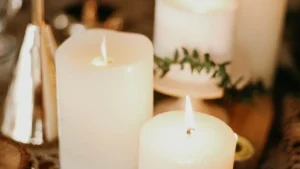
A scented candle is a candle made to fragrance a room while it burns. It is the same object as an ordinary candle — wax, a wick and a container — with one addition: fragrance oil or essential oil blended into the wax. When the flame melts the wax, fragrance evaporates from the melt pool and scents the room.
The confusion usually starts on the label. Words like soy, coconut blend, fragrance load, cold throw and clean burn are printed as if every buyer already knows them, and most do not. The difference between two jars that look identical is almost always in the wax, the fragrance, the wick or the room — not in the brand name on the front.
This guide explains what a scented candle is, piece by piece, in plain language: the wax types and what each one changes, how much fragrance a candle can hold, how wicks and burn time work, why scent travels well in one room and disappears in another, and the safety basics that matter every time you light one.
Key takeaways
- A scented candle is wax with fragrance blended in, a wick to burn it, and usually a vessel to hold the melt pool. The scent is released from the melted wax, not from the flame itself.
- Wax decides much of the behaviour: paraffin throws scent strongly, soy and coconut blends burn cooler and cleaner, and beeswax brings its own honey scent.
- Fragrance load is the percentage of fragrance in the wax, usually around 6 to 12 percent.
- Scent throw is two things: cold throw, what you smell from the unlit jar, and hot throw, what you smell once it is burning.
- Trim the wick, let the first burn reach the edge, and never leave a candle burning unattended.
What a scented candle is
A scented candle has four parts, and each one does a different job. The wax is the fuel: it melts, carries the fragrance and feeds the flame. The fragrance is the scent itself, usually a blend of fragrance oils, sometimes essential oils, mixed into the wax. The wick is the delivery system: a braided cotton cord that draws melted wax up to the flame. The vessel — a glass jar, a tin, a ceramic cup — holds the melted wax in a pool and keeps the burn contained.
When you light the wick, the flame melts a small circle of wax around it. That melted wax, called the melt pool, is where the scent lives. Fragrance molecules escape from the warm surface of the pool into the air, and warm air carries them around the room. The flame itself has no scent. If a candle smells of nothing, the problem is almost never the flame: it is the wax, the fragrance load, or the size of the pool.

Wax types and what each one changes
Paraffin is the oldest and most common candle wax, refined from petroleum. It holds fragrance well, throws scent strongly, and melts into a smooth, even pool, which is why the houses in our guide to the top luxury candle brands for 2027 still use it, often refined to a high grade. Its drawback is soot: a paraffin candle with a long wick or a draft will smoke, and it burns hotter and faster than plant waxes.
Soy wax is made from soybean oil. It burns cooler and slower than paraffin, so a soy candle of the same weight usually lasts longer, and it produces less soot. Its scent throw is softer: a soy candle scents a bedroom gently rather than filling a whole floor. Soy wax is soft, so soy candles almost always come in jars rather than as free-standing pillars.
Coconut wax comes from coconut oil and is usually blended with soy or another wax, because pure coconut wax is very soft. It is prized for a clean burn and a strong throw, and it is one of the more expensive waxes. Most candles you will buy are blends, not single waxes, and a blend is not a sign of a cheap candle — it is the maker choosing a burn speed, a throw and a price.
Fragrance load and scent families
Fragrance load is the percentage of the candle’s wax weight that is fragrance rather than wax. Most scented candles sit between about 6 and 12 percent: a 200 gram candle at 10 percent load holds about 20 grams of fragrance oil. Below 6 percent, a candle often smells faint even when it is burning well. Above 12 percent, the wax can struggle to hold the oil: the candle may sweat, smoke or burn unevenly, and the scent can turn sharp rather than stronger.
More fragrance does not always mean more scent in the room. Light, volatile notes such as citrus and green herbs escape the melt pool quickly and fade fast. Heavy notes such as woods, amber, vanilla and musk escape slowly and linger.
The two kinds of fragrance in candles are fragrance oils and essential oils. Fragrance oils are made in a laboratory, either to copy a natural scent or to create one that does not exist in nature, such as sea salt or clean linen. Scent families are the industry shorthand: fresh and citrus suit kitchens and bathrooms, florals suit bedrooms and hallways, and woody, amber and spicy scents suit living rooms and evenings, because their heavy molecules carry further and linger longer.
Wicks, burn time and scent throw
The wick decides how much wax melts, and how much wax melts decides how much scent is released. A wick that is too small makes a narrow melt pool, so the scent stays faint and the candle tunnels — a hole burns down the middle while wax stays stuck to the sides. A wick that is too large makes a deep pool, burns the wax fast, and smokes. The right wick makes a pool that reaches the edge of the jar within about an hour, and no further.
Most scented candles use braided cotton wicks, sometimes with a paper or zinc core to keep them upright. Wooden wicks are thin strips of wood that crackle faintly as they burn and make a wider flame, which suits large jars. Large jars often have two or three wicks: one wick cannot melt a pool wide enough to reach the edge of a broad jar, so the wax at the edges would never melt at all.
Burn time is the number of hours a candle should burn before the wax is gone, and it is always an estimate. A rough guide is that a well-made candle burns about 7 to 9 grams of wax per hour, so a 190 gram jar lasts roughly 25 to 30 hours at that rate. The fairer measure is cost per hour of burn, not price per jar, and our roundup of the best luxury candles for home in 2027 compares nine jars that way. Scent throw is the distance a candle’s fragrance travels: cold throw is what you smell from the unlit jar, and hot throw is what you smell once it has been burning for an hour.
What to check before you buy
| Detail | What is known |
|---|---|
| Wax type | Paraffin throws strongly; soy and coconut blends burn cooler and cleaner; beeswax adds its own honey scent. |
| Fragrance load | Usually 6 to 12 percent of wax weight. Above 12 percent the wax may sweat or smoke rather than smell stronger. |
| Wick type and count | Cotton is standard; wood crackles and suits wide jars. Broad jars need two or three wicks to melt edge to edge. |
| Burn time | Roughly 7 to 9 grams of wax per hour. Compare cost per hour of burn, not price per jar. |
| Cold throw vs hot throw | Cold throw is the unlit smell; hot throw after an hour of burning is the real test of a candle. |
| Scent family | Fresh and citrus suit small bright rooms; woods, amber and spice suit large living rooms and evenings. |
| Vessel | A jar holds the melt pool and shields the flame. A good vessel is worth keeping once the wax is gone. |
| Safety markings | Look for lead-free wicks and burn instructions. Never buy a candle with no safety information. |
Checklist: before you light a scented candle
- Trim the wick to about 5 millimetres before every burn, so the flame stays small and the candle does not smoke.
- On the first burn, let the melt pool reach the edge of the jar before you blow it out, so the candle does not tunnel.
- Place the candle on a flat, heat-proof surface, away from drafts, curtains, books and anything that can catch.
- Burn for one to four hours at a time, and never leave a burning candle unattended or in a room where children or pets are alone.
- Keep the wax free of wick trimmings, matches and dust.
- Stop when about a centimetre of wax remains, and never burn a candle to the very bottom of its jar.
Frequently asked questions
What is the difference between a scented candle and a regular candle?
A scented candle has fragrance oil or essential oil blended into its wax, so it releases scent as the wax melts. A regular candle is unscented and gives light and warmth only. The wax, wick and vessel are otherwise the same.
How long should a scented candle burn?
Most scented candles burn for one to four hours per session. The first burn should last until the melt pool reaches the edge of the jar, usually about an hour for a standard jar. A 190 gram jar typically lasts around 55 to 60 hours at a slow burn.
Why does my scented candle not smell when it is burning?
Usually the melt pool is too small, the room is too large or too draughty, or the fragrance is light and volatile. Trim the wick, let the pool reach the edge, close the windows, and give it a full hour.
Are soy candles better than paraffin candles?
Neither is better in every way. Soy burns cooler, slower and with less soot, and it suits bedrooms and smaller rooms. Paraffin holds fragrance well and usually throws scent further, which suits large living rooms. Coconut blends sit between the two.
Is it safe to burn scented candles every day?
Yes, with basic care: trim the wick, burn in a ventilated room, keep the candle away from drafts and flammable objects, and never leave it unattended. If a candle gives you a headache or smells of smoke, blow it out, air the room, and try a different wax.
How do I make a scented candle last longer?
Let the first burn reach the edge, trim the wick before each relight, burn for one to four hours at a time, and keep the candle out of drafts, which make the flame burn hotter and faster. Our guide on how to choose a luxury candle in 2027 walks through the nine decisions in order.
The bottom line
A scented candle is a simple object with a surprising number of moving parts: wax that sets the burn, fragrance that sets the scent, a wick that sets the size of the melt pool, and a room that decides how far the scent travels. Once you can read those four parts, the label stops being decoration and starts being information.
Start with the room, then the wax, then the scent family, and let the first burn tell you the truth. A candle that melts edge to edge and smells the same after an hour as it did after ten minutes is a good candle at any price.
Note: Fragrance loads, burn rates and burn times are typical ranges, not guarantees; makers vary, and scent is personal. Check the label of the candle you buy, and never leave a burning candle unattended.
Meet our experts
BrassSmile’s editors explain home and lifestyle products from published specifications and brand listings. No claim here is a laboratory test.
Why trust BrassSmile
We only describe products that are real, currently sold and verifiable from the brand or a major retailer, and we explain how they work before we recommend anything.
Sources
Brand and retailer listings for candle wax, wick and burn-time guidance, checked November 2026.