A diamond pendant is the easiest piece of fine jewellery to buy well — and one of the easiest to buy badly. Unlike a ring, there is no finger size to get wrong, which is why shoppers rush the decision. Yet two pendants that look identical in a shop window can differ enormously in sparkle, durability and value.
The difference comes down to a handful of things you can check in minutes: the quality of the stone, the security of the setting, the strength of the chain, the metal, and the certificate that proves what you are paying for.
This guide covers what to look for in a diamond pendant in 2027, from the 4 Cs and setting styles to chain lengths, certification and budgets.
Key takeaways
- Cut matters most: a well-cut smaller diamond out-sparkles a poorly cut larger one, so protect the cut grade first.
- G to H colour and VS1 to VS2 clarity are the sweet spot — white and eye-clean, without paying for grades nobody can see.
- The chain is half the purchase: a solid cable or box chain with a secure clasp protects a pendant worth far more than the chain.
- Choose the setting for how you will wear it — a bezel or martini setting sits flat, while a halo makes a modest stone look larger.
- Insist on an independent GIA or IGI report for any centre stone of 0.50 carats or more.
Start with the 4 Cs — in the right order
Every diamond is graded on four factors: cut, colour, clarity and carat weight. The 4 Cs were developed by the Gemological Institute of America in the 1950s and remain the universal language of the diamond trade. Most buyers start with carat weight, but the wiser order is different: begin with cut, then settle colour and clarity for value, and let size follow. A pendant is seen from a normal conversational distance, not examined at arm’s length like a ring. Our diamond buying guide covers the 4 Cs in full.
Cut: the sparkle comes first
Cut does not mean the shape, such as round or oval. It means how precisely the facets were cut — their angles, proportions, symmetry and polish — and how well they return light to your eye. Of all the 4 Cs, cut has the strongest visible effect: an excellently cut diamond with modest colour and clarity can still look radiant, while a badly cut stone with better grades elsewhere can look flat. For round brilliants, look for an Excellent or Ideal cut grade and never go below Very Good.
Colour: pay for what your eye can see
Diamond colour is graded from D to Z, measuring the absence of colour: the less body tint a white diamond shows, the higher the grade and usually the higher the price. D to F is colourless and carries the highest premium; G to H is near-colourless and faces up white to the eye, which is why most buyers land there. The metal changes the answer: in yellow or rose gold, an I to J stone faces up beautifully, while in white gold or platinum you should stay at G to H.
Clarity: eye-clean is enough
Clarity measures internal inclusions and surface blemishes, graded under ten-times magnification from Flawless through VVS and VS to SI and Included. What matters is not the grade on paper but whether the diamond is eye-clean — free of inclusions visible to the naked eye. For a pendant, VS1 to VS2 is eye-clean in almost every case, and stepping up to VVS buys a cleaner report rather than a visibly cleaner stone.
Carat: size follows quality
One carat equals exactly 0.2 grams. It is a measure of weight, not size, although the two correlate: a one-carat round stone is about 6.5 millimetres across, while a half-carat round is about 5.1 millimetres. For everyday wear, 0.50 to 1.00 carats is the sweet spot. Under 0.50 carats the pendant can disappear on the chain; over 1.50 carats it starts to pull the chain into a V. Lab-grown diamonds have made larger sizes far more attainable: a one-carat lab-grown solitaire in 14k gold typically costs around $500 to $1,200, while the equivalent mined diamond runs several times higher.
Choose a setting that suits real life
The setting holds the stone, decides how much light reaches it, and determines whether the pendant sits flat or flips over. Three designs solve flipping: a bezel setting, whose metal rim lowers the stone’s centre of gravity; a low-profile three-prong martini setting, whose conical cup hugs the stone; and a stationary fixed-chain setting, where the chain is anchored at two balanced points. The classic solitaire remains the most versatile choice.
| Style | Best for | Look | Watch out for |
|---|---|---|---|
| Solitaire | Everyday elegance, first diamond gift | One clean stone, timeless | Thin prongs can snag; check them yearly |
| Halo | Maximum presence per carat | Centre stone looks up to twice as large | Small accent stones need regular cleaning |
| Bezel | Daily wear, active lifestyles | Modern, sleek, sits flat | Metal rim covers the stone’s edges |
| Martini (three-prong) | Maximum sparkle from a round stone | Minimal metal, big light return | Best up to 1.50 carats |
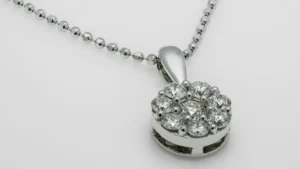
| Cluster | Vintage feel on a smaller budget | Several small stones read as one larger gem | Harder to clean between stones |
| Drop | Evening and special occasions | Movement and drama below the neckline | Catches on clothing; not ideal daily |
| Tennis or station | A line of sparkle, not one focal stone | Continuous shimmer across the collarbone | Costs more; check every link’s setting |
| Three-stone | Anniversaries and milestones | Past, present and future symbolism | Side stones must match the centre in colour |
If you are building a small collection, our round-up of the best diamond necklaces shows the full range of styles, from solitaires to tennis necklaces.
The chain matters as much as the stone
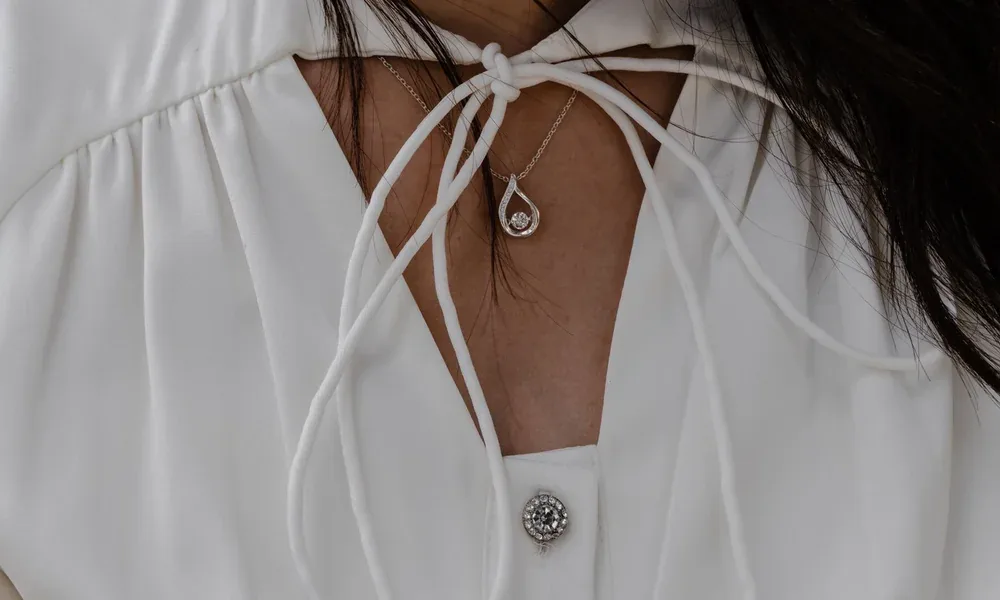
Buyers obsess over the diamond and ignore the chain, and that is a mistake. The chain carries the pendant’s full weight, takes daily friction against skin and clothing, and is the component most likely to fail. Start with length: sixteen inches sits at the collarbone; eighteen inches is the standard length that suits almost everyone, especially with an adjustable link; twenty to twenty-four inches layers beautifully. Check the type too: cable chains are sturdy, box chains are strong and tangle-resistant. Insist on solid links and a clasp that closes with a firm click.
Pick the metal for your skin, wardrobe and budget
Fourteen-karat gold is the practical default: durable enough for daily wear, available in yellow, white and rose, and kinder to the budget than eighteen-karat, which has a richer colour but scratches more easily. Platinum is the most durable and hypoallergenic choice and holds stones securely, but it costs more and develops a soft patina. White gold needs occasional rhodium replating. Yellow gold flatters warm skin tones; rose gold adds a soft warmth that suits vintage-inspired settings. Also check the bail, the loop joining pendant to chain: a hidden bail or slider sits flatter and removes the O-ring that can wear through a gold chain over years of friction.
Certification: proof, not promises
Never buy a diamond pendant without an independent grading report for the centre stone — for solitaires of 0.50 carats and up, this is non-negotiable. The two most trusted laboratories are GIA and IGI, which grade mined and lab-grown diamonds to the same 4 Cs standards. The report should state the cut, colour, clarity and carat weight, and whether the stone is natural or lab-grown. Check the report number yourself on the laboratory’s verification page before you pay. Lab-grown versus mined is a personal choice, not a quality question — lab-grown stones are chemically, physically and optically identical to mined diamonds and sell at roughly seventy to eighty per cent less, though they generally hold less resale value.
Set a budget — and know where to save
Work out your total budget before you fall in love with a stone, remembering it includes the setting, the chain and any taxes, not just the diamond. As a broad guide for 2026 and 2027, a lab-grown solitaire pendant in 14k gold runs roughly $250 to $600 at 0.25 to 0.50 carats, $500 to $1,200 at one carat, and $1,000 to $2,200 at two carats. Mined-diamond pendants cost several times more — a one-carat mined pendant typically runs from around $900 to $5,500 and beyond. The smartest savings are invisible: buy just under a round carat weight, choose G to H colour and VS to SI1 clarity, and let a halo do the work of a larger stone.
Checklist: before you buy a diamond pendant
- Cut grade is Excellent or Ideal for a round stone, or symmetry and polish are strong for a fancy shape.
- Colour is G to H for white metals, or I to J for yellow or rose gold.
- Clarity is VS1 to VS2, or SI1 verified eye-clean with your own eyes, not just on paper.
- The setting sits flat and does not flip, and the prongs or bezel feel secure with no rough edges.
- The chain is solid-link, matched to the pendant’s weight, with a secure clasp and an adjustable length.
- An independent GIA or IGI report is in hand, the report number is verified online, and the return policy is in writing.
How to style and care for your pendant
A diamond pendant earns its place by being worn, not kept in a box. An eighteen-inch solitaire works with almost everything, from a white blouse to an evening dress, while longer lengths layer well over knitwear. Keep metals consistent across the pieces you wear together. For a coordinated set, our guide to the best diamond earrings is a useful companion when you want earrings that match your pendant’s metal and stone quality.
Frequently asked questions
What is the best carat size for a diamond pendant?
For everyday wear, 0.50 to 1.00 carats is the best balance of presence and practicality — a one-carat round stone is about 6.5 millimetres across and reads as a clear focal point at the collarbone. Under 0.50 carats the pendant can disappear on the chain, while stones over 1.50 carats need a stronger chain and suit evening wear better.
What colour and clarity should I choose for a diamond pendant?
G to H colour and VS1 to VS2 clarity are the sweet spot. G to H faces up white to the naked eye, and VS1 to VS2 is eye-clean in almost every case. In yellow or rose gold you can drop to I to J colour, because the warm metal masks the stone’s faint warmth.
Which diamond pendant setting is best?
It depends on how you will wear it. A bezel setting is the best all-rounder for daily wear: secure, modern and it sits flat without flipping. A three-prong martini setting gives the most sparkle from a round stone, while a halo makes a modest centre stone look larger.
What chain length is best for a diamond pendant?
Eighteen inches is the standard and suits most people, especially with an adjustable link that shortens it to sixteen inches. Sixteen inches sits at the collarbone and suits high necklines; twenty to twenty-four inches suits layering and long or drop pendants.
Do I need a certificate for a diamond pendant?
Yes, for any centre stone of 0.50 carats or more, insist on an independent grading report from GIA or IGI and verify the report number on the laboratory’s own website before paying. The certificate confirms the cut, colour, clarity, carat weight and whether the stone is natural or lab-grown.
Are lab-grown diamond pendants worth buying?
For most wearers, yes. Lab-grown diamonds are chemically, physically and optically identical to mined diamonds and cost roughly seventy to eighty per cent less, so the same budget buys a larger or better-quality stone. The main trade-off is resale value, which is generally lower.
The bottom line
A good diamond pendant is a short list of right decisions: an excellent cut, G to H colour, eye-clean clarity, a sensible carat weight, a setting that sits flat, a solid chain with a secure clasp, and an independent certificate to prove it all. Get those right and the brand name on the box matters very little. Buy the sparkle you can see and the security you can feel.
Note: Prices and grading guidance in this article reflect widely published 2026 buying guides and can vary by retailer, region and stone. Always verify the grading report and the seller’s return policy before buying.