Vitamin E has sat in skincare formulas for more than fifty years, outlasting every trend that promised to replace it. That longevity is no accident. Vitamin E works because it does one specific job in the skin exceptionally well, and it does it where damage begins.
The confusion around it is understandable. Its reputation includes scar erasing, wrinkle curing, and dark-spot miracles — some claims hold up, several do not. The difference comes down to how the molecule behaves once it touches your skin.
This guide stays with the mechanism: what vitamin E is, how it stops a chain reaction that damages your skin’s fats, why the form on the label matters, what the evidence supports, and how to use it. No rankings, no miracles — only the science.
Key takeaways
- Vitamin E is the skin’s main fat-soluble antioxidant, breaking the chain reaction of lipid peroxidation inside cell membranes.
- Alpha-tocopherol is the form your skin keeps and uses most; the epidermis is about 87 percent alpha-tocopherol.
- Most products use tocopheryl acetate, a stable ester the skin must convert into active tocopherol.
- Vitamin E protects best with vitamin C, which regenerates it after it neutralises a free radical.
- Realistic results are a steadier barrier, softer skin, and less UV damage over weeks — not overnight scar removal.
What vitamin E actually is
Vitamin E is not a single molecule. It is a family of eight related fat-soluble compounds: four tocopherols and four tocotrienols, each in alpha, beta, gamma, and delta forms. All eight share a chromanol ring, the part that does the antioxidant work, but differ in the tail attached to it. Tocopherols carry a saturated phytyl tail; tocotrienols carry a shorter, unsaturated tail.
In human skin, one form dominates. Alpha-tocopherol is the most abundant vitamin E compound in the epidermis, making up roughly 87 percent of the vitamin E measured there. The body prioritises alpha-tocopherol: the liver selects it for retention, and skin accumulates it most readily.
Your skin does not wait for a cream to supply it. Vitamin E reaches the skin surface naturally through sebum, the oil your sebaceous glands secrete. It accumulates in those glands, then rides out with sebum to the stratum corneum, where it concentrates between skin cells. This supply is fragile: ultraviolet light and ozone rapidly deplete vitamin E in the stratum corneum, and levels decline with age.
The core mechanism: breaking the chain of lipid peroxidation
To understand why vitamin E works, picture what it defends. Every cell in your skin is wrapped in a membrane made largely of unsaturated fatty acids, and the spaces between cells in the stratum corneum hold similar fats. These fats are the mortar of your skin barrier.
When UV light, pollution, or ozone strikes the skin, it generates reactive oxygen species — unstable molecules called free radicals. A free radical steals an electron from a nearby fat molecule, turning it into a new radical. That radical attacks the next fat molecule, and so on, in a chain reaction called lipid peroxidation. Left unchecked, one radical can damage dozens of fat molecules.
Vitamin E sits inside those same membranes. Its chromanol ring donates a hydrogen atom to a peroxyl radical, neutralising it before it can attack the next fat molecule. The vitamin E molecule itself becomes a radical — a tocopheroxyl radical — but a remarkably calm one: stable, low in energy, and unable to continue the chain. One vitamin E molecule can therefore stop a reaction that would otherwise have damaged many fat molecules, which is why research finds meaningful protection even at roughly one vitamin E molecule per two thousand phospholipids.
That is the whole secret, and it explains both the power and the limits of the ingredient. Vitamin E is a chain-breaking antioxidant, not a builder. It does not make new collagen, the way vitamin C does, or speed cell turnover, the way retinol does. What it does is preserve what is already there: the fats in your membranes and barrier, and the collagen and DNA free radicals would otherwise damage.
The forms of vitamin E, compared
The ingredient list rarely says simply “vitamin E.” It names a specific form, which decides how stable the product is and how much active ingredient reaches your skin.
| Form | What it is | Stability | Best for |
|---|---|---|---|
| Alpha-tocopherol | The pure, natural, most active form | Low, oxidises in air and light | Fresh, well-sealed formulas |
| dl-alpha-tocopherol | The synthetic version, a mix of isomers | Low, like the natural form | Budget formulas; half the activity |
| Tocopheryl acetate | The ester form, most common in skincare | Very good | Everyday moisturisers and serums |
| Tocopheryl linoleate | Vitamin E joined to linoleic acid | Good | Barrier formulas, dry skin |
| Gamma-tocopherol | Second most common form in skin | Moderate | Radicals alpha-tocopherol misses |
| Delta-tocopherol | A minor form, stronger in lab tests | Moderate | Supporting roles in blends |
| Tocotrienols | Unsaturated-tail cousins of tocopherols | Lower, oxidises easily | Premium formulas; faster penetration |
| Mixed tocopherols | Blend of alpha, beta, gamma, delta | Moderate | Broad cover, close to plant oils |
Tocopheryl acetate dominates product labels for a practical reason: pure alpha-tocopherol oxidises quickly once a bottle is opened, while the acetate ester stays stable on the shelf. The trade-off: the ester is inactive until skin enzymes hydrolyse it, releasing free tocopherol. That conversion takes time and is incomplete, so an acetate formula works more gradually. In practice, packaging and freshness matter more than the isomer on the label.
What the evidence actually supports
Vitamin E’s strongest evidence is for photoprotection — reducing the damage UV light does to skin. Topical tocopheryl acetate significantly reduces the redness, swelling, and sensitivity of UVB sunburn, and vitamin E applied before sun exposure lowers sunburn-cell formation and UV-induced DNA damage. It is not a sunscreen and should never replace one: on its own, vitamin E offers only modest UV protection.
The evidence gets considerably stronger when vitamin E is paired with vitamin C. Vitamin C regenerates oxidised vitamin E, returning it to active tocopherol so it can neutralise another free radical. This recycling loop is well documented: studies of vitamins C and E together show a higher minimal erythemal dose — the amount of UV needed to cause sunburn — and less UV-induced DNA damage than either vitamin achieves alone. Our guide to the best vitamin C serums of 2027 covers the other half of that partnership.
Barrier support is the second well-supported benefit. By protecting the lipids of the stratum corneum, vitamin E helps the barrier hold water in. Skin deficient in vitamin E shows faster lipid damage and higher transepidermal water loss, the rate at which moisture escapes through skin. In barrier-disrupted skin, topical vitamin E has been found to accelerate repair, with one trial reporting recovery about two days faster than placebo. That makes it a useful barrier player, as explained in our guide to the best barrier repair creams of 2027.
By protecting barrier lipids, vitamin E also reduces water loss and leaves skin softer and more supple. For pigmentation, alpha-tocopherol slows tyrosinase in lab studies, and combined vitamins C and E have improved melasma more than either alone. One claim deserves a frank correction: vitamin E does not reliably fade established scars. Trials have found no benefit over a plain moisturiser: a scar is reorganised collagen, not oxidised fat.
How to use vitamin E so it actually works
Concentration is the first thing to get right. Most over-the-counter products use vitamin E at 0.1 to 1 percent, typically as tocopheryl acetate, and that range is enough for meaningful protection. Studies showing wrinkle improvement used around 5 percent d-alpha-tocopherol cream, but more is not always better: above 1 to 2 percent, extra dose adds little benefit. A well-formulated 1 percent product beats a crude 20 percent oil.
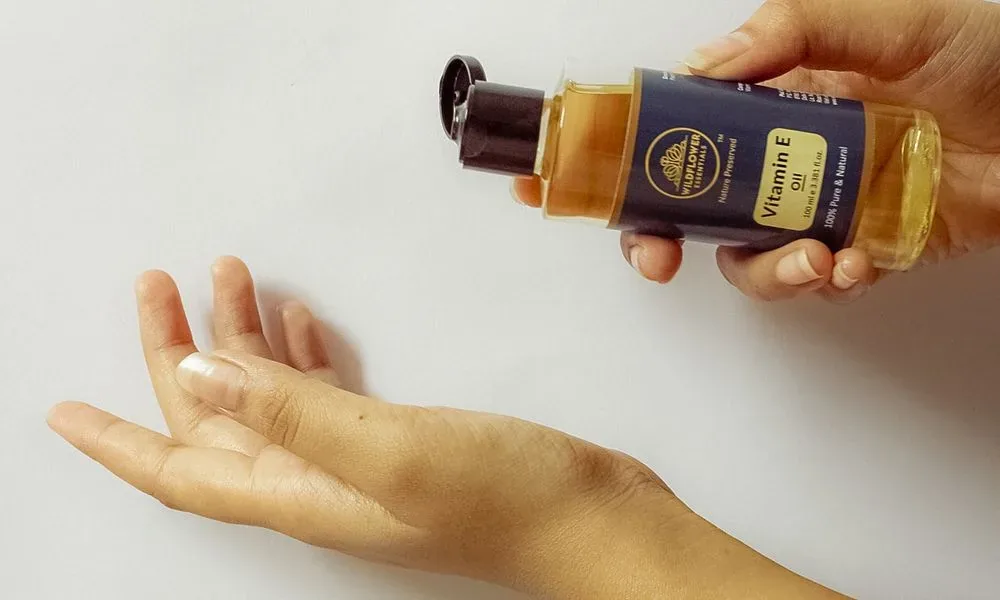
The format matters as much as the dose. Pure vitamin E oil is thick, golden, and sticky; it sits heavily on the skin, is hard to dose, and carries the highest reaction risk. A cream or serum delivers a controlled dose in a base designed to spread and absorb. Our guide to the best vitamin E oils for skin in 2027 explains which format suits which skin type. As a rule, dry skin that tolerates oils can use a few drops of oil; most people will do better with a cream or serum that contains vitamin E as one ingredient among several.
Vitamin E suits the night: it pairs with overnight repair, and its heavy texture stays out of daytime makeup. Apply it after water-based serums and before, or mixed into, your moisturiser. Pair it with vitamin C, which regenerates it, and with sunscreen, which stops the UV that would otherwise deplete it. Patch-test first — vitamin E is a common cause of contact dermatitis — and store the product in a cool, dark place, discarding pure oil once it smells rancid or turns dark.
Your vitamin E checklist
- Choose tocopheryl acetate for stability, or fresh d-alpha-tocopherol at around 1 percent for potency.
- Prefer a cream or serum over pure oil unless your skin is very dry and tolerates oils well.
- Apply one or two drops at night, after water-based serums and before or mixed into moisturiser.
- Always pair it with vitamin C and daily sunscreen — vitamin C regenerates it, sunscreen stops the UV that depletes it.
- Patch-test on the inner arm for twenty-four hours, then the jawline, before full-face use.
- Give it eight to twelve weeks, and replace any oil that smells rancid or has darkened.
Does vitamin E really work for skin?
Yes, within its real job description. It is a proven chain-breaking antioxidant that protects the fats in your membranes and barrier from free-radical damage, translating into less UV damage, a steadier barrier, and softer skin over time. It is not a scar remover or a wrinkle eraser.
Which form of vitamin E is best for skin?
Alpha-tocopherol is the most active and most studied form, and the form your skin naturally contains most of. For everyday use, tocopheryl acetate is the practical choice: it is far more stable on the shelf and your skin converts it into active tocopherol. Tocotrienols look promising in lab studies, but are less studied and more expensive.
Can I use vitamin E oil on my face every day?
Most people can, if the dose is small. One or two drops mixed into moisturiser at night is the safest daily routine. Pure oil used neat every day is more likely to cause breakouts or irritation. If you notice congestion or redness, switch to a cream with a lower dose.
Does vitamin E help with dark spots?
It can help modestly, mainly as part of a combination. Alpha-tocopherol slows tyrosinase in laboratory studies, and vitamins C and E together have improved melasma more than either alone. On its own, vitamin E is a weak brightener compared with vitamin C, niacinamide, or azelaic acid, so treat it as a supporting ingredient, always with sunscreen.
Can I mix vitamin E with vitamin C and retinol?
Vitamin C is vitamin E’s ideal partner: it regenerates oxidised vitamin E and extends its protection, so the pair is better than either alone. Retinol can join the same routine, but sensitive skin should split them across morning and evening, introducing one at a time.
Why does my vitamin E oil feel sticky, and is that normal?
Yes, it is normal. Pure tocopherol is a thick, viscous oil with a saturated tail that resists spreading, so it sits on the surface and feels tacky for an hour or more. Mixing one or two drops into your moisturiser thins it and removes most of the sticky feeling.
The bottom line
Vitamin E works because it does one job, in one place, extraordinarily well: it sits inside the fatty membranes and barrier lipids of your skin and breaks the chain reaction that turns one free radical into widespread lipid damage. That mechanism explains both its real benefits and its limits. It protects what you have; it does not rebuild what is gone.
Buy the mechanism, not the mythology: a stable form at a sensible concentration, paired with vitamin C and sunscreen, used nightly in a small dose, and judged after twelve weeks. Used that way, vitamin E earns its fifty-year reputation — not as a miracle, but as the quiet antioxidant that keeps your routine working.
Note: This article explains the science of vitamin E in skincare for general information, not medical advice. If you have a skin condition or use prescription treatments, check with a dermatologist before changing your routine.