The best catfish bait is the one that suits the fish you are after, the water you are fishing and the way you like to spend your time on the bank. Some anglers swear by live bait, others by cut bait, and others by the strong-smelling prepared baits that catfish are famous for following. This guide answers the central question directly: which bait should you put on the hook, and when should you use it?
There is no single bait that works everywhere. Channel, blue and flathead catfish each have their own habits, and the same bait can behave very differently in a river, a lake or a pond. The ten picks below cover the main types, so you can match your bait to your quarry.
Key takeaways
- Match the bait to the species: live bait suits flatheads, cut bait suits blues, and prepared bait suits channels.
- Fresh bait matters more than fancy bait, and a bait that has turned will put fish off.
- Strong scent helps in murky or moving water, where catfish hunt largely by smell.
- Check local rules before you fish, as some waters restrict live bait or certain species as bait.
How to Choose Catfish Bait
Start with the species you want to catch. Flathead catfish prefer live prey, blue catfish respond well to fresh cut bait, and channel catfish will take a wide range of baits, including prepared dough and dip baits. Knowing your target narrows the choice at once.
Think about the water in front of you. In a fast river, a tough bait that stays on the hook matters most, while in a still lake a softer bait can sit undisturbed. In murky water, scent carries further than sight, so a strong-smelling bait earns its place.
Consider how you like to fish. Live bait needs care and patience, cut bait needs a cool box and a sharp knife, and prepared bait needs only a tub and a hook. The best bait is often the one you can use well.
The 10 Best Catfish Baits in 2027
1. Nightcrawlers
Best for: beginners and channel catfish.
Nightcrawlers are the classic all-round bait, and they have earned their place in almost every angler’s bag. They are easy to find, simple to hook, and they appeal to channel catfish in particular. A whole worm wriggling on the hook is a natural sight in the water.
Their appeal is their simplicity: no preparation, no special rig, and they work in rivers, lakes and ponds alike.
2. Chicken Liver
Best for: anglers after scent-driven bites.
Chicken liver is a soft, strong-smelling bait that catfish find hard to ignore. It releases scent quickly in the water, which makes it useful in murky conditions or when fish are feeding by smell. Many anglers use it with a treble hook or a bait holder to keep it in place.
It suits anglers who do not mind a messy bait, and it has a long record of catching channel catfish from the bank.
3. Cut Shad
Best for: blue catfish.
Cut shad is a staple for blue catfish, and it is one of the most trusted baits in the southern states. A fresh shad cut into steaks or chunks gives off the oily scent that blues follow, and it stays on the hook well in a current.
It suits anglers who fish rivers and large lakes. Keep your shad cool and cut it on the bank.
4. Cut Skipjack Herring
Best for: big blue catfish.
Cut skipjack herring is prized by anglers chasing large blue catfish, and it is often the bait of choice where skipjack are part of the local food chain. The oily flesh gives off a strong scent, and a big chunk on a heavy hook is a serious offering.
It suits anglers who are happy to put in the effort, as skipjack can be hard to find in some areas.
5. Live Bluegill
Best for: flathead catfish.
Live bluegill is the classic flathead bait, and it is hard to improve on. A lively bluegill swimming near the bottom is exactly what a flathead is looking for, and the bait’s movement does much of the work for you.
It suits anglers who fish snags, log jams and deep holes where flatheads hide. Keep the bait lively and give the fish time to take it.
6. Live Shad
Best for: flatheads and blues in open water.
Live shad is a lively, silvery bait that draws attention in open water. It suits anglers who fish from a boat or a long cast, where a swimming bait can cover ground and pull fish in from a distance.
It needs a little care to keep alive, so a bait bucket with fresh water is worth carrying.
7. Prepared Dough Bait
Best for: channel catfish from the bank.
Prepared dough bait is a ready-made option that suits anglers who want a clean, simple session. It comes in a tub, moulds easily onto a treble hook, and gives off a steady scent in the water. Channel catfish take it readily.
It suits bank anglers and families, as there is no cutting and no mess.
8. Dip Bait
Best for: warm-water channel catfish.
Dip bait, often called stink bait, is a thick, strong-smelling paste used with a dip worm or sponge hook. It is designed to release scent in warm water, and channel catfish follow that scent trail with confidence.
It suits anglers who fish in summer, when warm water carries scent well.
9. Punch Bait
Best for: anglers who want a tidy stink bait.
Punch bait is a firmer version of dip bait, and it is pushed onto a treble hook with a stick rather than dipped. It holds its shape better in the water, which makes it easier to cast and less messy to handle.
It suits anglers who like the scent of a stink bait without the fuss, and it works well for channel catfish.
10. Shrimp
Best for: a simple, widely available option.
Shrimp is a simple bait that is easy to buy and easy to use. Raw shrimp on a hook gives off a mild scent, and channel catfish and smaller blues will take it without hesitation. It is a good choice when other baits are hard to find.
It suits anglers who want to keep things straightforward: peel it or leave the shell on, hook it through the tail, and cast it out.
What Fishing for Catfish Feels Like
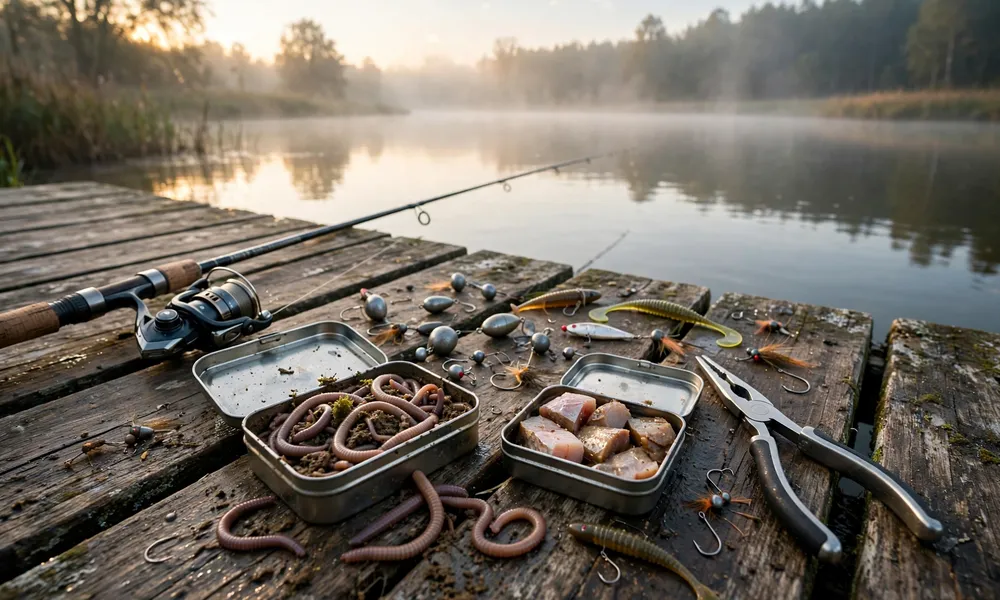
Fishing for catfish is a slow, patient pleasure. You settle on the bank, cast out your bait, and wait. The rod rests in its holder, the line runs out into the water, and the world narrows to the tip of the rod and the sound of the river.
Then the rod tip pulls down, the reel clicks, and everything changes. A catfish fights hard, using its weight and the current against you, and the next few minutes are all focus and steady pressure. It is the moment every catfish angler waits for.
Afterwards comes the quiet satisfaction of a fish well caught and a session well spent, whether you keep your catch or return it to the water.
How the 10 Picks Compare
The table below gives a quick view of the ten picks, showing the type of each bait, the species it suits best and how it is used. Use it to narrow the list, then read the full pick for the detail that matters to you.
| Pick | Type | Best species | How it is used |
|---|---|---|---|
| Nightcrawlers | Live bait | Channel catfish | Hooked whole |
| Chicken liver | Soft bait | Channel catfish | On a treble hook |
| Cut shad | Cut bait | Blue catfish | Cut into chunks |
| Cut skipjack | Cut bait | Blue catfish | Cut into chunks |
| Live bluegill | Live bait | Flathead catfish | Hooked live |
| Live shad | Live bait | Flathead and blue | Hooked live |
| Dough bait | Prepared bait | Channel catfish | Moulded on a hook |
| Dip bait | Prepared bait | Channel catfish | Dipped on a worm |
| Punch bait | Prepared bait | Channel catfish | Pushed on a hook |
| Shrimp | Natural bait | Channel and blue | Hooked through the tail |
What to Check Before You Buy
Check the rules for the water you plan to fish. Some waters restrict live bait, and some restrict the use of certain species as bait. A quick check of local rules before you go will keep your session free of trouble.
Check that your bait is fresh. Fresh cut bait gives off the scent catfish follow, while bait that has turned will put them off. Keep cut bait cool and live bait lively.
Check your tackle matches your bait. A big live bluegill needs a strong hook and a sturdy rod, while a soft dough bait needs a treble hook that holds it in place.
For the rest of your kit, a good cooler keeps bait fresh, as our guide to the best luxury cooler brands shows, and clear sight helps too, as our comparison of polarised and non-polarised sunglasses explains. If you fancy turning a session into a trip, see our guide to the best beach destinations.
Your Catfish Bait Checklist
- Decide which species you are targeting before you choose your bait.
- Buy or catch your bait fresh, and keep it cool until you use it.
- Match your hook to your bait, so soft baits stay put and live baits stay lively.
- Pack a towel and a sealed tub if you use dip bait or punch bait.
- Check local rules on live bait and bait species before you fish.
- Carry a spare tub of prepared bait in case your first choice runs out.
Frequently Asked Questions
What is the best bait for channel catfish?
Channel catfish take a wide range of baits, and nightcrawlers, chicken liver, dough bait and dip bait all work well. Scent matters a great deal, so a fresh, strong-smelling bait is a good starting point.
What is the best bait for flathead catfish?
Flathead catfish prefer live prey, and live bluegill is the classic choice. Live shad also works well, especially in open water. Keep the bait lively and fish it near cover where flatheads hide.
What is the best bait for blue catfish?
Blue catfish respond well to fresh cut bait, and cut shad and cut skipjack herring are the most trusted choices. Freshness matters, so cut your bait on the bank and keep it cool.
Can I use the same bait in a river and a lake?
Yes, most of the baits in this guide work in both. In a river, choose a bait that stays on the hook in a current, while in a lake you can use softer baits that sit undisturbed on the bottom.
Do I need live bait to catch catfish?
No. Live bait suits flatheads best, but channel and blue catfish are often caught on cut bait and prepared bait. Choose the bait that suits the species you are after and the water you are fishing.
The Bottom Line
The best catfish bait for you depends on the species you are after and the water you are fishing. Live bluegill suits flatheads, fresh cut shad suits blues, and a good prepared bait suits channels from the bank. Any of the ten picks above is a sensible starting point.
Keep your bait fresh, match your hook to your bait, and check the local rules before you fish. Do that, and you will spend more time watching the rod tip, which is where the pleasure of catfishing lies.