A tennis necklace earns its sparkle from a continuous line of stones, each one set close to the next so the light runs around the neck without a break. That same design is what makes it need care. Skin oils, perfume, hairspray and everyday dust settle into the tiny gaps between the stones and under the settings, and once they build up, the necklace looks flat no matter how good the stones are. Cleaning it is not complicated, but it is a job where the details matter, because a tennis necklace has dozens of small settings and one clasp that carries the whole piece.
The good news is that most tennis necklaces can be cleaned safely at home with warm water, a drop of mild soap and a soft brush. The mistakes people make are almost always the same ones: reaching for a harsh cleaner, scrubbing hard, using hot water, or cleaning over an open sink. None of those are needed. A gentle soak and a patient brush do more for a tennis necklace than any strong product, and they carry none of the risk.
Below is a nine-step method for diamond, lab-grown and cubic zirconia tennis necklaces in gold, platinum or silver settings, with what to do, what to avoid and how long each step takes.
Key takeaways
- A tennis necklace dulls because oils and dust build up between the stones, not because the stones themselves lose their sparkle.
- Warm water, a drop of mild dish soap and a soft brush are enough for most tennis necklaces — harsh cleaners are not needed and can cause damage.
- Soak for ten minutes, brush gently along the settings, rinse with the plug in, and pat dry rather than rubbing.
- Cleaning is also the best time to check the clasp and each stone, since a loose setting is easiest to spot on a clean necklace.
- Cleaning cannot fix a loose stone, a bent prong or a worn clasp, and a necklace with any of those problems should go to a jeweller, not back into the soak.
What cleaning a tennis necklace actually means
Cleaning a tennis necklace means removing the film that sits on the stones and in the settings, not polishing the metal or changing the stones. The stones themselves, whether diamond, lab-grown diamond or cubic zirconia, are hard and do not wear out from a gentle wash. What changes is the light. When a thin layer of oil and dust coats the top of each stone and fills the gaps beneath it, less light gets in and less comes back out, so the necklace looks grey and quiet instead of bright.
That is why the order matters more than the product. A soak loosens the film, a soft brush lifts it from the settings, a rinse carries it away, and careful drying stops water spots. Each step is simple; together they return the necklace to the way it looked when new.
It also helps to know what cleaning will not do. It will not make a cloudy stone clear, it will not tighten a loose prong, and it will not repair a clasp that no longer clicks shut. Those are jobs for a jeweller, and pretending otherwise is how a necklace gets worse instead of better. If you notice a stone that moves, a prong that looks bent, or a clasp that feels weak while you clean, stop, dry the necklace, and take it in. Our guide to diamond tennis necklaces for women explains how the continuous line of stones is set, which is useful background here, because the settings are exactly where dirt collects and where damage shows first.
What you need and what to look for
You need very little: a small bowl, warm water, a drop of mild dish soap, a soft toothbrush or a soft jewellery brush, a lint-free cloth, and a towel to work over. That is the whole kit. Avoid anything abrasive, anything with bleach or ammonia, and any cleaner that promises a fast shine, because the fast shine usually comes from a chemical that is too strong for the settings or the metal.
Before you start, look at the necklace in good light. Lay it flat on a white cloth and check the clasp first: does it open and close cleanly, and does it click shut? Then look along the line of stones from the side. Are all the stones level, or does one sit lower than its neighbours? Is there a prong that looks bent or a setting that looks open? A quick look now saves you from discovering a problem in the middle of a soak, when a loose stone is much harder to keep track of.
Also check what your necklace is made of. Gold, platinum and sterling silver all tolerate a mild soap soak, but silver tarnishes more easily and needs to be dried thoroughly. Lab-grown stones and cubic zirconia clean the same way as natural diamonds, so the method below works for all of them. If your necklace has pearls, opals or other soft stones set into it, stop here — those need a different method, and a jeweller is the safer choice.
The 9 steps to clean a tennis necklace properly
1. Lay the necklace flat and look at it first
What to do: Lay the necklace flat on a clean white cloth in good light and look at the clasp, the stones and the settings before anything gets wet. What to avoid: Do not skip this step or clean over a sink, where a loose stone would be lost. Best for: Every tennis necklace, every time. Time needed: Two minutes. Standout tip: A white cloth makes a loose or missing stone easy to spot.
2. Gather warm water, mild soap and a soft brush
What to do: Fill a small bowl with warm water, add one drop of mild dish soap, and set out a soft toothbrush and a lint-free cloth. What to avoid: Do not use hot water, bleach, ammonia, toothpaste or baking soda, and do not use a hard brush. Best for: Gold, platinum and silver tennis necklaces with diamond, lab-grown or cubic zirconia stones. Time needed: Two minutes. Standout tip: One drop of soap is enough; more soap means more rinsing.
3. Mix the soak — a few drops, never a harsh cleaner
What to do: Stir the drop of soap into the warm water until it is mixed, then test the water with your hand. What to avoid: Do not pour undiluted soap or any commercial jewellery dip directly onto the necklace. Best for: Necklaces with a visible film of oil or dust. Time needed: One minute. Standout tip: If the water feels slippery, you have used too much soap; start again with less.
4. Soak for ten minutes, no longer
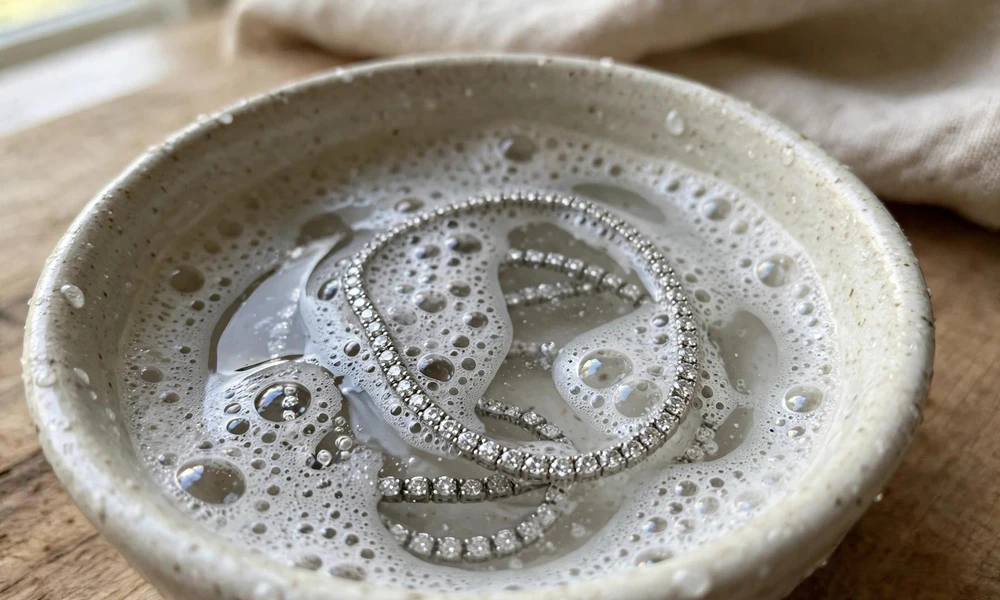
What to do: Lay the necklace in the bowl so it is fully covered, and leave it for ten minutes. What to avoid: Do not leave it soaking for hours or overnight, and do not soak it in anything other than the mild soap water. Best for: Loosening oil, perfume residue and dust from between the stones. Time needed: Ten minutes. Standout tip: Set a timer; ten minutes is enough, and longer does not clean better.
5. Brush gently along the settings, never across them
What to do: Lift the necklace out, hold it over the bowl, and brush gently along the line of stones with the soft brush, following the direction of the settings. What to avoid: Do not scrub hard, do not brush across the prongs, and do not use a brush with stiff bristles. Best for: Clearing dust and oil from the gaps between stones. Time needed: Three to five minutes. Standout tip: Brush along the line, not across it, so the bristles slide between the settings instead of catching on them.
6. Rinse under slow running water with the plug in
What to do: Rinse the necklace under slow, lukewarm running water, with the plug in the sink or a bowl underneath to catch anything that comes loose. What to avoid: Do not rinse over an open drain, and do not use a strong jet of water. Best for: Washing away loosened dirt and soap residue. Time needed: One to two minutes. Standout tip: The plug in the sink is not optional; it is the cheapest insurance a necklace can have.
7. Pat dry, never rub
What to do: Lay the necklace on a lint-free cloth and pat each section dry, then leave it flat on the cloth for ten minutes to air dry fully. What to avoid: Do not rub the necklace with a towel, and do not use a hairdryer or any heat to dry it. Best for: Preventing water spots on the stones and tarnish on silver. Time needed: Two minutes of patting, plus ten minutes of air drying. Standout tip: Water spots form when water is left to dry on the stones, so pat first and let the rest evaporate flat.
8. Check the clasp and each stone while it is clean
What to do: Once dry, lay the necklace flat again and look at the clasp, each stone and each prong in good light. What to avoid: Do not wear the necklace if a stone moves, a prong looks bent, or the clasp does not click shut. Best for: Catching wear before a stone is lost. Time needed: Two minutes. Standout tip: A clean necklace shows problems clearly, which is why this check belongs after the wash, not before it.
9. Store it flat, clasped, away from other jewellery
What to do: Fasten the clasp, lay the necklace flat in its own soft pouch or lined box, and store it away from other jewellery. What to avoid: Do not hang it, do not coil it tightly, and do not toss it into a box with other pieces. Best for: Keeping the necklace clean and tangle-free between wears. Time needed: One minute. Standout tip: A clasped necklace stored flat cannot tangle with itself, which is the most common cause of kinks and bent links.
Which cleaning method is right for you
For most people, the soap-and-water method above is the right one: gentle, suitable for every common tennis necklace material, and free. Clean a daily-worn necklace once a month, and an occasional one after every few wears, or whenever it looks dull in daylight. A tennis bracelet follows the same logic, because it is the same continuous line of stones in a shorter piece, so the routine you learn here works for both.
An ultrasonic cleaner is sometimes suggested as a faster option, and it can work, but only for necklaces that are already in good condition. If any stone is loose, any prong is bent, or the clasp is worn, an ultrasonic cleaner can shake a stone out of its setting. That is why jewellers check a piece before they put it in one. At home, without that check, the gentle soak is the safer choice, and it is not much slower.
A professional clean is worth it once a year, or before an important occasion. A jeweller will check every setting, tighten any loose prong, and clean the necklace with equipment that reaches deeper than a home soak. Think of it as a service, not a replacement for the routine above. The home clean keeps the necklace bright between visits; the professional clean keeps it secure.
The caveats that matter
Cleaning is gentle work, but it has limits. A necklace with a loose stone or a damaged clasp should not be soaked or brushed at home: water and movement make a loose stone looser, and a stone that comes out in a bowl is a repair, while one lost while wearing the necklace is usually gone for good.
| Detail | What is known |
|---|---|
| Best cleaning method | Warm water, one drop of mild dish soap, a soft brush, ten-minute soak |
| How often | Monthly for daily wear; after every few wears for occasional wear |
| Water temperature | Warm, not hot; hot water can loosen glue in some settings |
| What to avoid | Bleach, ammonia, toothpaste, baking soda, hard brushes, ultrasonic cleaners on worn pieces |
| Drying | Pat dry with a lint-free cloth, then air dry flat for ten minutes |
| Clasp check | Open and close it after every clean; a clasp that does not click shut needs a jeweller |
| When to see a jeweller | Loose or moving stones, bent prongs, weak clasp, or a stone that stays dull after cleaning |
| What cleaning does not do | It does not fix loose settings, repair a clasp, or make a cloudy stone clear |
If your necklace is valuable, gem-set, or has stones other than diamond, lab-grown diamond or cubic zirconia, ask a jeweller before cleaning it at home. Soft stones such as pearls, opals and emeralds need different care, and the wrong method can damage them in minutes. That check is free, and it is the sensible step before any cleaning routine.
Checklist: cleaning a tennis necklace honestly
Run through these checks before you start, and again after the necklace is dry.
- Check the clasp and every stone in good light before anything gets wet.
- Use warm water and one drop of mild dish soap — never bleach, ammonia, toothpaste or baking soda.
- Soak for ten minutes, no longer, and set a timer.
- Brush gently along the line of stones, never across the prongs.
- Rinse under slow water with the plug in, and pat dry rather than rubbing.
- Check the clasp and each stone again once dry, and take the necklace to a jeweller if anything moves or looks uneven.
Frequently asked questions
How often should I clean a tennis necklace?
Once a month if you wear it daily, and after every few wears if you wear it occasionally. If it looks dull in daylight, it is due a clean, even if a month has not passed.
Can I use toothpaste or baking soda to clean a tennis necklace?
No. Both are abrasive, and they can scratch the metal and the settings, and dull the surface of the stones over time. Warm water and a drop of mild dish soap clean better and carry none of that risk.
Can I clean a tennis necklace in an ultrasonic cleaner?
Only if the necklace is in good condition, with no loose stones, bent prongs or worn clasp. An ultrasonic cleaner can shake a loose stone out of its setting. If you are unsure, use the gentle soak instead, or ask a jeweller to check the piece first.
What if one stone looks dull after cleaning?
Check whether it is the same stone that looked dull before. A single dull stone can mean dirt trapped under the setting, a stone that has shifted, or a stone that is damaged. If a second gentle clean does not help, take it to a jeweller rather than cleaning it again.
Is it safe to clean a lab-grown tennis necklace the same way?
Yes. Lab-grown diamonds and cubic zirconia clean the same way as natural diamonds, with warm water, mild soap and a soft brush. The method depends on the stones and the metal, not on whether the stones are natural or lab-grown. Gold tennis necklaces are a common example, and the gold setting cleans the same way regardless of the stone.
When should I take my tennis necklace to a jeweller instead?
When a stone moves, a prong looks bent, the clasp does not click shut, or a stone stays dull after cleaning. Also take it in once a year for a professional check, even if nothing looks wrong, because a jeweller can spot wear that is hard to see at home.
The bottom line
Cleaning a tennis necklace is a gentle, unhurried job: warm water, a drop of mild soap, a ten-minute soak, a soft brush along the settings, a careful rinse and a pat dry. Done once a month, that routine keeps the line of stones bright and gives you a regular chance to check the clasp and the settings before a small problem becomes a lost stone.
Do the checks, skip the harsh cleaners, and let a jeweller handle anything loose, bent or worn. A tennis necklace looked after this way stays bright for years, and the cleaning itself becomes the habit that protects it.