Diamond jewellery has a reputation for being kept in a box and saved for special occasions, but the pieces that earn their place in a wardrobe are the ones that get worn every day. A small pair of diamond studs, a slim tennis bracelet, or a fine pendant on a short chain can sit comfortably alongside a work shirt, a weekend jumper, or a simple dress, and still look right at dinner. The trick is choosing diamonds that are made for daily wear, not diamonds that demand a occasion.
Everyday diamond jewellery is defined less by size than by design. The stones are usually small to medium, the settings are secure, and the metal is sturdy enough to take a knock. A bezel or a low prong setting protects the stone. A chain that is too fine will snap, and a ring with a high, exposed setting will catch on everything. The best everyday pieces are the ones you forget you are wearing until someone compliments them.
Below are nine diamond pieces worth considering in 2027, from classic studs to a modern bar pendant. Each one is described by what it does well, what to watch for, and who it suits best, so you can choose a piece that fits your routine, not just a jewellery box.
Key takeaways
- Everyday diamond jewellery works when the setting is secure, the stones are small to medium, and the metal is sturdy enough for daily wear.
- Bezel and low prong settings protect stones best, while high, exposed settings catch on clothing and are easy to knock.
- Lab-grown and natural diamonds look the same to the eye, so choose on budget and preference, and check the grading report either way.
- Wear diamonds daily, but take rings off for the gym, gardening, and heavy cleaning, and clean pieces gently at home between professional checks.
- No diamond is indestructible, and a loose stone, a bent prong, or a cloudy stone that will not brighten should be seen by a jeweller, not fixed at home.
What diamond jewellery for everyday actually is
Everyday diamond jewellery is jewellery designed to be worn, not stored. The stones are usually between 0.1 and 1 carat in total, spread across a piece rather than concentrated in one large, exposed stone. The metal is usually 14k or 18k gold, or platinum for rings that take the most wear. White gold, yellow gold, and rose gold all work, and the choice is mostly about what suits your skin and the other jewellery you already wear.
The setting matters more than the size. A bezel setting wraps metal around the edge of the stone, so there is nothing to catch and very little to bend. A low four-prong setting holds a stone close to the band and keeps it secure without raising it into harm’s way. Pavé settings, where small stones are set in a row along a band or a pendant, look delicate and catch the light beautifully, but each tiny stone needs its setting checked, because a single loose stone can be lost without you noticing.
Comfort is the other test. A pair of studs should sit flat against the ear and not pull. A bracelet should move with your wrist and not slide over your hand. A necklace should sit where you put it in the morning and still be there in the evening.
How we chose these pieces and what to look for
We looked first at wearability. Every piece below is one that can be worn daily without special care beyond the normal routine: secure settings, sensible stone sizes, and metals that cope with everyday knocks. We looked next at versatility, because an everyday piece should work with more than one outfit.
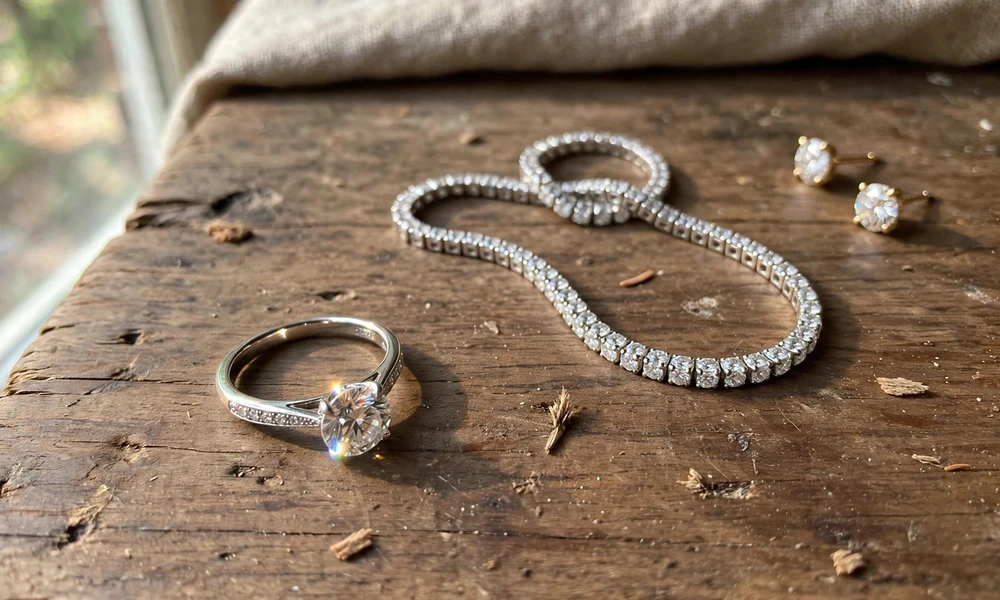
Look at the grading report before you buy, even for small stones. A report from a recognised laboratory tells you the cut, colour, clarity, and carat weight, and it is the simplest way to know what you are paying for. For everyday pieces, cut matters most, because a well-cut stone sparkles even when it is small, while a poorly cut stone can look dull at any size. Colour and clarity matter less at small sizes, which is why a near-colourless stone with a few tiny inclusions can be excellent value in a stud or a pendant. Our guide to cleaning diamond jewellery explains how to keep that sparkle once you own the piece, because even the best-cut stone looks flat under a layer of soap, lotion, and everyday grime.
Finally, look at the clasp, the back, and the chain. A bracelet needs a clasp you can fasten yourself. Studs need backs that stay put. A necklace chain should be strong enough for the pendant it carries, with a little spare strength. These small details are what separate a piece you wear every day from a piece you wear once and put away.
The 9 best diamond jewellery pieces for everyday of 2027
The Classic Diamond Stud Earrings
What we like: The simplest everyday diamond there is. A pair of round brilliant studs in a four-prong or bezel setting suits every face, every outfit, and every occasion, from a work meeting to a wedding. What to consider: Screw backs are more secure than push backs, and very large studs can pull on the earlobe over a long day. Best for: Anyone buying a first diamond piece. Material: 14k white or yellow gold, lab-grown or natural diamonds. Price range: Moderate, rising with total carat weight. Standout feature: A single pair that works with everything you own.
The Slim Diamond Tennis Bracelet
What we like: A line of small, evenly matched diamonds on a flexible bracelet that moves with the wrist and catches the light with every gesture. What to consider: The clasp must be secure, ideally with a safety catch, and the bracelet should fit closely so it does not slide over the hand. Best for: Dressing up a simple outfit without a statement piece. Material: 14k or 18k gold, round brilliant diamonds. Price range: Moderate to high, depending on total carat weight. Standout feature: Continuous sparkle from every angle.
The Delicate Diamond Pendant Necklace
What we like: A single diamond on a fine chain, worn at the collarbone, that adds a point of light to any neckline. It layers well with longer chains and sits comfortably under a shirt collar. What to consider: The chain should be sturdy for its fineness, and a pendant that is too heavy for its chain will wear the links thin. Best for: Everyday necklines, from crew necks to V-necks. Material: 14k gold chain, solitaire diamond in a bezel or prong setting. Price range: Moderate. Standout feature: One stone, worn close to the skin, that goes with everything.
The Diamond Eternity Band
What we like: A band of small diamonds set all the way around, so the ring sparkles from every angle and never needs turning to look right. What to consider: A full eternity band cannot be resized easily, so the size must be right from the start, and the stones on the underside take the most wear. Best for: A wedding band, an anniversary ring, or a right-hand ring worn daily. Material: 14k or 18k gold, or platinum, with pavé or shared-prong diamonds. Price range: Moderate to high. Standout feature: Sparkle from every angle, with no front or back.
The Minimal Diamond Solitaire Ring
What we like: A single diamond on a slim band, low-set and secure, that reads as quiet luxury rather than a statement. It works alone or stacked with a plain band. What to consider: A very slim band can bend over time, so choose a band with enough metal to hold its shape, and keep the setting low. Best for: A daily ring that does not interfere with work. Material: 14k or 18k gold, or platinum, with a round or oval diamond. Price range: Moderate, rising with the centre stone. Standout feature: One stone, one band, nothing to catch or snag.
The Diamond Huggie Hoop Earrings
What we like: Small hoops that hug the earlobe, set with a row of tiny diamonds, giving the sparkle of a hoop with the security of a stud. What to consider: The hinge and clasp must close firmly, and the hoops should be light enough not to pull. Best for: Anyone who likes hoops but wants something secure for all-day wear. Material: 14k gold, pavé diamonds. Price range: Moderate. Standout feature: Hoop sparkle that stays close to the ear.
The Diamond Station Chain Necklace
What we like: A fine chain with small diamonds set at intervals along its length, so the sparkle is spread evenly and the necklace looks good from any angle. What to consider: Each station is a setting to check, and the chain should be strong enough to carry the stones without stretching. Best for: Layering, or wearing alone with a simple top. Material: 14k gold, bezel-set diamonds. Price range: Moderate. Standout feature: Diamonds spaced along the whole chain, not just at the centre.
The Diamond Bar Pendant
What we like: A short horizontal bar set with a row of small diamonds, on a fine chain, with a clean modern line that suits both work and evening. What to consider: The bar should sit flat and not flip, so look for a pendant with a well-placed bail and a chain that matches its weight. Best for: A modern, minimal everyday necklace. Material: 14k gold, pavé diamonds. Price range: Moderate. Standout feature: A straight, modern line of sparkle at the collarbone.
The Diamond Signet Ring
What we like: A signet with a small diamond set into its face, combining the weight and presence of a signet with a single point of sparkle. What to consider: The face should be smooth and comfortable, and the diamond should be set low so it does not catch. Best for: A statement daily ring with a personal, heirloom feel. Material: 14k gold, single diamond in a bezel setting. Price range: Moderate. Standout feature: A classic signet shape with a diamond at its centre.
Which diamond jewellery is right for you
Start with how you spend your day. If you work at a keyboard, a low-set ring and a bracelet that sits close to the wrist will bother you least. If you are on your feet and moving, earrings and necklaces take no knocks at all, and a pendant or a pair of studs is the easiest place to start. If you already wear a watch, a slim tennis bracelet pairs with it naturally, while a chunky bangle would fight it.
Next, think about the metal you already wear. Diamond jewellery in yellow gold warms the skin and pairs with gold chains and rings you own. White gold and platinum read cooler and sit well alongside silver and white metal pieces. Rose gold is softer and suits warm skin tones. There is no rule that says you must match, but an everyday piece earns its place faster when it sits comfortably with what you already reach for. If your other everyday jewellery is gold, our guide to cleaning gold jewellery is worth a read, because gold and diamond pieces are usually cleaned together and the same gentle routine suits both.
Finally, buy the best cut you can afford and be flexible on size. A small, well-cut diamond outshines a larger, poorly cut one, and at everyday sizes the difference is visible. A lab-grown diamond gives you a larger or better-cut stone for the same money.
The caveats that matter
Diamonds are hard, but they are not unbreakable. A sharp knock on a hard edge can chip a stone, and a diamond can scratch other diamonds, which is why pieces should be stored separately rather than jumbled in a box together. Gold, meanwhile, is soft. A thin band will bend, a fine chain will stretch, and a prong will wear down over years of daily wear. That is normal, and it is why a yearly check by a jeweller matters more than any cleaning routine.
| Detail | What is known |
|---|---|
| Best everyday settings | Bezel and low prong settings protect stones and rarely catch |
| Stone size for daily wear | Small to medium stones, usually 0.1 to 1 carat in total per piece |
| Most important quality | Cut, because a well-cut stone sparkles even when it is small |
| Lab-grown vs natural | Identical to the eye; choose on budget and preference |
| When to take rings off | For the gym, gardening, heavy cleaning, and contact sport |
| Home cleaning | Warm water, mild soap, and a soft brush; dry thoroughly |
| What to avoid | Harsh chemicals, ultrasonic cleaners on fragile settings, and storing pieces loose together |
| When to see a jeweller | Yearly, or sooner if a stone moves, a prong bends, or a clasp loosens |
If a stone feels loose, stop wearing the piece until it is checked. A loose stone is usually a quick repair, but a lost stone is not. The same applies to a clasp that no longer clicks firmly or a chain that has a thin, stretched link. Small problems are cheap when they are caught early, and expensive when they are ignored.
Checklist: choosing diamond jewellery for everyday honestly
Use these checks before you buy, and again after a month of wear.
- Check the setting: bezel or low prongs, with no sharp edges and nothing that catches on fabric.
- Check the grading report: cut first, then colour and clarity, from a recognised laboratory.
- Check the clasp and backs: fasten the bracelet yourself, and make sure stud backs stay put.
- Check the fit: a bracelet that slides over your hand is too loose, and a ring that spins is too big.
- Check the weight: if a piece feels heavy after an hour, it will not be an everyday piece.
- Check the care: know how to clean it gently at home, and book a jeweller’s check once a year.
Frequently asked questions
Can I wear diamond jewellery every day?
Yes, if the piece is made for it. Secure settings, modest stone sizes, and sturdy metal are what make a diamond piece wearable daily. Take rings off for the gym, gardening, and heavy cleaning, and have settings checked once a year.
Are lab-grown diamonds a good choice for everyday jewellery?
Yes. Lab-grown diamonds are real diamonds with the same hardness and sparkle, usually at a lower price, which means a better cut or a larger stone for the same money. They are a sensible choice for a piece you will wear every day.
How do I clean diamond jewellery at home?
Soak it briefly in warm water with a drop of mild soap, brush gently with a soft toothbrush, rinse, and dry with a lint-free cloth. Avoid harsh chemicals and bleach, and do not use an ultrasonic cleaner on pavé or fragile settings.
Will a diamond ring scratch?
A diamond is very hard to scratch, but it can chip if knocked sharply on a hard edge, and it can scratch other diamonds and gemstones. Store diamond pieces separately, and take rings off for heavy work.
Is gold or platinum better for everyday diamond jewellery?
Both work. Platinum is heavier and more durable, and it holds stones very securely, but it costs more. Fourteen-karat gold is sturdy, lighter, and easier on the budget. Choose the metal that suits your skin and your other jewellery, and if you want more everyday gold ideas, our guide to the best gold jewellery for everyday covers pieces that pair naturally with diamonds.
How often should a jeweller check my diamond jewellery?
Once a year is enough for most everyday pieces, sooner if you notice a loose stone, a bent prong, a clasp that does not click, or a chain link that looks thin. A check is quick, and it usually includes a professional clean.
The bottom line
The best diamond jewellery for everyday is not the biggest or the most expensive. It is the piece with a secure setting, a well-cut stone, and a design you can wear without thinking about it. A pair of studs, a slim tennis bracelet, or a fine pendant will do more for your wardrobe than a large piece that stays in a box, because the pieces you wear are the pieces that earn their value.
Choose one piece, wear it for a month, and see how it fits your routine before you buy the next. Check the setting, clean it gently, and have it looked at once a year. That is the honest way to own diamond jewellery you actually wear, every day, for years.