A silk robe can make a man look either completely at ease or completely undone, and the difference has almost nothing to do with how much it cost. The robe is simple — a wrap front, a belt, a collar — but silk shows everything: a belt tied too high, a hem ending in the wrong place, a chest left open too far.
Most men get a silk robe wrong in the same three ways. They buy the wrong size, because robes are sold in broad sizes and one-size wraps. They tie the belt like a hotel dressing gown. And they throw the robe on over anything — or nothing — without considering where they are going in it.
This guide covers the practical side only: fit, the belt, what to wear underneath and over it, and which occasions suit a silk robe and which do not. If you are still choosing one, the best luxury silk robes for men list covers the buying side. If you wonder whether silk is worth the price, why silk robes are worth it makes the case.
Key takeaways
- Fit comes first: shoulders on the shoulder, sleeves at the wrist, hem at the knee for most men.
- The belt sits at your natural waist, tied in a double knot, ends hanging evenly.
- Wear silk over a plain base layer, and nothing heavier than light loungewear on top.
- Mornings and evenings at home are the robe’s natural home; it stops working when guests, deliveries or video calls appear.
- Not confirmed: no single length or colour suits every man.
What wearing a silk robe well actually means
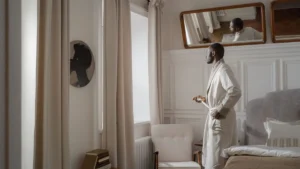
Wearing a silk robe well is mostly about restraint. Silk has a sheen, a drape and a reputation, and it does a lot of the talking on its own. Your job is to keep everything else quiet: a clean fit, a tidy belt, a plain layer underneath, and nothing competing for attention.
Think of the robe as loungewear with standards — not a coat, and not pyjamas. A coat is built to be seen by the world; pyjamas are built to be slept in. A silk robe sits between the two, and it works when it looks deliberate: put on properly, tied properly, worn in the right room at the right hour. Silk also behaves differently from cotton or terry. It slides, catches the light and shows every tug, so fit matters more, not less.
Getting the fit right
Start with the shoulders. The seam should sit on the point of your shoulder, where a shirt seam sits — not drooping down the arm, and not pulling towards the neck. A small drop is fine, as many silk robes are cut that way for a relaxed look, but if the sleeve is falling off the shoulder the robe is too big.

Next, the sleeves: they should end at your wrist bone when your arms hang naturally. Sleeves stopping halfway down the forearm look as if the robe shrank; sleeves covering your hands look as if you are wearing someone else’s clothes. Most men’s silk robes come in proper sizes, small through to 3XL, so take your usual shirt size as the starting point and size up only if you are between sizes and prefer a looser drape.
Then the length. For most men, the knee is the right hemline: easy to sit in, easy to walk in, and it reads as a robe rather than a gown. A calf-length robe can look superb on a taller man, and a full-length robe suits a formal evening look, but both are harder to wear — they catch on chair legs, drag on stairs and demand a cleaner belt tie.
Finally, the chest. With the belt tied, the wrap should overlap by a good hand’s width. If the robe gapes when you sit, the wrap is too shallow or the belt too loose — pull the inner tie, if your robe has one, and re-tie the belt a touch higher. The guide on how to choose a bathrobe covers lengths and cuts from the buying side.
The belt: how to tie it so it stays put
The belt is where most silk robes fail, and it is almost always technique, not the robe. Silk is smooth, so a loosely tied belt slips, and a belt tied in a bow comes undone the moment you sit down.
First, the height: the belt goes around your natural waist — the narrowest point of your torso, roughly at navel level — not around your hips. A belt at the hips lets the robe hang open at the chest and drag at the hem; a belt at the natural waist holds the wrap closed and gives the robe its shape. Thread it through the loops if your robe has them, and make both ends hang to the same length before you tie.
Second, the knot. Cross the ends, pull one under and through, then tie a single simple knot — the first step of tying a shoelace — and pull it snug. Then tie a second simple knot on top, leaving the ends hanging flat, about a hand’s length each. That double knot holds against silk’s slipperiness without looking fussy, and it beats a bow every time.
What to wear underneath — and what to wear over it
Underneath, keep it plain and light. A plain white or black T-shirt with pyjama bottoms or lightweight lounge trousers is the standard combination, and it works because nothing underneath competes with the silk. What does not work is a patterned shirt, a collar, or anything with a logo: the robe is the statement, and a busy layer underneath turns the outfit into a clash.
Wearing nothing underneath is a private choice at home, but the moment anyone else is in the house, a base layer is the courteous choice. It also protects the silk from skin oils and sweat, which shortens the life of the fabric. Silk is delicate, and a thin layer between skin and silk is the simplest way to keep a robe looking new.
Over the top, the rule is simple: a silk robe is an indoor garment and does not layer under a coat or over a suit. In cool weather, the only thing that belongs over it is more loungewear. If you are cold, choose a heavier silk weight instead of an extra layer: a 22 momme robe, the heavier end of the usual range, is noticeably warmer than a 19 momme one and drapes better too. On your feet, keep it simple — bare feet at home, or plain leather or suede slippers. Trainers or heavy soles break the line of the robe.
Morning, evening and lounging: matching the robe to the moment
Mornings are the silk robe’s natural home. The classic routine — out of bed, robe on, coffee, newspaper, shower — works because the robe is the first thing on and the last thing off before dressing. In the morning, a lighter robe in a pale colour reads well: cream, dove grey or navy, belt tied, plain T-shirt underneath.
Evenings are the robe’s second home, and the mood is different. An evening robe is a wind-down garment, worn after the day’s clothes come off, and it suits a darker colour and a heavier silk: deep navy, charcoal or burgundy, in 22 momme if you have the choice. The rule is the same — belt tied, base layer on, slippers on — but the pace is slower, and the robe can be a touch longer.
Lounging — an afternoon reading, a long weekend at home — is where the robe is most forgiving, and also where it is easiest to get sloppy. The test is simple: if you would be comfortable answering the door in what you are wearing, the robe is being worn properly; if you would need to rush upstairs and change, it is not. A silk robe is not for the doorstep, the garden, a video call, or the hotel corridor.
The mistakes that make a silk robe look wrong
Most silk robe mistakes are small, and most are visible from across the room. The table below lists the common ones, why they happen, and the fix.
| Mistake | Why it happens | The fix |
|---|---|---|
| Belt tied at the hips | It feels natural, like trousers | Move it to your natural waist |
| Belt in a bow | It looks neat when first tied | Use a double simple knot |
| Robe gaping at the chest | Wrap too shallow or belt too loose | Use the inner tie and overlap the wrap by a hand’s width |
| One-size robe | Bought quickly, without checking sizes | Buy a sized robe |
| Wearing it outside | It feels comfortable enough to step out in | Keep it indoors |
| Busy layer underneath | Grabbing whatever is clean | Plain T-shirt or vest only |
| Sleeves too long or too short | Wrong size, or a robe cut for someone else | Sleeves should end at the wrist bone |
| Ignoring the belt loops | They seem optional | Thread it through the loops |
Checklist: before you step out of the bedroom
- Shoulders: the seam sits on the point of your shoulder, not drooping down the arm.
- Belt: at your natural waist, double-knotted, ends hanging evenly and about a hand long.
- Chest: the wrap overlaps by a hand’s width, with no gap when you sit down.
- Length: the hem ends at the knee, or at the calf if you are tall and sitting still.
- Underneath: a plain T-shirt or vest and lounge trousers, nothing patterned or logoed.
- Feet and extras: plain slippers or bare feet, watch only, and nothing that can snag the silk.
Frequently asked questions
How long should a silk robe be on a man?
Knee length suits most men: easy to sit and walk in, and it reads as a robe rather than a gown. Calf length can look superb on a taller man, especially in the evening, and full length suits a formal look.
Should a silk robe be worn over clothes or nothing?
Over a plain base layer — a T-shirt or vest and lounge trousers — is the standard, and the courteous choice whenever anyone else is in the house. Wearing nothing underneath is a private choice at home.
How do you stop a silk robe belt from coming undone?
Tie a double simple knot rather than a bow, thread the belt through the loops, and tie it at your natural waist rather than your hips.
Can you wear a silk robe outside the house?
No, not as outdoor clothing. A silk robe is an indoor garment, and its boundary is the front door. The exceptions are a spa, where a robe is the expected dress, or a private terrace.
What colour silk robe should a man choose?
Navy is the safest first choice: it suits most skin tones, hides marks, and works morning and evening. Charcoal and deep burgundy are good second choices, and cream or dove grey suit mornings and warm weather.
How do you wash a silk robe without ruining it?
Check the label first: washable silk can go in the machine on a cold, gentle cycle in a laundry bag, while other silk needs a cool hand wash or dry cleaning.
The bottom line
A silk robe worn well is a quiet thing: shoulders in the right place, sleeves at the wrist, a hem at the knee, a belt tied in a double knot at the natural waist, and a plain layer underneath. None of that is difficult, and none of it costs anything — a set of habits, learned once and repeated every morning.
The rest is knowing where the robe belongs. It belongs in the morning and the evening, in the bedroom and the living room, and nowhere else. Kept behind your own front door, it becomes what it is meant to be: the easiest luxury a man can own.
Note: fit and care guidance here is general; check your robe’s own label for its composition, momme weight and washing instructions before you follow any care advice.
Meet our experts
BrassSmile’s style editors cover men’s loungewear and luxury fabrics.
Why trust BrassSmile
We write from the maker’s own listings and published specifications, and flag what we have not verified.
Sources
Maker listings from Derek Rose, Lunya and LilySilk; standard silk care guidance from textile care publications.