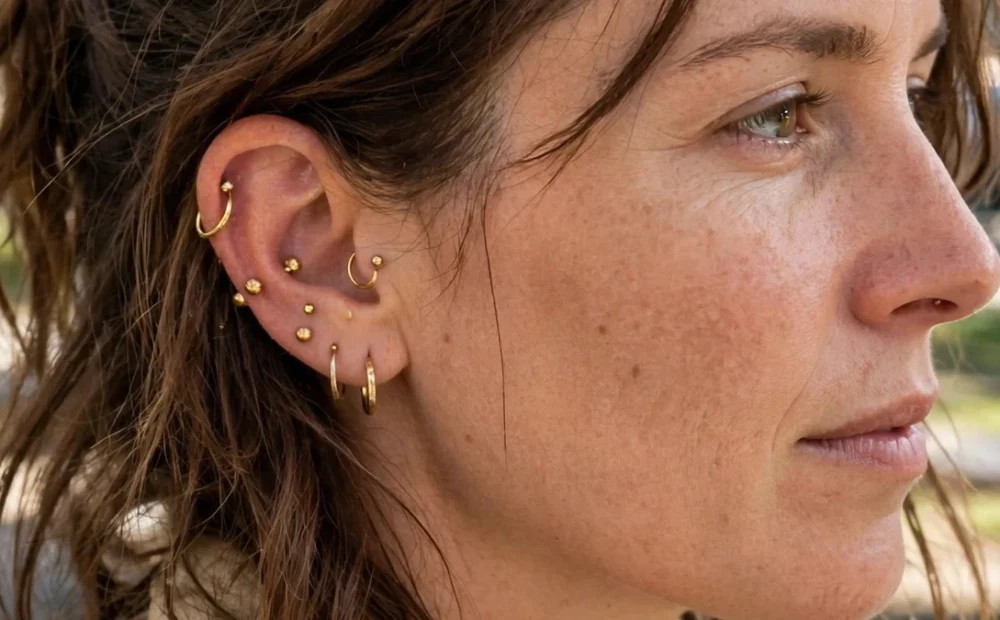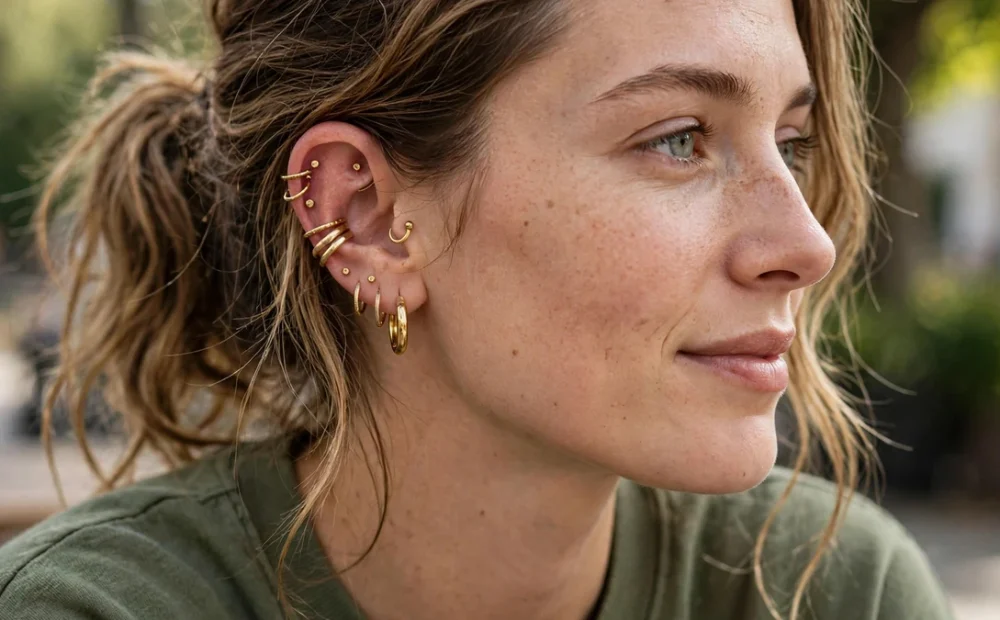

A climber earring is the piece of jewellery that makes people ask whether you have had five new piercings. It has not. A climber, also called an ear crawler, is a single earring that starts at an ordinary lobe piercing and curves upward along the edge of the ear, usually set with a graduated line of stones, beads or a slim bar of metal. From the front it reads as a row of separate studs climbing the ear. From the side you can see the trick: one post, one curve, one earring doing the work of several.
Climbers became a fixture of everyday jewellery in the 2010s, when ear cuffs and stacked piercings made the ear itself a place to style, and they have stayed because they solve a real problem. They give the layered, pierced look without new holes, without healing time, and without the commitment of cartilage jewellery. They suit short hair, updos and tucked-back hair, and they work in gold, silver, rose gold, crystal, pearl and coloured stones, so the same shape can look minimal at lunch and dramatic at dinner.
This guide explains what a climber earring is, how the shape works, how to choose one that fits your ear, and what to watch for before you buy. It covers the nine facts that matter most, so you can tell a good climber from a pretty one that slides, pinches or falls out by midday.
Key takeaways
- A climber earring is a curved piece that runs up the ear from a single lobe piercing, creating the look of several piercings with one earring.
- Most climbers need only a standard lobe piercing; cartilage climbers are a separate style and need a healed helix piercing.
- They come in plain metal, pavé crystal, pearl and gemstone versions, in gold, silver and rose gold, from under $25 to over $300.
- Fit matters more than size: a climber that is too long slides down the ear, and one that is too short pinches and sits crooked.
- Climbers are not ideal for fresh piercings, very heavy designs, or nickel-sensitive ears, and a cheap backing is the most common reason they fall out.
What a climber earring actually is
A climber earring is a curved bar or chain of settings that follows the outer curve of the ear. The post sits in the lobe piercing at the bottom, like a stud. From there the piece sweeps upward, hugging the ear, with stones or beads that usually get smaller as they rise. The largest stone sits at the lobe and the smallest near the top of the curve. That graduation is what makes the design look deliberate, and it is the first detail to check when comparing climbers.
The shape is sometimes called an ear crawler, and the two names describe the same piece. Early versions were simple gold or silver bars, but the style took off when designers set the curve with pavé crystals, so the whole line sparkled like a row of tiny studs. Since then the range has widened: plain polished metal for a quiet look, pearl for weddings, gemstones in emerald, sapphire and ruby tones, and two-tone pieces mixing gold and silver.
What a climber is not is an ear cuff. A cuff clips onto the cartilage and needs no piercing at all, while a climber is anchored by a post through the lobe. That anchor is both the strength and the weakness of the design. It keeps the piece secure, but it also means the fit depends on the shape of your ear. Two people can find the same climber sits perfectly on one ear and tilts on the other, so easy returns matter more for climbers than for ordinary studs.
How to choose a climber earring
Start with length. Measure the curve of your ear from the lobe piercing upward, or hold a piece of thread along it, and compare that length with the climber you are considering. Most climbers are 15 to 30 millimetres long. A shorter one suits a smaller ear and a subtle look; a longer one makes a bolder line and needs a taller ear. If it is longer than your ear’s curve, the top will stick out, and no backing will fix that.
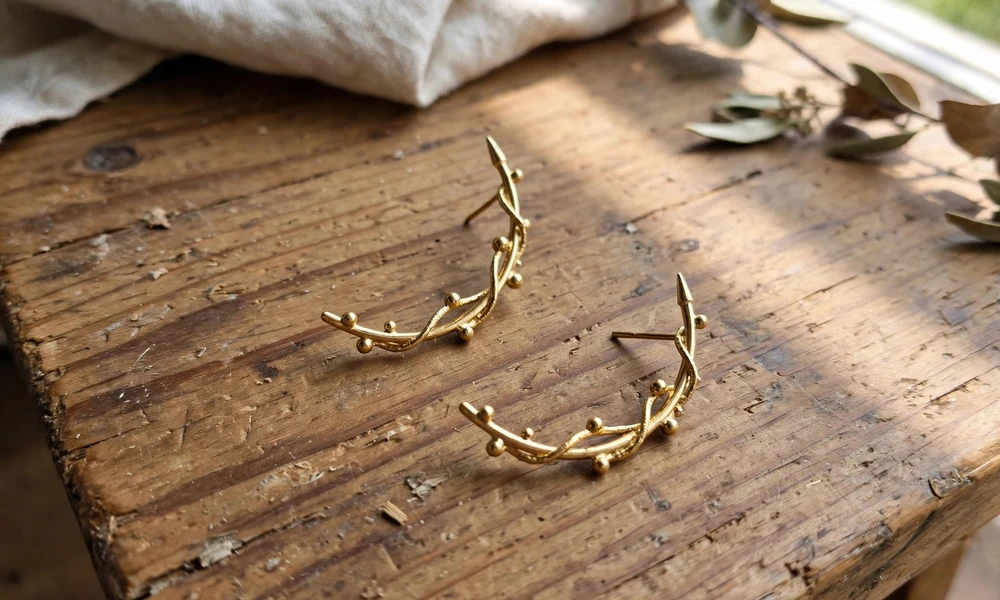
Look next at the metal and the stones. Solid gold and gold vermeil are the usual choices for everyday wear, sterling silver suits cooler tones, and rose gold sits between the two. Pavé crystals catch the light best in the evening, while plain polished metal reads as modern and quiet by day. If your skin reacts to nickel, check the metal composition before you buy, and prefer solid gold, titanium or clearly labelled hypoallergenic pieces over plated mystery metal. Our guide to the best climber earrings of 2027 compares nine styles across these materials, so you can see how the same shape changes with metal, stones and price.
Finally, look at the backing. A climber puts more leverage on the post than a stud does, because the weight sits above the piercing rather than in it. A flat disc backing, sometimes called a jumbo back, spreads that pressure and holds the piece upright far better than a small butterfly clutch. Some climbers come with a screw back, the most secure option for an expensive pair. Test any backing at home for an hour first, and check the post is straight: a bent post is the most common reason a climber leans.
9 facts about climber earrings worth knowing
A climber creates the look of several piercings from one hole
What It Shows: The whole point of the design is the illusion. One post in the lobe, one curved line of stones, and the eye reads four or five separate studs climbing the ear.
What to Consider: It is the cheapest and least painful way to try the layered-ear look, and it comes off at the end of the day. Best For: anyone curious about stacked piercings. Material: gold vermeil, sterling silver or solid gold. Price Range: $25 to $180. Standout Feature: a graduated line of stones that reads as several studs.
Most climbers sit on the lobe, not the cartilage
What It Shows: A standard climber is designed for the lobe. The post goes through the lobe piercing and the curve follows the outer edge of the ear.
What to Consider: Do not force a lobe climber onto cartilage. It will not sit flat, and it can irritate a piercing that is not fully healed. Best For: standard lobe piercings. Material: gold, silver or rose gold. Price Range: $25 to $200. Standout Feature: a curve shaped for the lobe, not the upper ear.
The curve should follow your ear, not fight it
What It Shows: Ears differ more than people expect. Some curve gently, some curve sharply, and a climber made for one shape will sit crooked on the other.
What to Consider: If a climber gaps away from your ear at the top, it is the wrong length or the wrong curve for you, and a different pair will fit better than forcing this one. Best For: ears of all shapes, once the length matches. Material: flexible gold or silver bar. Price Range: $30 to $220. Standout Feature: a gentle curve that hugs the ear.
Stones usually graduate from large at the bottom to small at the top
What It Shows: Look at any well-made climber and you will see the pattern: the biggest stone sits at the lobe, and each stone above it is slightly smaller, until the line tapers to a single small stone or a plain metal tip.
What to Consider: A climber with stones all the same size can look blocky and tends to tip forward, because the weight is not distributed along the curve. Best For: a balanced, deliberate look. Material: pavé crystal, cubic zirconia or gemstone. Price Range: $35 to $300. Standout Feature: graduated stones that taper toward the top.
Climbers come in left and right versions, so check before you buy a pair
What It Shows: A climber is not symmetrical. The curve is shaped for one ear, and a left climber worn on the right ear will point the wrong way and sit badly. Good sellers label each earring left and right, or sell them as a matched pair.
What to Consider: Before you order, check the listing says left and right, and when the pair arrives, hold each earring against its ear before you put it on. Best For: anyone buying a pair rather than a single. Material: any. Price Range: $25 to $250. Standout Feature: a matched left and right curve.
A flat disc backing holds a climber steadier than a butterfly clutch
What It Shows: Because a climber’s weight sits above the piercing, it pulls forward and down. A small butterfly clutch gives the post almost nothing to brace against, so the climber leans.
What to Consider: If your climbers came with butterfly backs, replacement disc backs are inexpensive and fit most standard posts, and they are the single easiest upgrade you can make. Best For: all-day wear. Material: gold or silicone disc backs. Price Range: $5 to $20 for backs alone. Standout Feature: a wide, flat back that stops leaning.
Lightweight climbers stay comfortable far longer than heavy ones
What It Shows: A climber that feels fine for ten minutes can ache after three hours, because the weight hangs from one small piercing. The most comfortable climbers are hollow-backed or made from a thin bar, and they rarely weigh more than a gram or two per earring.
What to Consider: If your lobes are stretched or tender from years of heavy earrings, choose the lightest climber you like and wear it for shorter stretches. Best For: sensitive or stretched lobes. Material: hollow gold, titanium or thin silver. Price Range: $30 to $200. Standout Feature: a hollow or slim bar that keeps weight down.
Climbers work best with short hair, updos and hair tucked behind the ear
What It Shows: A climber is a detail earring, and it needs to be seen. Long hair worn loose covers it completely, which wastes the design.
What to Consider: That does not mean you cannot wear climbers with long hair. Just expect them to appear when you move, and choose a brighter stone if you want them noticed. Best For: updos, bobs and tucked-back hair. Material: crystal or polished metal. Price Range: $25 to $180. Standout Feature: a bright line that shows against the ear.
You can stack a climber with a stud in a second piercing
What It Shows: If you have a second lobe piercing, a tiny stud above the climber extends the line and makes the whole ear look intentionally styled.
What to Consider: Avoid stacking a climber with a hoop or a large drop in the same ear. Two statement pieces in one ear look crowded, and the weight adds up quickly. Best For: second piercings and stacked looks. Material: matching gold or silver. Price Range: $15 to $120 for the stud. Standout Feature: a small stud that extends the line.
How climber earrings compare with other styles
Against a stud, a climber is simply more visible: a stud is one point of light, a climber is a line of it, which is why climbers suit evenings when a stud feels too quiet. Against a hoop, a climber is more secure and less likely to catch on hair or clothing, because nothing dangles or swings. Against an ear cuff, a climber is more stable, because it is anchored by a post, but it needs a piercing, which a cuff does not.
The closest relative is the huggie hoop, which circles the lobe while a climber travels up the ear, so the two read very differently. For everyday wear, the practical choice is a short, lightweight climber in plain metal, which gives the layered look without the weight or the sparkle of a pavé piece. Our roundup of the best earrings for everyday wear includes climbers alongside studs and huggies, so you can compare how each style behaves across a full day.
Price is the other difference worth noting. A good climber costs more than a good stud, because the setting work is more complex, but less than a pair of statement drops, because there is less metal and fewer stones. Expect $25 to $60 for a well-made fashion climber, $60 to $150 for gold vermeil or sterling silver with good stones, and $150 to $300 or more for solid gold or genuine gemstones. Below $15, the curve is often stamped, the stones glued rather than set, and the backing is usually the first thing to fail.
The caveats that matter
Climbers are easy to wear, but they have real limits. They should not go into a fresh piercing, because the curved bar moves more than a stud and can slow healing. They should not be slept in, because the curve presses into the ear and can bend. Clean them gently with a soft cloth and lukewarm soapy water, as described in our guide to how to clean hoop earrings, and dry them before storing.
| Detail | What is known |
|---|---|
| What it is | A curved earring that runs up the ear from one lobe piercing |
| Piercing needed | A standard healed lobe piercing for most styles; a healed helix for cartilage climbers |
| Typical length | 15 to 30 millimetres, measured along the curve of the ear |
| Best backing | A flat disc back, 6 to 8 millimetres across, holds the piece upright |
| Who should avoid them | Fresh piercings, very sensitive lobes, and anyone allergic to nickel in plated metal |
| Weight | Lightest climbers weigh a gram or two; heavy gemstone pairs suit evenings only |
| Cleaning | Soft cloth and lukewarm soapy water; dry before storing |
| What it does not do | It does not replace a real stacked piercing, and it will not fit every ear shape |
If your ear is red, sore or swollen after wearing climbers, take them out and let the piercing rest. A reaction is usually the metal, not the shape, so try solid gold or titanium before giving up on the style. If a climber keeps falling out despite a disc backing, a jeweller can fit a thicker post or a screw back for a small fee.
Checklist: buying a climber earring honestly
- Check the length: measure your ear’s curve and compare it with the climber’s stated length.
- Check left and right: the listing should say the pair includes a left and a right earring.
- Check the backing: prefer a flat disc back or a screw back over a small butterfly clutch.
- Check the metal: solid gold, titanium or clearly labelled hypoallergenic if your skin reacts.
- Check the weight: hold the pair in your palm; if it feels heavy now, it will ache by evening.
- Check the return policy: buy from a seller that accepts returns, because fit depends on your ear.
Frequently asked questions
Do climber earrings need more than one piercing?
No. A standard climber needs only one healed lobe piercing; the curve creates the look of several, anchored by a single post.
Are climber earrings comfortable to wear all day?
Lightweight climbers usually are, especially with a flat disc backing. Heavy gemstone pairs can ache after a few hours, so save those for evenings.
Can I wear climber earrings with long hair?
Yes, but the design mostly shows when you move or tuck your hair back. Short hair, updos and ponytails show the full curve best.
Do climber earrings fall out easily?
They can, if the backing is a small butterfly clutch. A flat disc back or a screw back holds them far more securely.
Are climber earrings suitable for sensitive ears?
Often yes, if the metal is right. Choose solid gold, titanium or clearly labelled hypoallergenic pieces, and avoid plated metal if your skin reacts to nickel.
Can men wear climber earrings?
Yes. Climbers are unisex, and plain metal climbers in gold or silver are the most commonly worn styles.
The bottom line
A climber earring is a clever, low-commitment way to get the layered-ear look. The best climbers are the ones that fit your ear: the right length, a gentle curve, a secure disc backing, and a weight you forget you are wearing.
Choose a short, lightweight pair in a metal that suits your skin, and test it at home for an hour. If it does, you have a piece that works from a weekday lunch to a wedding. If it does not, the ear, not the earring, is telling you to try a different length.