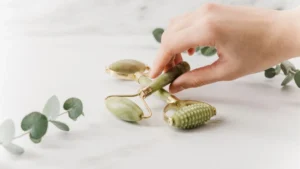
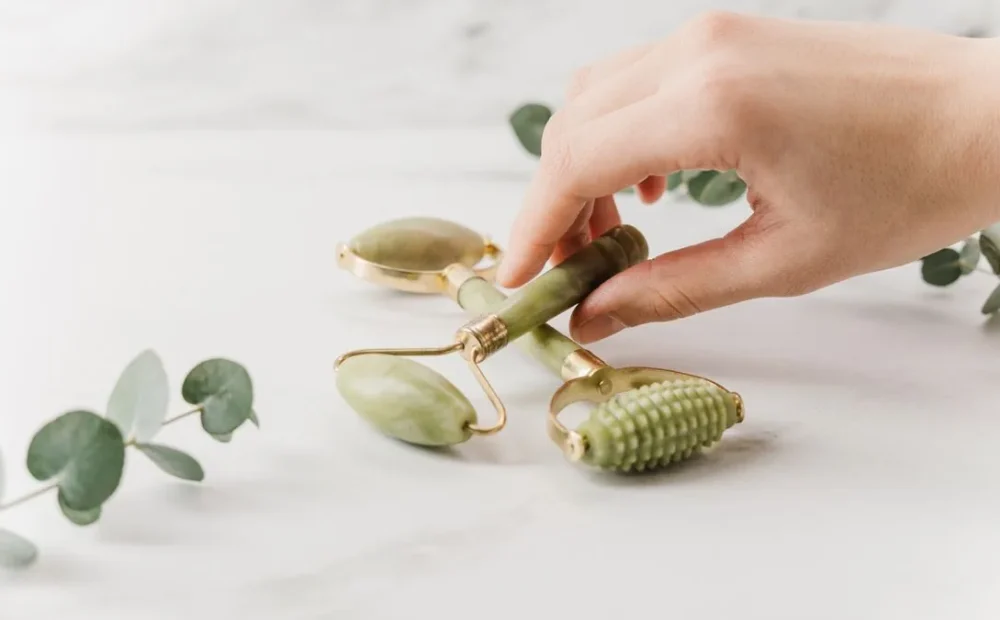
A jade roller is a small handheld skincare tool with one or two smooth stone cylinders mounted on a handle. You roll it slowly across your face, usually after applying a serum or facial oil, in short, upward strokes. It is one of the simplest tools in skincare: no batteries, no settings, and nothing to plug in.
Most jade rollers have a large stone at one end for the cheeks, forehead and jaw, and a smaller stone at the other end for under the eyes. The stones turn freely on a metal frame, so the roller moves smoothly instead of dragging. Real jade is naturally cool, which is why the first strokes feel refreshing.
This guide explains what a jade roller is, where the idea comes from, how to use one, and what it can and cannot do, plus how to choose one and keep it clean. The honest summary is short: a jade roller is a pleasant massage tool that can make skin look briefly fresher and less puffy, not a treatment for wrinkles.
Key takeaways
- A jade roller is a handheld tool with smooth stone cylinders, rolled over the face over serum or facial oil.
- Its main effects are temporary: cooler skin, a brief glow, and less visible morning puffiness.
- Use light pressure and short upward and outward strokes, always over a slippery layer of product.
- The stone matters less than the build quality: a good roller is smooth, silent, firmly fixed, and free of chips.
- A jade roller cannot lift skin, erase wrinkles, shrink pores or reshape your face.
What a jade roller actually is
At its simplest, a jade roller is a massage tool for the face. The handle is usually metal or wood, and the heads are polished stone, most often nephrite jade, the tougher and more common form, or jadeite, the rarer form. Cheaper rollers may be serpentine or dyed quartz sold as jade.
The design has barely changed in years: two stone cylinders, a forked metal frame, and a handle long enough to hold comfortably. The large end covers the cheeks and forehead, while the small end fits tighter spots such as under the eyes. The classic version is completely smooth, and smooth is what you want.
Jade rollers are often confused with gua sha tools, but they are not the same. Gua sha uses a flat stone edge scraped across oiled skin, while a jade roller uses a cylinder that moves with far less friction and pressure. The roller is the gentler, quicker option, which is why many people who find gua sha fiddly prefer it.
A short history of the jade roller
Jade has been valued in China for thousands of years, where it has symbolised purity and balance. Facial rolling with smooth stones is described as an old practice in Chinese beauty routines, with stories linking it to the Qing dynasty courts. Those stories are widely repeated and hard to verify.
What is certain is the modern story. Jade rollers reached Western beauty shelves in the mid-2010s, and sales rose sharply around 2017 and 2018. The trend has cooled since, but the tool has stayed in rotation because it is cheap, durable, and pleasant to use.
How a jade roller works, and what it can and cannot do
A jade roller works in straightforward, physical ways. The cool stone lowers the temperature of the skin surface for a few minutes, which can make puffiness look temporarily reduced, in the same way a cold flannel can. The rolling motion increases blood flow, which is why skin looks briefly brighter afterwards. Gentle pressure also encourages lymphatic fluid to drain toward the neck, softening a puffy morning face.
Those effects are real, but they are temporary: fluid returns, the flush fades, and the skin warms up again within an hour or so. That does not make the roller useless; much of skincare works the same temporary way. The problem starts when a roller is sold as a permanent fix, such as a face lift or wrinkle eraser. There is no good evidence that rolling changes facial structure.
There is also a practical benefit: rolling a serum or facial oil into the skin helps the product spread evenly, and the slow motion encourages a minute or two on the routine instead of rushing it. Our guide to the best face oils can help you choose a product with enough slip for comfortable rolling. What a roller will not do is lift sagging skin, clear acne, or fade dark spots.
Choosing a jade roller
The stone matters less than the build quality. A good roller feels cool, smooth and solid, and the stones turn quietly without wobbling or squeaking. A poor one feels light and hollow, and the stones rattle in the frame. Because the tool touches your face daily, those details matter more than the mineral name on the box.

Before you buy, check the stone for chips, cracks and rough patches. Run a fingertip over the whole surface: it should feel completely smooth. Check that both stones sit firmly in the frame and spin freely. Price is a rough guide; a decent roller can cost very little.
Rollers also come in other stones, each with its own character. Rose quartz stays cool at first and warms up with use, and suits people with sensitive skin. Stainless steel feels colder and heavier, is non-porous, and is the easiest to clean. Amethyst and obsidian look striking but offer no proven advantage over jade. Choose the material you enjoy holding and can keep clean.
Jade roller stones at a glance
| Stone | Feel on skin | Best for | Care notes |
|---|---|---|---|
| Nephrite jade | Cool, smooth, classic weight | Everyday rolling, puffy mornings | Mild soap and water, dry fully |
| Jadeite | Cool, dense, finely polished | A luxury-feel everyday roller | Mild soap and water, avoid dropping |
| Rose quartz | Cool at first, warms with use | Gentle routines, sensitive skin | Mild soap and water, dry fully |
| Stainless steel | Very cool, firm, heavy | De-puffing, easy cleaning | Rinse or wipe, dries fast |
| Amethyst | Cool, smooth, lighter | Everyday rolling | Wash gently, avoid dropping |
| Obsidian | Cool, dense, highly polished | Cooling massage, smooth glide | Wash gently, avoid dropping |
| Serpentine or dyed quartz | Cool, smooth, lighter | Budget rollers | Wash before first use |
| Textured stone | Uneven, stimulating | Occasional use | Clean grooves carefully |
How to use a jade roller step by step
Set aside two to five minutes, and start with clean skin and a clean roller, washed with mild soap and water. You can keep the roller in the fridge for a stronger cooling effect, but never use a stone that feels icy.
Apply slip generously: a few drops of facial oil or a layer of serum over the face and neck gives the roller something to glide on. Without it the stone will drag and irritate. If the roller sticks, add another drop of oil rather than pressing harder.
Work in short strokes, always upward and outward, never back and forth in a scrubbing motion. Use the large end on the cheeks, forehead and jaw, and the small end under the eyes and around the nose. Repeat each stroke three to five times, then move on. Finish by rolling gently down the sides of the neck.
Keep the pressure light: the weight of the roller plus a feather-light touch is enough, and pressing hard only risks irritation, especially around the eyes. Use the roller once or twice a day, morning or evening. Morning sessions suit people who wake up puffy; evening sessions suit people who use the roller as a wind-down ritual. For a fuller picture of what rollers can do, our guide to jade roller benefits explains the effects in more detail.
Clean the roller after every use: rinse with lukewarm water and a drop of mild soap, then dry it completely. A damp roller left in a closed drawer can develop a musty smell. Store it somewhere dry, away from direct sunlight, and do not drop it: stone chips easily on hard tiles.
When to skip the roller
A jade roller is gentle, but it is not suitable for every skin condition. Skip rolling over broken skin, sunburn, active breakouts, rashes, or eczema flare-ups: rolling there can spread bacteria, increase irritation, and slow healing. Wait until the skin has fully recovered.
Be cautious if you have very sensitive skin or rosacea, since rolling and increased blood flow can trigger redness. Test the roller on a small area such as the jaw for a few days first. Also pause after a professional treatment such as a chemical peel, laser session, or microneedling until the practitioner says it is safe, and never roll over a freshly treated area after injectables.
Checklist: before you buy and before you roll
- Check the stone is completely smooth, with no chips, cracks or rough patches.
- Make sure both stones spin freely and quietly and sit firmly in the frame.
- Choose a handle that feels comfortable in your hand for two to five minutes.
- Always roll over serum or facial oil, never on dry skin, and add more product if the stone drags.
- Use light pressure and short upward and outward strokes, three to five times per area.
- Clean the roller with mild soap and water after every use, dry it fully, and replace it if the stone chips.
Frequently asked questions
What is a jade roller used for?
A jade roller is used for gentle facial massage. It is rolled over the face, usually over serum or facial oil, to cool the skin and help move fluid that causes morning puffiness. Its effects are temporary, and it is best thought of as a pleasant addition to a routine rather than a treatment.
Does a jade roller really work?
It works for what it physically does: cooling the skin, increasing blood flow for a brief glow, and temporarily reducing puffiness. It does not permanently lift skin, erase wrinkles, or change the shape of your face, and there is no strong evidence for lasting benefits.
Should I use a jade roller before or after moisturiser?
Use it after a serum or facial oil, and before a heavy moisturiser or sunscreen. The roller needs a slippery layer to glide, so apply your serum or oil first, roll for a few minutes, then finish with moisturiser and, in the morning, sunscreen. Rolling on bare skin can irritate.
Can I use a jade roller every day?
Yes, most people can use a jade roller once or twice a day, as long as the pressure stays light and the skin is healthy. Keep sessions to two to five minutes, and skip it when your skin is irritated, broken out, sunburnt, or recovering from a treatment.
Is a real jade roller better than a rose quartz or steel one?
Not in any proven way for the skin. The massage effect comes from coolness, pressure and movement, which all smooth stones and steel provide. Real jade holds its cool temperature well, rose quartz warms up faster and feels gentler, and steel is colder, heavier and easiest to clean.
How do I clean a jade roller?
Rinse it with lukewarm water and a drop of mild soap after every use, then dry it completely with a soft cloth. Do not soak the roller for long periods, since water can work into the frame and loosen the stones, and do not use harsh cleaners or alcohol.
The bottom line
A jade roller is a simple, inexpensive tool that does a small job well. It cools the skin, gives a brief glow, softens morning puffiness, and turns a rushed routine into a slower, more pleasant one. Those are modest benefits, but they are real, and they are enough to earn the roller a place on the bathroom shelf.
What a jade roller will not do is just as important to know. It will not lift, tighten, or reshape your face, erase wrinkles, clear acne, or replace sunscreen and proven treatments. Anyone promising those results is selling a story, not a tool. Used with realistic expectations, a jade roller is a calm, low-effort habit that makes skin look and feel briefly better. If you are curious about powered facial tools, our roundup of the best microcurrent facial devices explains what the electronic options add.
Note: This guide is general information, not medical advice. If you have a skin condition or are unsure whether facial massage is safe for you, check with a dermatologist first.