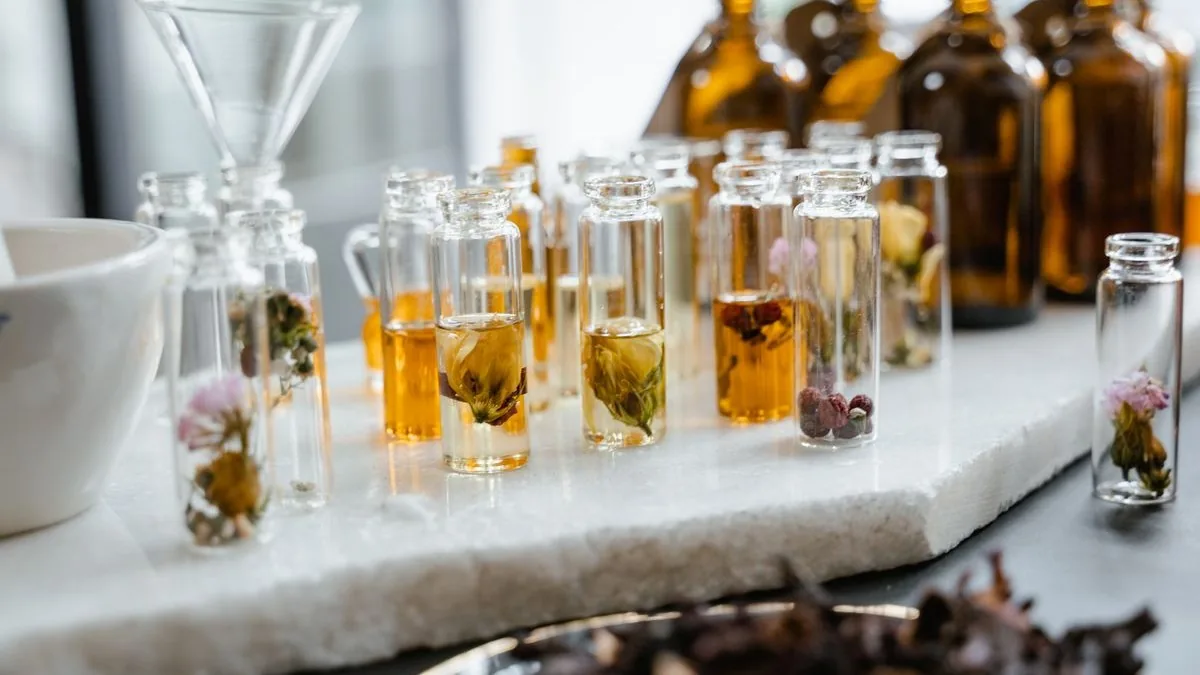
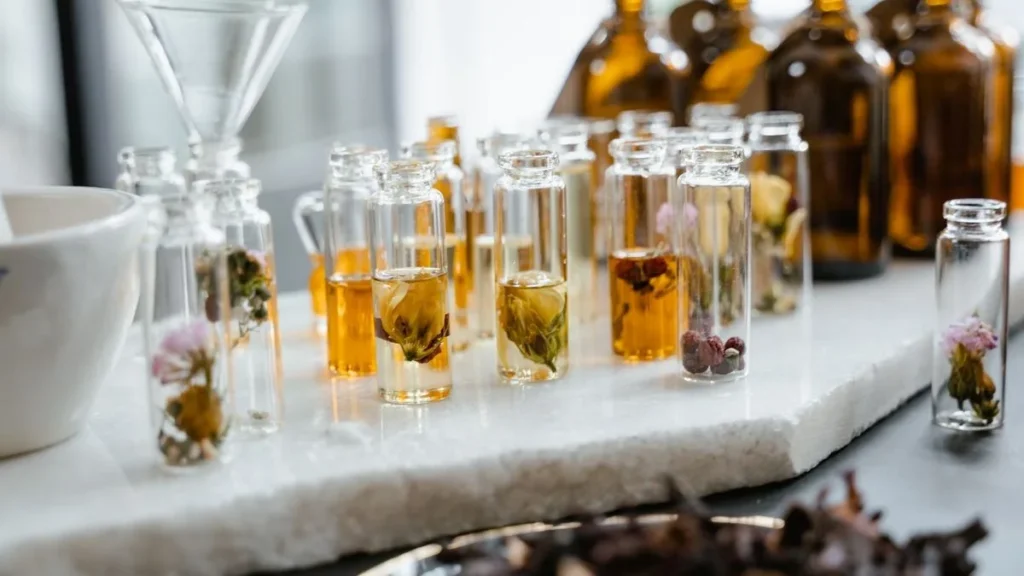
Perfume oil is fragrance in its most concentrated, quiet form. Instead of scent dissolved in alcohol and sprayed into the air, it is scent carried in oil — usually jojoba or fractionated coconut oil — and applied directly to the skin with a rollerball, a dropper, or a fingertip. What you get is a small, warm patch of scent that sits close to the skin and unfolds slowly.
It is easy to confuse perfume oil with other oily fragrance products. Body oils are moisturisers with a light scent added. Essential oils are single plant extracts. Hair perfumes are made for hair. Perfume oil is none of those. It is a finished fragrance, built from top, heart, and base notes like any good perfume, but blended into oil rather than alcohol.
Below is a plain guide to what perfume oil is, how it differs from spray perfume, how to apply it, and how long it lasts, so you can decide whether the format belongs in your routine.
Key takeaways
- Perfume oil is a finished fragrance carried in oil rather than alcohol, applied to the skin with a rollerball, dropper, or fingertip.
- It smells quieter and closer than a spray, but usually lasts longer, because oil slows down how fast the scent evaporates.
- It suits people who want a personal scent rather than a room-filling one, and people whose skin finds alcohol sprays drying.
- Less is genuinely more: one or two small applications at pulse points are enough, and over-applying is the most common mistake.
- Perfume oil does not project like a spray, so it is a poor choice when you want your fragrance noticed across a room.
What perfume oil actually is
A perfume oil is a fragrance concentrate mixed into a carrier oil. The perfumer takes the same kind of scent composition that would go into a spray — citrus at the top, flowers or spices in the middle, woods, musk, or amber at the base — and blends it into oil instead of alcohol. The carrier is usually jojoba oil, fractionated coconut oil, sweet almond oil, or a light synthetic base chosen because it is stable and nearly scentless.
The oil base is the whole point. Alcohol evaporates quickly, carrying the lighter scent molecules with it, which is why a spray smells strong at first and then fades. Oil evaporates slowly, holding the fragrance against the skin and releasing it gradually, so the scent stays closer but lasts longer — and the deep base notes come forward sooner.
This is the oldest form of perfumery, used in the Middle East, South Asia, and North Africa for centuries, long before alcohol-based sprays became the Western standard. Attars, the concentrated perfume oils of India and the Middle East, are the best-known example. What is new is the format reaching a wider audience, with small rollerball bottles and independent makers selling oils alongside sprays.
How to choose a perfume oil
Start with the scent family you actually like. If you love warm, woody fragrances, look for oils built around sandalwood, cedar, amber, or oud. If you prefer something fresh, look for citrus, green, or aquatic oils, and accept that fresh notes are the hardest to hold in oil and fade fastest. Floral oils — rose, jasmine, tuberose — sit in the middle, rich and long-lasting without being heavy. Read the note list as you would for a spray, and be suspicious of any oil that lists no notes at all.
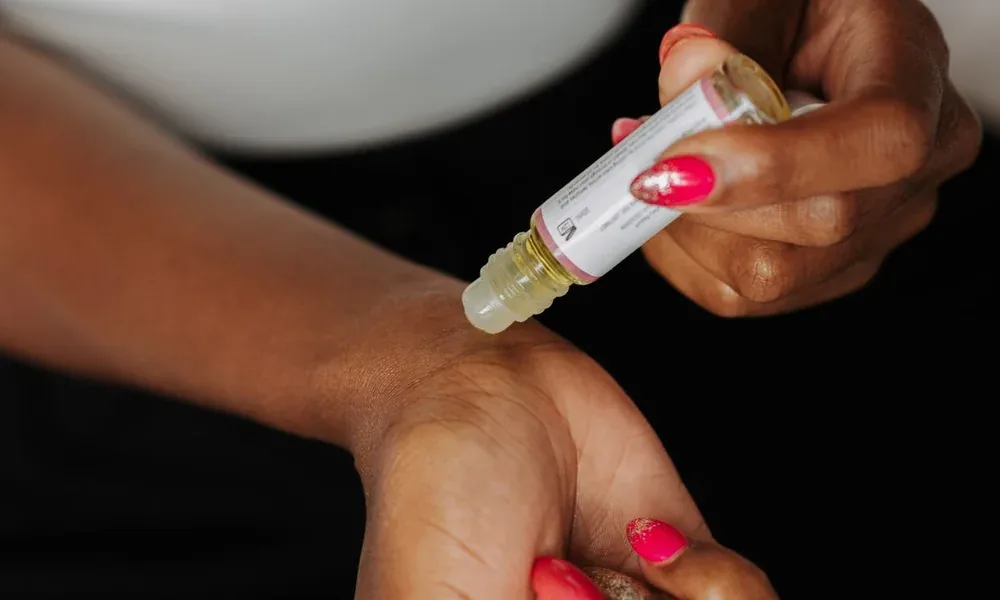
Look next at the applicator. A rollerball is the most common and the most forgiving: it lays down a thin, even layer and makes it hard to over-apply. A dropper gives more control but needs a careful hand, since one extra drop can double the dose. A stopper bottle is traditional for attars but the easiest to overdo. For a first perfume oil, a rollerball is the safest choice, and the most practical to carry.
Check the carrier oil before you buy. Jojoba is the most popular carrier because it is stable, absorbs well, and rarely causes reactions. Fractionated coconut oil is light and nearly scentless. Sweet almond oil is richer and can feel heavier. If you have nut allergies, avoid almond-based carriers and ask the maker what they use. Our guide to the best indie perfume oils shows how smaller makers describe their carriers and concentrations, because independent brands tend to be more open about what is in the bottle.
Finally, test it on skin, not on paper. Oil needs warmth and time to show its real character. Apply a small amount to one wrist, wait at least thirty minutes, and then decide. The dry-down — the warm scent that remains after several hours — is where a perfume oil earns its place or loses it.
Perfume oil vs spray perfume: the differences that matter
The most obvious difference is the delivery. A spray throws fine droplets of alcohol and fragrance into the air and across a wide area of skin and clothing. A perfume oil is placed, deliberately, on a small patch of skin. A spray announces itself; an oil keeps a secret. A spray is easy to over-apply by accident; an oil is easy to control. A spray works on clothes as well as skin; an oil should stay on skin, because oil can stain fabric.
Longevity is where perfume oil usually wins. A good oil can last eight to twelve hours on the skin, while many sprays fade noticeably after four to six. A strong eau de parfum can last just as long, but as a general pattern, oils outlast sprays on skin. What oils give up is projection: a spray can fill a room, while a perfume oil is usually only noticeable to someone standing close to you.
Skin feel is another honest difference. Perfume oil feels like a light oil on the skin — comfortable, even moisturising, and well suited to dry skin. People who dislike any oily feeling, or who live in hot, humid weather, may find it less pleasant. Spray perfume dries almost instantly, which is cleaner but can also be drying, and its alcohol can sting broken skin or irritate sensitive skin.
On price, a small 10 ml rollerball often costs less than a 50 ml spray from the same brand, and because you use so little at a time, it can last for months. The comparison that matters is cost per wear, not cost per bottle, and on that measure a concentrated oil usually comes out ahead. Our guide to the best luxury perfumes shows the spray side of the same calculation.
How to apply perfume oil
Start with clean, slightly moisturised skin, because oil sits better on skin that is not completely dry, and unscented moisturiser underneath can help the scent last longer. Roll or dab a small amount onto one pulse point — the inside of the wrist is the classic choice — and then stop. One pulse point is enough to test, and two or three are enough for a full day.
The usual pulse points are the wrists, the sides of the neck, behind the ears, the inside of the elbows, and the chest. Warmth helps the oil release its scent, which is why pulse points work: the blood runs close to the surface there and gently warms the oil all day. Keep it away from your face, your eyes, and any broken or freshly shaved skin.
Do not rub your wrists together after applying: rubbing breaks down the top notes faster and flattens the scent. Let the oil sit and warm on its own. And remember the warning that matters most: perfume oil can stain clothing, especially light fabrics and silk, so apply it to skin only and let it absorb before dressing. For colder months, our guide to the best winter perfumes is worth a look, because many of the warm scents it covers are also available in oil form.
The caveats that matter
Perfume oil is straightforward, but a few honest caveats decide whether it works for you. The table below gathers the ones that come up most often.
| Detail | What is known |
|---|---|
| Projection | Low. It stays close to the skin, noticeable mainly at conversation distance. |
| Longevity | Usually 8 to 12 hours on skin, longer than most sprays, because oil slows evaporation. |
| Application | Placed on pulse points with a rollerball, dropper, or fingertip; one or two applications are enough. |
| Staining | Oil can stain light fabrics and silk, so apply to skin only and let it absorb before dressing. |
| Sensitive skin | Often gentler than alcohol sprays, but fragrance oils can still irritate. Patch-test first. |
| Allergies | Check the carrier oil. Almond-based carriers are a problem with nut allergies. |
| Fresh scents | Citrus and aquatic notes fade fastest in oil, so fresh oils need reapplying sooner than woody ones. |
| Storage | Keep in a cool, dark place with the cap on. Heat and light degrade fragrance oil like sprays. |
Checklist: before you buy a perfume oil
- Know the scent family you like, and read the note list rather than buying on the bottle alone.
- Check the carrier oil, especially if you have nut allergies or sensitive skin.
- Choose a rollerball for your first oil, since it is the hardest applicator to overdo.
- Test on skin and wait at least thirty minutes before deciding, because the dry-down is the real scent.
- Start with one pulse point and add more only if you need it, rather than applying generously at first.
- Store the bottle somewhere cool and dark, and keep it off fabric until the oil has absorbed.
Frequently asked questions
Is perfume oil better than spray perfume?
It is better for longevity and for a close, personal scent, and often gentler on skin because it contains no alcohol. It is worse for projection and for scenting clothes.
How long does perfume oil last?
A good perfume oil usually lasts eight to twelve hours on skin. Woody, musky, and amber oils last longest; citrus oils fade fastest.
How much perfume oil should I apply?
Less than you think. One small roll across a wrist or a single drop is enough to test, and two or three pulse points are enough for a full day. Start small and add more later if the scent feels too quiet.
Can I wear perfume oil every day?
Yes. Many people wear it daily because it is discreet, long-lasting, and easy to carry, and in a scent-sensitive workplace it is often a better choice than a strong spray.
Does perfume oil stain clothes?
It can, especially on light fabrics, silk, and delicate materials. Apply it to skin only, let it absorb for a minute or two before dressing, and avoid applying it over a collar or cuff.
Can I layer perfume oil with a spray perfume?
Yes. Apply the oil first as a base on your pulse points, then spray the same scent, or a complementary one, lightly over it. The oil extends the life of the spray, and the spray adds the projection the oil lacks.
The bottom line
Perfume oil is not a lesser version of perfume. It is the oldest way of wearing fragrance, and it does a few things better than a spray: it lasts longer, stays close and personal, and is kinder to skin that dislikes alcohol. Its limits are clear too: it does not project, it can stain fabric, and fresh scents do not hold in oil the way deep, warm ones do.
The best way to decide is to try one. Pick a scent you already love, find it in a small rollerball, apply a little to one wrist, and give it a full day. If you enjoy the quiet, long-lasting warmth of it, perfume oil may become your everyday format.
Note: Fragrance is personal, and skin chemistry changes how any scent behaves. Patch-test a new oil on a small area first, check the carrier oil if you have allergies, and stop using it if irritation appears.
Meet Our Experts: This guide was prepared by the BrassSmile beauty desk, drawing on published fragrance guides and standard perfumery practice. No individual tester claims are made.
Why Trust BrassSmile: We explain fragrance formats in plain language, compare them against the spray alternative on the same measures, and flag the practical limits, such as staining and low projection, alongside the benefits.
Sources: Standard perfumery references on fragrance concentration and carrier oils; BrassSmile fragrance guides.