What Is an Osmanthus Perfume 2027
An osmanthus perfume is a fragrance built around the scent of a small autumn blossom, the flower of Osmanthus fragrans. It is not a perfume made from apricots, and it is not a perfume that smells of fruit in the everyday sense. What it smells of is apricot skin, black tea, and soft suede, all at once, in a warm, slightly powdery, faintly leathery note.
It is one of the most recognisable notes in perfumery, and also one of the most often misunderstood. It appears in everything from a $25 Elizabeth Arden spray to a $280 Ormonde Jayne extrait, and in each it does a different job: sometimes it warms the heart, sometimes it softens the citrus, sometimes it is barely there at all. The name on the pyramid changes too, from osmanthus to sweet olive to kinmokusei, which is why two people can be wearing the same note and never know it.
This guide explains what osmanthus is, where it comes from, how it reaches a bottle, and how to tell it from apricot and peach. The nine facts below cover the plant, the chemistry, the history, and how it behaves on skin, plus the warnings worth knowing.
Key takeaways
- An osmanthus perfume is built around the blossom of Osmanthus fragrans, and it smells of apricot skin, black tea, and soft suede.
- The blossom yields almost no oil, so the note is usually an absolute made from hand-picked flowers, or a careful reconstruction.
- Osmanthus, sweet olive, and kinmokusei are the same flower under three names, while apricot and peach are different materials entirely.
- Jean-Claude Ellena made the note famous in niche perfumery, with Osmanthus for The Different Company in 2000 and Osmanthe Yunnan for Hermès in 2005.
- The note is gentle on its own, but the citrus and leather notes around it are not always so.
What an osmanthus perfume is, in plain terms
An osmanthus perfume is any fragrance in which the scent of the osmanthus blossom plays a named, deliberate part. That sounds narrower than it is, because the note is rarely the star. It almost never leads a composition, and that quiet role is why perfumers keep it on hand: it warms what is around it, softens what is underneath, and adds an apricot-like glow that no other floral can quite match.
The smell itself is easy to recognise once you have met it. Think of a dried apricot left in a leather glove, a cup of black tea gone cold, and a suede jacket warmed by the sun. The apricot is not the sharp apricot of fruit, and the leather is not the heavy leather of a saddle. And underneath it all there is a faint powderiness, like talc on warm skin, that keeps the note from turning heavy.
Our earlier guide to violet leaf perfume took the same plain-terms approach, and it works here too. An osmanthus perfume is not a perfume that smells of apricots in any everyday sense. It is a perfume that borrows the blossom’s apricot-like, tea-like, faintly leathery character to warm the rest of the composition.
How osmanthus ends up in a bottle
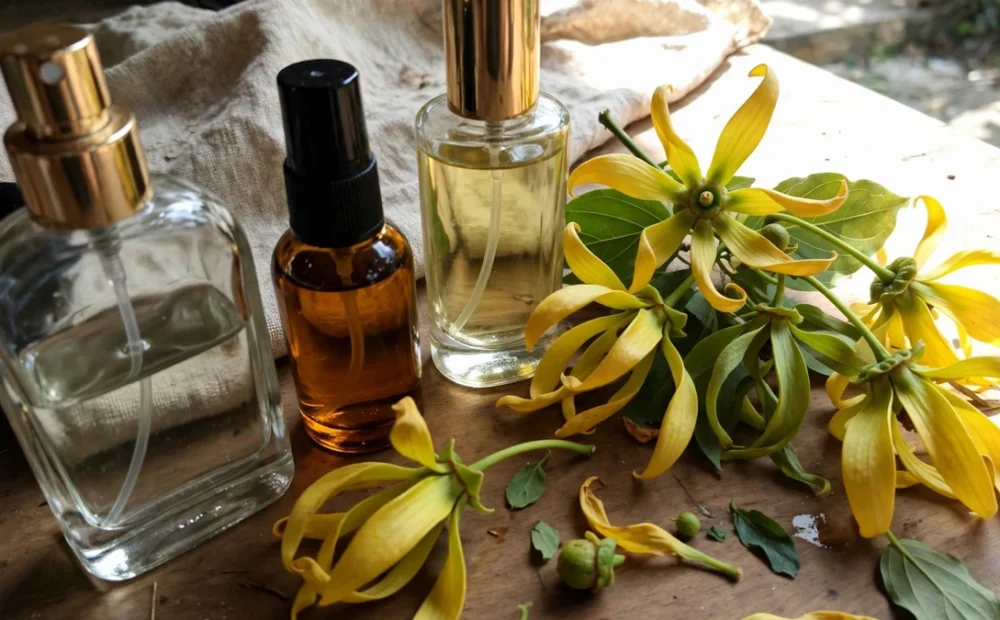
The blossom yields almost no oil, so the note is usually an absolute or a reconstruction. A perfumer does not press osmanthus flowers and pour the result into a bottle. Instead, they soak the blossoms until their scent is drawn out, or they combine apricot, tea, and suede notes to recreate what the flower smells like. That is why two osmanthus perfumes can smell so different: one builds towards tea and citrus, another towards leather and amber.
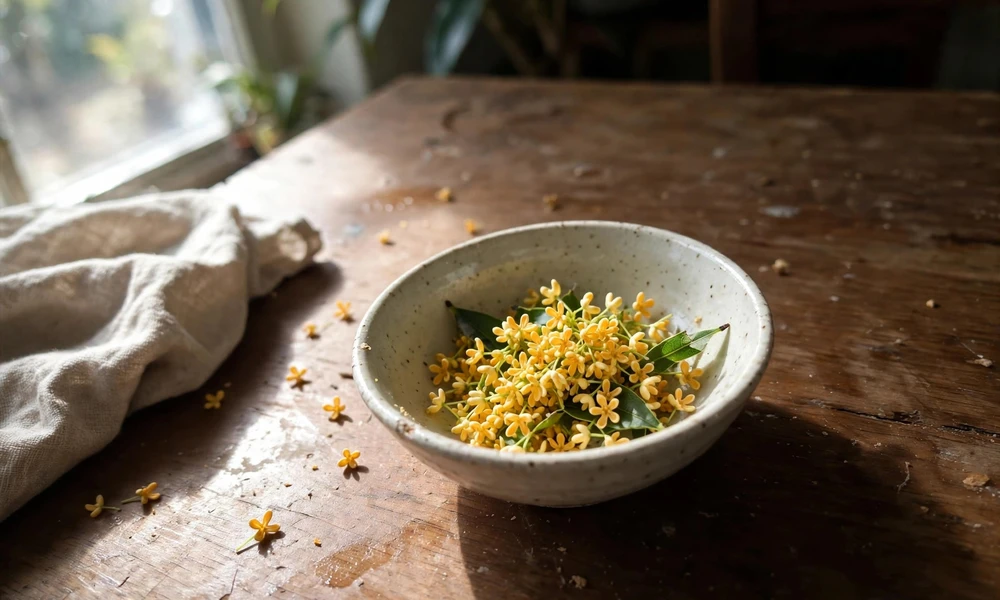
The absolute is then placed in the pyramid, usually in the heart. In the heart it gives the middle its apricot warmth and holds the composition together while the top notes evaporate. It is almost never placed in the opening, because it is too soft to announce a perfume, and rarely in the base on its own, because it needs woods or amber underneath to last.
Placement matters more than concentration. A cologne with osmanthus in the heart will carry it for hours, while an extrait with osmanthus in the top will lose it within the hour. That is why the same note can smell fleeting in one bottle and persistent in another.
Nine facts about osmanthus perfume
One tree, two colours: the flower is white or orange, and both smell of apricot
What it shows: Osmanthus fragrans grows in two forms, one with white flowers and one with orange flowers, and both smell of apricot skin, black tea, and soft suede. The orange form, called kinmokusei in Japan, is slightly sweeter and more leathery, while the white form, called ginmokusei, is slightly greener and more delicate. A perfume that names osmanthus can use either form.
What to consider: The two forms are not interchangeable in every market. Japanese pyramids say “kinmokusei” for the orange flower, Chinese ones say “gui hua” for either, and English ones switch between osmanthus and sweet olive freely. A perfume that lists “kinmokusei” is using the orange flower, not a different note.
Almost no oil comes from the flower, so the note is an absolute or a rebuild
What it shows: Osmanthus flowers are too small and too briefly in bloom to yield oil in useful quantities, so perfumers make an absolute by soaking the blossoms, or they rebuild the smell from other materials: apricot for the fruity sweetness, tea for the dry warmth, and a touch of suede for the leathery depth.
What to consider: Because the note is an absolute or a rebuild, there is no single true osmanthus smell. Two absolutes can both be honest and still smell different, and a perfume that calls itself osmanthus is really calling itself an osmanthus absolute. That is not a flaw; it is simply how the note works.
Osmanthus, sweet olive, and kinmokusei are the same flower under three names
What it shows: The three names all point at the same blossom of Osmanthus fragrans. “Osmanthus” is the botanical name, “sweet olive” is its English common name, and “kinmokusei” is the Japanese name for the orange flower. A pyramid that uses any of the three is naming that same material.
What to consider: The three names are not used the same way in every market. French pyramids say “osmanthe”, Japanese ones say “kinmokusei”, and English ones switch between the three names freely. A perfume that lists “sweet olive” is not using a different note from one that lists “osmanthus”.
The usual way to describe it: apricot skin, black tea, and suede
What it shows: The three comparisons capture different parts of the note. Apricot skin gives the soft, slightly powdery fruitiness, black tea gives the dry, warm depth, and suede gives the faint leathery edge underneath. Together they describe a smell that is floral without being powdery, fruity without being sweet.
What to consider: Treat the comparisons as a guide, not a guarantee. With citrus it smells brighter than with leather, and with amber it smells warmer than with tea. The note does not change; the company it keeps changes everything.
The note is too soft for the opening, so it usually sits in the heart
What it shows: Osmanthus is too soft and too warm to open a composition, so perfumers place it in the heart, where it can do its work and then stay. In the heart it gives the middle its apricot warmth, and in the base it holds the drydown together while the lighter notes evaporate.
What to consider: Do not expect osmanthus to greet you in the first spray. If you love the note, choose a heart placement like Hermès Osmanthe Yunnan over a top placement like Jo Malone Osmanthus Blossom; the heart lasts hours longer.
Tea, apricot, peach, and leather are its closest companions
What it shows: The five pairings are the most common, and each shows a different side of the note. Tea sharpens it, apricot deepens it, peach sweetens it, leather darkens it, and white florals cool it. Hermès Osmanthe Yunnan is the classic tea pairing, and Serge Lutens Nuit de Cellophane is the classic white floral pairing.
What to consider: The pairing is what decides whether the perfume suits you. A tea pairing is dry and sharp, a leather pairing dark and warm, a white floral pairing soft and bright. If you do not like the pairing, you will not like the perfume, even if the osmanthus itself is beautiful.
Jean-Claude Ellena made it famous in niche perfumery, in 2000 and 2005
What it shows: The note has two histories. The Different Company Osmanthus, from 2000, was the first major perfume to put the note in the name, and it made osmanthus a selling point in its own right. Hermès Osmanthe Yunnan, from 2005, was the first to put the note in a luxury house, and it made osmanthus a reference point for the whole industry.
What to consider: Both perfumes are still in production, and they are the best way to smell the note’s history. Our guide to sweet clover perfume follows the same history-first approach. For the purest flower, try The Different Company; for the most balanced, try the Hermès.
A two- or three-week autumn bloom makes this a seasonal scent
What it shows: Osmanthus flowers bloom for two or three weeks in autumn, when the scent is strongest. The note follows the season: it feels natural in autumn and winter, when its apricot warmth matches the weather, and out of place in high summer.
What to consider: That seasonal character is a strength, not a weakness. An osmanthus perfume worn in October smells warmer than the same one worn in June, because the air is cooler and the skin underneath is different. Wear it while the blossom is out, and it will smell its best.
It can turn leathery, powdery, or slightly sour on some skins
What it shows: Osmanthus is a skin-dependent note. On most people it stays warm and apricot-like, but on some it turns leathery, like an old glove, and on others it turns powdery, like old-fashioned talc. The change comes from the way the absolute interacts with individual skin chemistry, and it is more common with osmanthus than with most florals.
What to consider: Always sample it on your own skin first, and wear it for a full day. A paper strip will not show the leathery turn, and a five-minute shop test will not show the powdery one. If it goes leathery on you, try a greener pairing like Ormonde Jayne Osmanthus; if it goes powdery, try a warmer one like The Different Company.
Osmanthus vs apricot vs peach
The three names cause most of the confusion around this note, so it is worth setting them out plainly. Osmanthus is the blossom of Osmanthus fragrans, and it smells of apricot skin, black tea, and soft suede. Apricot is the fruit of Prunus armeniaca, and it smells sweeter, juicier, and more obviously fruity. Peach is the fruit of Prunus persica, and it smells softer, creamier, and more velvety than either.
The three materials do different jobs: osmanthus warms and deepens, apricot sweetens, and peach softens. A perfume that names osmanthus will smell warm and leathery, while one that names apricot will smell fruity and a little sharp. A pyramid that says only “apricot” could mean the fruit, or it could be describing the osmanthus smell without naming the flower. Our guide to elderflower perfume makes the same point about names that look alike yet mean different things.
When you are unsure, check the rest of the pyramid: tea, suede, and leather point at the flower. If the other notes are plum, blackberry, and dark woods, the apricot is more likely the fruit. And if the pyramid says “osmanthus” outright, it is definitely the flower, not the fruit.
The caveats that matter
Osmanthus is gentle, but buying it well takes care: the name changes from pyramid to pyramid, the note is an expensive absolute rather than a pressed oil, and the scent can turn leathery or powdery on some skins. The table below sets out the points worth knowing before you spend anything.
| Detail | What is known |
|---|---|
| What it is | A fragrance built around the blossom of Osmanthus fragrans, smelling of apricot skin, black tea, and soft suede |
| What it is not | Not apricot or peach, which come from fruit and smell sweeter and more obviously fruity |
| How it is made | Usually an absolute from hand-picked flowers, or rebuilt from apricot, tea, and suede notes, because the blossom yields almost no oil |
| Where it sits | Heart in most perfumes; it warms over the first hour and stays for several more |
| Best season | Autumn and winter, when its apricot warmth matches the weather |
| Who should sample first | Anyone whose skin turns florals leathery or powdery should wear it for a full day before buying |
| Price range | $25–$30 at the low end, $280–$295 at the high end, for standard bottles |
| What it does not do | It does not make a perfume last longer, and it does not suit every skin chemistry |
If your skin reacts easily, test any new perfume on a small patch first and wait a day. The blossom is gentle, but the citrus and leather notes beside it can irritate.
Checklist: telling a true osmanthus perfume from the rest
Work through these before you buy.
- Look at the pyramid first: it should name the flower in full, not just “apricot” or “peach”.
- Check the company it keeps: tea, suede, and leather point at the flower, while plum and blackberry point at the fruit.
- Spray it on your wrist, not a paper strip: warm skin changes how osmanthus behaves, and paper hides that change.
- Wear it for a full day before you decide: the apricot note arrives softly, then warms into suede over the first hour.
- Compare two side by side before you buy one: a tea pairing against a leather pairing shows you which side of the note you like.
- Choose the smallest bottle when you are unsure: a 50 ml you finish beats a 120 ml that gathers dust.
Frequently asked questions
Is osmanthus the same as apricot?
No. Osmanthus comes from the blossom of Osmanthus fragrans and smells of apricot skin, black tea, and soft suede. Apricot comes from the fruit of Prunus armeniaca and smells sweeter, juicier, and more obviously fruity. A pyramid that says only “apricot” names the fruit, not the flower.
Why is osmanthus so expensive in some perfumes?
The absolute around it. Osmanthus absolute is expensive, because the flowers are tiny, hand-picked, and briefly in bloom, and it turns up in niche perfumes where the price reflects the house and the bottle. A twenty-five-dollar spray like Green Tea Osmanthus proves the note itself can be cheap.
Does osmanthus last long on skin?
Usually several hours, because it sits in the heart and warms as the base takes over. A heart placement lasts longer than a top one, which is why Osmanthe Yunnan carries the note further into the day than Osmanthus Blossom.
Can osmanthus turn leathery on skin?
Yes, on some people. The absolute can turn leathery, like an old glove, or powdery, like old-fashioned talc, depending on skin chemistry. A paper strip will not show this, so sample it on your own skin and wear it for a full day before you buy.
What does kinmokusei mean on a pyramid?
It means the orange-flowered form of Osmanthus fragrans. Kinmokusei is the Japanese name for the golden osmanthus, and a pyramid that lists “kinmokusei” is naming the flower, not a different note. The white form is called ginmokusei, and it smells slightly greener.
Is osmanthus an autumn scent only?
It suits autumn and winter best, when its apricot warmth feels natural, but a tea or citrus pairing carries it into warm weather better than a leather or amber one.
The bottom line
An osmanthus perfume is a fragrance built around the blossom of Osmanthus fragrans, and it smells of apricot skin, black tea, and soft suede. The note is usually an absolute, it sits in the heart, and it goes by three names, while apricot and peach are different materials entirely.
Whatever you pick, make sure the pyramid names the flower in full, wear it on skin for a full day, and judge it by how the apricot note warms into suede over hours, not by the first minute. That is how you find one you will actually wear to the very last drop.