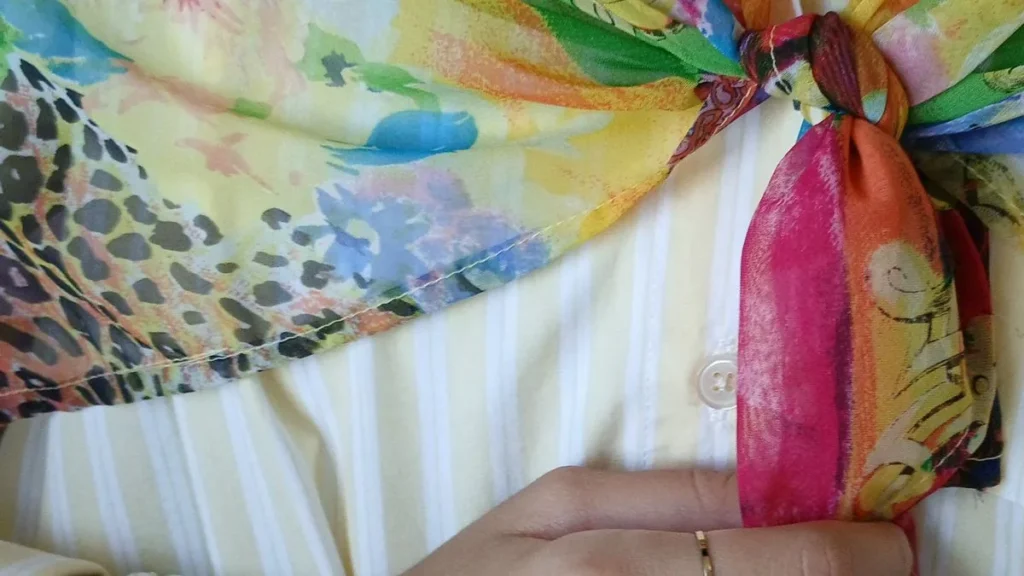
A silk scarf is easy to love and surprisingly hard to keep in place. Knotted, it slips, bunches, or creases the very print you bought it for. Left loose, it slides off the shoulder the moment you move. A silk scarf ring is the small piece of hardware that solves both problems: a loop of metal, horn, resin, or enamel that the folded scarf passes through, holding it neatly in place and turning the fastening itself into jewellery.
It is not a brooch, and it is not a clip. A brooch pins through fabric, and a clip grips by pressure, but a scarf ring never pierces the silk and never pinches it. It works by friction alone. Fold the scarf into a strip, thread the ends through the ring, slide the ring to where you want it, and the fabric stays put — high at the throat, lower on the chest, or off to one side — without a knot pressing into the silk.
This guide explains what a silk scarf ring is, what it is made from, how the sizes work, how it actually holds slippery silk, and how to choose one that will not damage a good scarf. There are no product picks here.
Key takeaways
- A silk scarf ring is a small loop that holds folded silk in place by friction, with no knot, pin, or clip.
- It is also called a scarf slide, and it doubles as neckline jewellery rather than hiding like a fastener.
- Match the opening to the fold: a 2 to 3 cm opening suits most 90 cm silk squares.
- The inside edge must be perfectly smooth, because a rough edge can snag or pull fine silk in a single wear.
- One plain, well-finished ring suits more scarves than a drawer full of decorative ones.
What a silk scarf ring actually is
A silk scarf ring is a closed loop, usually round or oval, with an opening wide enough for folded silk to pass through twice. The most common form is a simple circle of polished metal, about the size of a large coin, with nothing on it at all. Other forms include a slide, which is a frame divided by a centre bar into two openings, and a cuff, which is an open curve that the scarf is tucked into rather than threaded through.
It also has clear limits. A scarf ring does not fasten a coat, hold a shawl closed in wind, or replace a knot on a very heavy wool scarf, where the weight of the fabric can drag the ring down. It is designed for light, smooth fabrics, and silk is the fabric it suits best. If you want to see named styles once you know the basics, our roundup of the best luxury scarf rings shows how the main designs differ in practice.
How a scarf ring holds silk without a knot
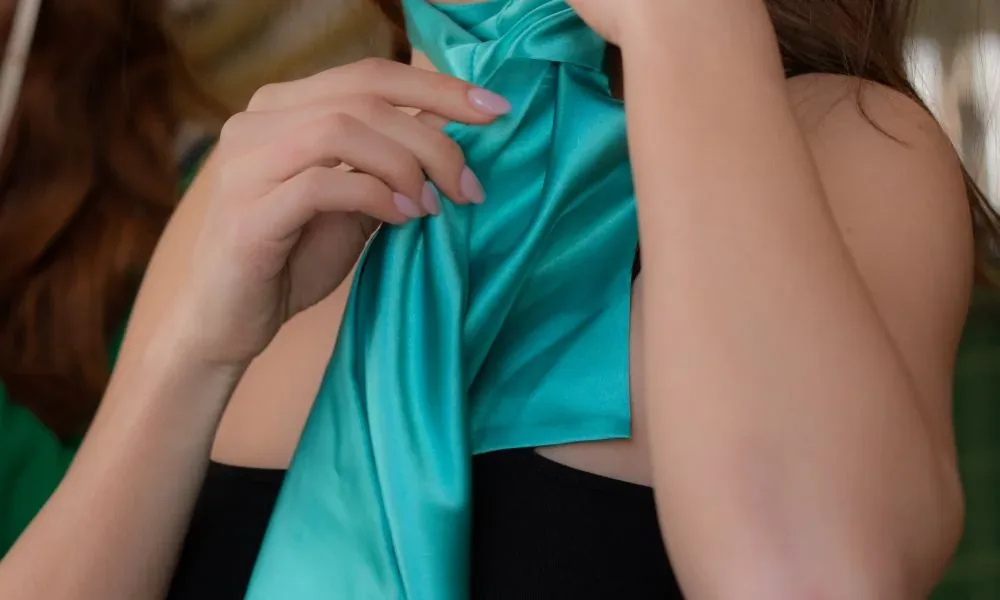
The method is simple, and that is why it works. Fold the scarf on the bias into a strip a few centimetres wide, pass both ends through the ring from the same side, and pull them through until the ring sits where you want it. The two layers of fabric press against each other and against the inside of the ring, and the friction between them is what holds everything still.
Silk needs this more than most fabrics because it is slippery. A knot in silk twill either works loose or has to be pulled so tight that it creases the fabric, and a crease in silk can take a long time to fall out. A ring spreads the pressure across the whole fold instead of concentrating it in one tight spot, so the print stays flat and the edges stay smooth.
What scarf rings are made from
Most scarf rings are metal. Gold-tone and silver-tone brass are the commonest, with palladium and solid silver at the higher end, and the finish matters more than the metal itself. A well-made ring is polished smooth on every surface, including the inside edge where the silk runs. A cheap ring can look identical from the front and still have a rough seam or a sharp join on the inside, and that is the part that touches your scarf all day.
Enamel rings add colour at the neckline, usually over a metal frame, and they suit solid-coloured silk, where the ring is the accent. Horn, resin, and lacquered wood give a softer, lighter feel and suit patterned scarves, because they do not compete with the print. Rings set with crystals or a single coloured stone are made to be seen; they are heavier, so they suit evenings and occasions better than everyday wear, where the extra weight can pull a light scarf out of place.
Sizes and shapes: matching the ring to the scarf
The size that matters is the opening, not the outside of the ring. For a standard 90 cm silk square folded on the bias, an opening of 2 to 3 cm is the usual fit, and it suits most scarves in that size. A 70 cm square folds into a slightly narrower strip, so it can take a ring at the smaller end of that range, while a 140 cm shawl folds into a much bulkier strip and needs an opening of 4 to 5 cm.
Shape changes how the ring behaves. A plain round or oval ring is the easiest to use and the most forgiving, because the silk can pass through at any angle. A slide with a centre bar grips more firmly, since the two ends cross inside the frame, and it suits slippery fabrics like charmeuse that a plain ring might let slip. A cuff holds the scarf without threading, which is useful for a scarf you want to arrange loosely, but it grips less firmly than a closed ring. Chain-link and sculptural rings read as jewellery first and fasteners second, and they suit scarves worn as a belt or a bag accent as much as at the neck.
How to choose a silk scarf ring
Choose in this order: smoothness, grip, size, and then looks. Run a fingertip slowly over every edge, including the inside, before you buy; a luxury ring must feel perfectly smooth, with no seam, burr, or sharp join. Then test it with your own scarf, not a shop sample: fold the scarf as you would wear it, thread it through, and wear it around the shop for a few minutes.
If you are still building a scarf collection, our guide to choosing the perfect silk scarf covers the fabric and sizes to look for first, since the ring can only work with the scarves you own.
Looking after a scarf ring — and the silk it holds
A scarf ring needs almost no care, but the little it needs matters. Keep it away from perfume, hairspray, and hand cream, which can dull plating and cloud enamel; put the ring on after you have finished your hair and makeup, not before. Wipe it with a soft, dry cloth after wearing, and store it on its own, in a pouch or a lined compartment, so it does not scratch against other jewellery.
The silk needs more attention than the ring. Store scarves flat or loosely rolled, away from light and damp, and never store a scarf threaded through its ring, which can leave a permanent crease in the fold. If a ring ever feels rough, stop using it until the edge is checked; one afternoon with a rough edge can pull threads from a costly scarf. For the full routine, our guide to caring for a silk scarf covers washing, drying, and storage in detail.
The caveats that matter
| Detail | What is known |
|---|---|
| Rough inside edges | A seam or burr can snag fine silk in one wear; check with a fingertip before buying. |
| Wrong opening size | Too wide and the ring slips; too narrow and the fabric bunches. Test with your own scarf. |
| Heavy stone-set rings | Extra weight can drag a light scarf down; keep them for evenings and solid-coloured silk. |
| Thin plating | Gold plating can wear through with daily use; solid metal or thick plate lasts longer. |
| Perfume and hairspray | Both can dull plating and cloud enamel; apply them before putting the ring on. |
| Nickel sensitivity | Some base metals contain nickel; choose a known metal if your skin reacts to it. |
| Storing scarf in ring | Leaving a scarf threaded through a ring can leave a permanent crease in the fold. |
| Not a brooch | A scarf ring never pierces fabric, so it cannot hold a coat or shawl closed in wind. |
Checklist before you buy
- Run a fingertip over every edge, inside and out, and reject any ring with a seam or sharp spot.
- Test the ring with your own scarf, folded the way you will wear it, and wear it for a few minutes.
- Check the opening against your fold: 2 to 3 cm suits most 90 cm squares, and shawls need more.
- Match the metal to the jewellery you already wear, and keep the first ring plain and versatile.
- Weigh the ring in your hand: it should feel light for a light scarf and only a little heavier for a large one.
- Ask what the ring is made from and how it is plated, and avoid unknown base metals if your skin is sensitive.
Frequently asked questions
What is a silk scarf ring used for?
It holds a folded silk scarf in place at the neckline without a knot. The scarf is threaded through the ring and friction keeps it still, while the ring itself acts as a piece of jewellery at the front of the outfit.
Is a scarf ring the same as a scarf slide?
Mostly, yes. A scarf slide is a type of scarf ring: a frame divided by a centre bar into two openings, so the two ends of the scarf cross inside it and grip more firmly.
What size scarf ring do I need?
It depends on the fold, not the scarf alone. An opening of 2 to 3 cm suits most 90 cm silk squares folded on the bias.
Will a scarf ring damage silk?
A smooth, well-finished ring will not, because it never pierces or pinches the fabric. A ring with a rough seam, a burr, or a scratch on the inside edge can snag or pull threads.
Can you wear a scarf ring with any scarf?
It works best with light, smooth fabrics, and silk is the ideal one.
How do you clean a scarf ring?
Wipe it with a soft, dry cloth after wearing and store it on its own so it does not scratch against other jewellery.
The bottom line
A silk scarf ring is a small, simple object: a loop that holds folded silk by friction and turns the fastening into jewellery. The right one is smooth inside and out, the right size for the fold you make, and light enough for the scarf it holds.
Buy one plain ring first, test it with your own scarves, and only then think about decorative ones. A drawer of rings that do not fit your scarves is worth less than a single ring that holds them all day.
Note: Sizes and materials in this guide are general guidance for standard silk scarves. Check the finish and fit of any ring with your own scarf before buying, and follow the care instructions of the scarf maker for the silk itself.
Meet Our Experts
Our fashion editors cover accessories, jewellery, and silk, and test styling advice with the scarves in their own wardrobes before recommending it.
Why Trust BrassSmile
We explain accessories from their construction and materials, not from brand claims, and we check sizing and care guidance against how the pieces are actually worn.
Sources
Paris silk houses and their scarf-ring traditions; standard silk scarf sizes and weaves; jewellery care guidance for plated and enamelled finishes.