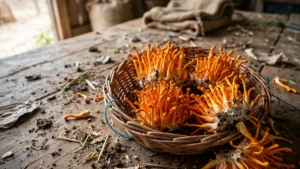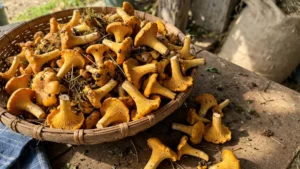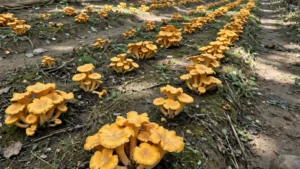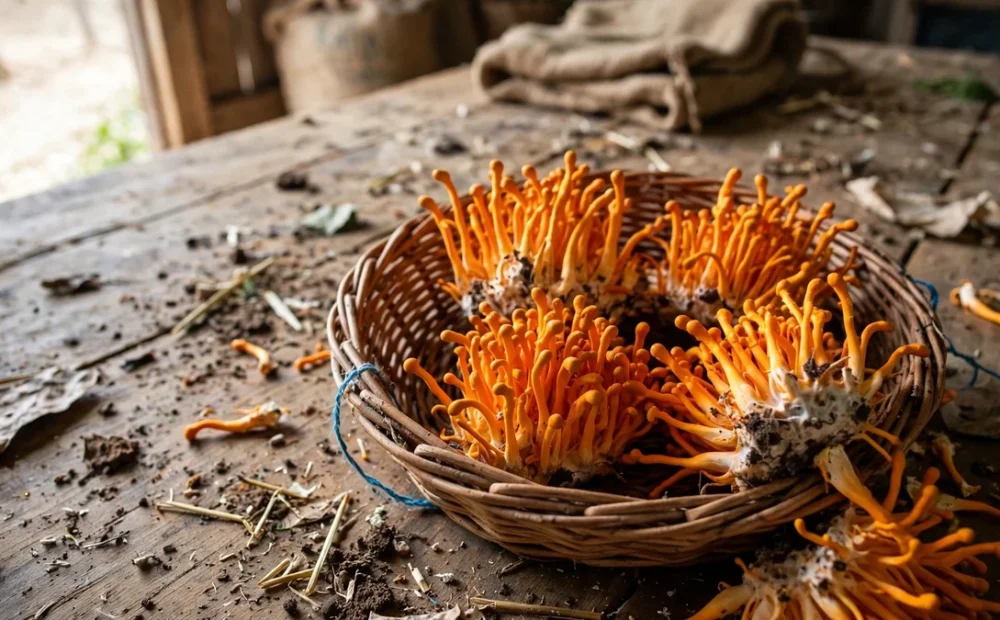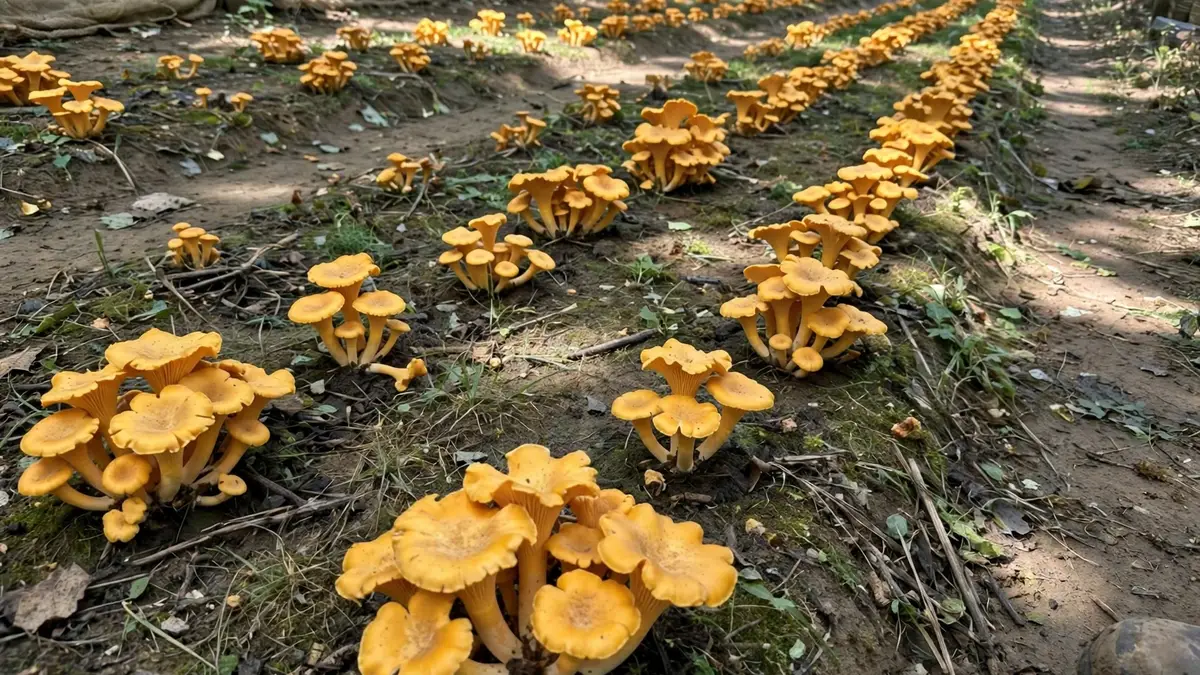
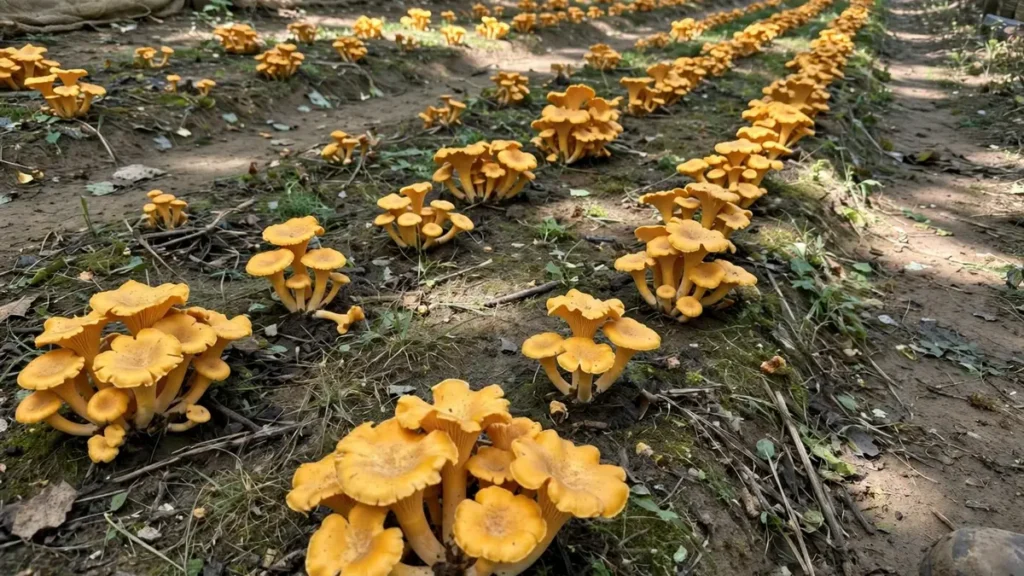
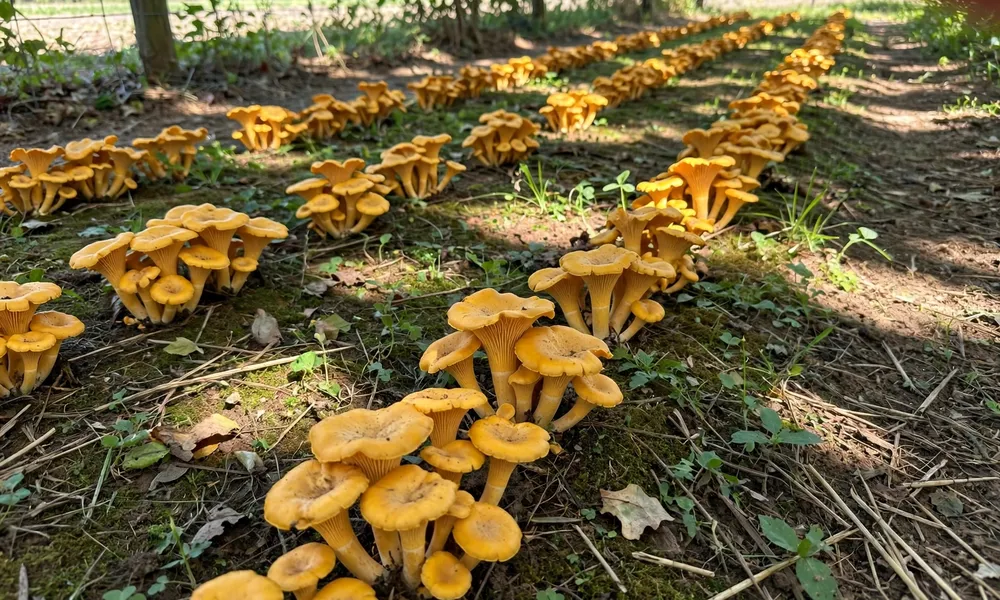
A chanterelle announces itself by smell before you ever spot it. Cantharellus cibarius carries a scent of apricots and dried leaves, and its cap is the colour of egg yolk, wavy at the rim and shaped like a small trumpet. Underneath, blunt ridges fork and run down the stem where a button mushroom would have thin, separate gills. The flesh inside is pale, firm and faintly sweet, and it holds up in hot butter while softer mushrooms turn to water.
On a chanterelle farm stay you rise before the sun, take a basket into mossy woods, and follow a guide who reads the ground the way other people read a map. Beech, oak, birch and pine slopes are the hunting ground, and the morning ends with cleaning, sautéing and bottling what you found. The farms here range from a four-room family house where supper is cooked by the owner, to a proper estate with a pool, a drying barn and a dining room that seats thirty. Every one of them gathers chanterelles on land it owns, sleeps guests on site, and lets you walk the woods yourself.
A night costs roughly seventy dollars at the simplest farmhouse and close to one hundred and seventy at the grandest suite with meals and walks included. Choose the region first, then decide how much gathering and cooking you want in the day.
Key takeaways
- Chanterelle is Cantharellus cibarius, a golden trumpet-shaped wild mushroom with blunt ridges in place of gills, an apricot scent and a peppery edge.
- It fruits in partnership with beech, oak, birch and pine, so a chanterelle stay is a woodland stay, and the season runs from high summer into autumn.
- The stays worth booking gather on their own ground, cook chanterelles every day, and walk the woods with every guest.
- Ask what the nightly rate actually includes, because guided walks, meals, transfers and cooking classes are often charged apart.
- Chanterelle itself has no gluten, but the kitchens bake with flour, so ask about gluten before you sit down to eat.
What chanterelle actually is
Chanterelle is a wild mushroom that lives in partnership with tree roots, which is why no farm on this list grows it in a shed. Its cap is golden yellow, wavy at the edge and hollow in the middle, and the underside carries blunt, forked ridges that run down the stem instead of the thin gills of a shop mushroom. Slice one open and you find pale, dense flesh with a smell of apricots and wet moss.
Its flavour is delicate and peppery at the same time, with a fruity note that survives the pan. Fresh chanterelle fries well in butter and stays firm, while dried chanterelle turns into a different ingredient altogether: deep, earthy and savoury, with a soaking liquid that works as a stock. The kitchens below dry as much as they cook fresh, and a jar of dried caps is the souvenir most guests carry home.
Do not confuse it with its relatives or its lookalikes. Porcini is Boletus edulis, brown-capped with a thick stem and a spongy pore layer. Morel is a spring mushroom with a pitted, honeycomb cap. Shiitake is an Asian mushroom cultivated on logs. None of them smells of apricots, none of them carries blunt ridges instead of gills, and none of them cooks the way chanterelle does. If a woodland picking trip appeals to you in general, our porcini farm retreats follow the same pattern in the same European woods, with a brown-capped bolete in the basket instead of a golden chanterelle.
How we picked these nine farm stays
Each stay below gathers chanterelles in its own woodland, puts guests up on the farm, and walks the woods with them while the season lasts. We favoured farms that state a nightly rate openly, explain what meals and transfers cost, and send a guide out with every group instead of lending a map and a basket. The nine cover France, Italy, Austria, the Czech Republic, Hungary, Slovenia and Croatia, so a stay can sit beside a city break or a country week without a second flight.
Farms that buy mushrooms at a market were cut, as were resorts that drive guests to a forest once a week and stays with no woodland of their own. A chanterelle stay ought to smell of damp moss at breakfast and taste of butter and cream by supper. A place that offers neither is a hotel that happens to serve mushrooms, and it does not belong here.
The 9 best chanterelle farm retreats of 2027
Loire Chanterelle Woodland Stay, Paris
What we like: A walled wood an hour from Paris, four guest rooms, a shaded drying shed and beech slopes ten minutes from the door. The dawn walk is proper foraging, and the cream-sauce class in the afternoon is generous. What to consider: Rooms are plain, the lane is narrow, and there is no pool. Best For: A first chanterelle trip out of Paris. Style: Working woodland farm. Price Range: $73–$109 a night, breakfast included. Standout Feature: Chanterelles sliced by hand in the drying shed.
Give it two nights and the rhythm settles: a walk on the first morning, a cooking class on the first afternoon, and chanterelles in cream on the second evening. The guides know the beech slopes by heart and point out a fresh cap from one past its best without a second glance.
Burgundy Chanterelle Forest Retreat, Lyon
What we like: Oak woods above a river, a small pool, and a kitchen that turns the morning’s basket into lunch. The light on the terrace in the evening beats every other stay here. What to consider: The path from the road climbs steeply, and the nights are very quiet. Best For: Couples wanting a view with their foraging. Style: Hillside forest farm. Price Range: $87–$131 a night, breakfast included. Standout Feature: Oak woods above the river.
Ask for the upper room. It takes the morning light across the trees and stays cooler than the ground-floor rooms when the afternoon heats up.
Langhe Chanterelle Oak Stay, Turin
What we like: Oak slopes below the Alps, a dog that hunts truffles in winter and mushrooms in summer, and a farmhouse serving chanterelle pasta with eggs from its own hens. The dawn light on the slopes is superb. What to consider: Winters are cold and damp, and little English is spoken outside the main house. Best For: Slow mornings beneath the oaks. Style: Alpine oak farm. Price Range: $81–$121 a night, breakfast included. Standout Feature: Chanterelle pasta with eggs from the farm hens.
Get out onto the oak slopes before breakfast. The ground is soft, the air carries leaf mould, and the baskets fill quickest in the first hour.
Chianti Chanterelle Pine Retreat, Florence
What we like: A short ride from Florence, pine woods, a Saturday market close by and a garden kitchen teaching chanterelles in cream alongside soup. What to consider: Weekends book up quickly, and the woods are smaller than at the other farms here. Best For: A weekend added to a Florence trip. Style: Pine-wood farmhouse. Price Range: $93–$141 a night, breakfast included. Standout Feature: Chanterelles in cream from a garden kitchen.
Come on a Friday and the weekend lines up neatly: market on Saturday morning, a walk on Saturday afternoon, and a slow breakfast on Sunday before the ride back to the city.
Salzburg Chanterelle Forest Stay, Vienna
What we like: Cool air smelling of pine, lakes along the fence line, and a farm gathering chanterelles beside porcini and wild herbs. The roasted chanterelle suppers stand out. What to consider: Rain comes often, the drive from Vienna can take ninety minutes, and the rooms are basic. Best For: A cool break from Vienna. Style: Lakeside forest farm. Price Range: $68–$104 a night, breakfast included. Standout Feature: Chanterelles, porcini and herbs from one slope.
Come for the golden caps and linger for the lake. The farm keeps a small dock, and a swim in the evening after a day in the woods repays the early start.
Moravian Chanterelle Woodland Retreat, Prague
What we like: A working forest farm with a big drying barn and a family gathering chanterelles for three generations. The chanterelle and barley soups are excellent. What to consider: High summer is hot, the walks begin early, and the rooms use fans rather than air conditioning. Best For: Dawn walks and woodland mornings. Style: Forest farm with drying barn. Price Range: $75–$113 a night, breakfast included. Standout Feature: Three generations gathering chanterelles.
Walk at dawn to the oldest beech stand. The farm’s finest caps grow there, and the day’s meal takes shape before lunch is even thought of.
Mátra Hills Chanterelle Forest Stay, Budapest
What we like: A polished farm an hour from the city, air-conditioned rooms, a proper restaurant and a mushroom festival while the season runs. The chanterelle goulash is cooked on site. What to consider: It feels more like an estate than a farm, and the walks run shorter than elsewhere. Best For: Comfort with a woodland flavour. Style: Polished estate farm. Price Range: $83–$125 a night, breakfast included. Standout Feature: Chanterelle goulash from the farm kitchen.
For tidy rooms and a real restaurant with muddy boots still allowed, this is the middle ground. If the mushroom festival falls on your dates, plan around it.
Kamnik Alps Chanterelle Pine Retreat, Ljubljana
What we like: The simplest logistics here, a farm in the hills above the city, guided walks and a cafe serving chanterelle toast all day. What to consider: The dearest stay on this list, small grounds, and the city never quite disappears. Best For: A single-night taster. Style: Hillside farm cafe. Price Range: $107–$163 a night, breakfast included. Standout Feature: Chanterelle toast in the farm cafe.
A single night does the job. Walk in the morning, eat toast at noon, and return to the city for dinner carrying a jar of dried caps.
Slavonian Chanterelle Oak Stay, Zagreb
What we like: A Croatian farm with sea views, a stone barn for drying and a host family folding chanterelles into every meal. The pace is the gentlest of the nine, and that is praise. What to consider: The journey here costs the most, the weather turns within an hour, and the wifi drops out. Best For: A long, slow southern stay. Style: Sea-view family farm. Price Range: $97–$147 a night, breakfast included. Standout Feature: Chanterelle soup beside a stone fireplace.
Stay three nights at least. The first day settles you in, the second is for walking, and the third builds toward the barn supper, which takes all afternoon and earns every minute.
Which region suits which traveller
Begin in France, where chanterelle is a woodland staple, the farms know guests well, and a stay sits easily beside Paris or Lyon. Cooking matters most in the Loire and Burgundy, where cream sauces, soups and dried slices are everyday food rather than an occasion. Italy fits a longer food trip better: the Langhe for oaks and pasta, Chianti for pine woods and markets.
For a short stay, look to Austria and the Czech Republic. Salzburg offers lakes and roasted suppers, Moravia offers drying barns and dawn walks. Budapest and Ljubljana are the comfortable choices, while Zagreb is the outlier and the prize: hardest to reach, slowest in pace, and the only place serving chanterelle soup by a stone fireplace. Our morel farm retreats cover a similar spread of regions in spring, for travellers who would rather chase a honeycomb-capped mushroom than a golden one.
The caveats that matter
Chanterelle is a safe, well-loved mushroom, but it grows wild, and wild mushrooms deserve respect. Eat nothing you picked yourself until a guide has checked it, and never eat chanterelle raw: cook it through. The kitchens bake with flour, so anyone avoiding gluten should ask before ordering pasta, goulash or toast. The rest comes down to weather, mud and the distance to the nearest town.
| Detail | What is known |
|---|---|
| What it is | Cantharellus cibarius, golden funnel-shaped wild mushroom, apricot scent, blunt ridges not gills |
| Where it grows | In partnership with beech, oak, birch and pine roots, summer into autumn |
| Can it be eaten raw | No, chanterelle must be cooked through, and only after a guide has checked the pick |
| Best-known dishes | Chanterelles in cream, chanterelle pasta, chanterelle soup, sautéed chanterelles, dried chanterelle stock |
| Who should ask first | Anyone avoiding gluten, and anyone with a mushroom allergy |
| What to pack | Closed shoes for mud, a basket or bag, sun protection, a light rain layer |
| How far ahead to book | Four to six weeks for the autumn season, two weeks outside it |
| What it is not | Not porcini, not morel, not shiitake, despite the shared kitchen |
A last practical point: stays in this series are small, and summer weekends go first. When your dates are fixed, secure the room before the train ticket. A farm with only three guest rooms cannot conjure a fourth one for you.
Checklist: before you book a chanterelle farm stay
Go through these checks before you pay, and again in the week you travel.
- Check the season dates: ask the farm which weeks the caps are really coming up, not only when rooms are free.
- Check what the rate includes: meals, transfers, guided walks and the cooking session are sometimes charged apart.
- Raise the food questions early: gluten in pasta and goulash, dairy in cream sauces, and any mushroom allergy in your group.
- Check the ground underfoot: closed shoes, gloves for handling, and a bag you are happy to get muddy.
- Check the pickup: who collects you, from which station, and what happens when your flight runs late.
- Check the wet-weather plan: heavy rain turns the paths to mud, so hold one day open for indoor cooking.
Frequently asked questions
Is chanterelle the same thing as a button mushroom?
No. Chanterelle is Cantharellus cibarius, a wild mushroom with a golden funnel cap and blunt ridges beneath, while the button mushroom is Agaricus bisporus, a cultivated mushroom with true gills. They taste nothing alike, and chanterelle is far firmer and more fragrant in the pan.
How is chanterelle different from a false chanterelle?
The false chanterelle is Hygrophoropsis aurantiaca, a thinner orange mushroom with true, crowded gills and a paler stem, and it lacks the apricot scent. A true chanterelle has blunt ridges that fork and run down the stem, firm pale flesh, and a fruity smell. When in doubt, the guide decides, never the guest.
Can I eat chanterelle raw?
No. Chanterelle must be cooked through, and you should only eat mushrooms a guide has checked. Raw wild mushrooms can upset the stomach, and a wrong identification can be dangerous, so the rule on every farm here stays simple: the guide checks, the kitchen cooks.
When is the best month to visit a chanterelle farm?
The fruiting season runs from summer into autumn, with September often the most reliable month. Ask the farm itself, because the exact weeks move with the weather and change between France, Italy and Croatia.
Do chanterelle farm stays suit children?
Often yes. Foraging is physical and muddy, which children usually love, and the cooking sessions are hands-on. Ask the farm about age limits, steep ground and the forecast, and pack sturdy closed shoes for the whole party.
Is chanterelle gluten-free?
The mushroom itself carries no gluten, but many farm dishes are not gluten-free. Pasta, goulash and toast made with chanterelles contain flour, so ask before you order, and tell the kitchen if you need a gluten-free plate.
The bottom line
The best chanterelle farm retreat in 2027 is the one that fits how hands-on you want to be. The Loire and Burgundy are the easiest first stays, with chanterelle dishes at every meal. The Langhe, Chianti and Salzburg suit travellers folding a farm into a longer food trip, while Zagreb rewards those who can spare the time and the flight. Our oyster mushroom farm retreats are the closest alternative if you would rather stay at a cultivated mushroom farm than a woodland one.
Book the fruiting weeks, settle what the rate covers, pack for mud, and arrive hungry. A chanterelle farm stay is at its best when you walk in the morning and eat what you gathered by the evening, with moss on your shoes and the smell of cream sauce in the air.