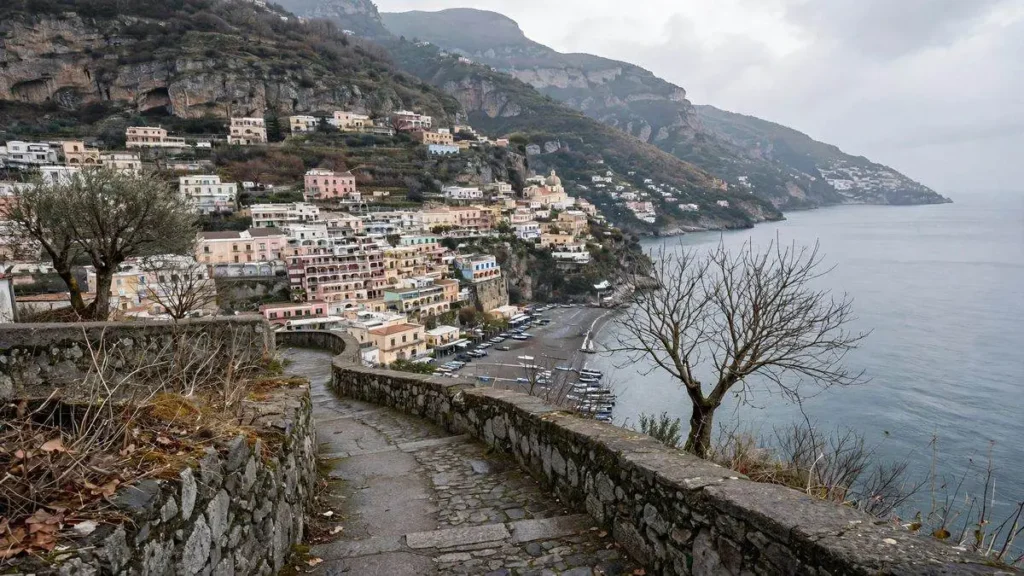
The Amalfi Coast in winter is a different place from the one on the summer postcards. The crowds thin out, the beach clubs close, and the villages of Positano, Amalfi and Ravello settle back into the quiet rhythm of the people who live there. What you get in return is space: empty lanes, tables without a wait, and the same sea light without the crush of August.
Winter here is mild by northern European standards, but it is not warm. Days usually reach 10 to 15 degrees, nights drop to between 3 and 9 degrees, and rain arrives often, sometimes every second day. The sea is far too cold for swimming, most ferries stop at the end of October, and many big hotels close until spring. That changes what belongs in your suitcase: layers, grip, and a waterproof shell.
This guide covers what winter here is really like, so you can pack once and pack right: the weather month by month, clothing for cool mornings and mild afternoons, footwear for wet stone steps, and what to leave at home, because an overstuffed suitcase is its own problem on a coast of stairs.
Key takeaways
- Winter days usually reach 10 to 15 degrees, nights 3 to 9, so pack layers rather than one heavy coat.
- Rain is frequent from December to February, so a waterproof jacket and grippy shoes matter most.
- Most ferries stop at the end of October and many large hotels close until spring, so base yourself in Amalfi or Sorrento.
- The SITA bus runs all year, making it the most reliable way to travel between towns in winter.
- Leave swimwear, beach towels and high heels at home, and bring a daypack, a compact umbrella and a scarf.
Winter weather on the Amalfi Coast, month by month
December brings festive lights and the Christmas markets of nearby Salerno, with highs often around 13 to 15 degrees. January is the coldest and quietest month, with highs nearer 12 to 14 degrees. February stays mild and damp at 13 to 14 degrees, with spring’s first hints by month’s end. Across all three months the pattern is the same: cool, changeable weather, pleasant sunny spells at midday, and damp, breezy evenings that demand a proper jacket.
Rain is the detail most visitors underestimate: showers can arrive on roughly every second day, with November the wettest month and December, January and February all bringing their share. Expect wet spells, plan indoor options for rainy afternoons, and always carry a waterproof layer. The sea sits between about 12 and 18 degrees, far too cold for swimming, and rough seas can cancel boat trips.
Daylight is short, so sightsee in the morning and save late afternoons for a long lunch or a museum. The low winter sun gives the cliffs a softer light, and the viewpoints crowded in summer are often empty. A warm layer you can add as the light fades makes the difference between enjoying the sunset and hurrying back cold.
| Month | Daytime high | Night-time low | Rain | What to expect | Pack first |
|---|---|---|---|---|---|
| December | 13 to 15°C | 8 to 10°C | Frequent showers | Festive lights, Christmas markets | Waterproof jacket, warm layers |
| January | 12 to 14°C | 7 to 9°C | Frequent showers | Coldest month, fewest visitors | Warm coat, scarf, gloves |
| February | 13 to 14°C | 8 to 9°C | Frequent showers | Mild and damp | Layers, umbrella, grippy shoes |
| November | 15 to 18°C | 10 to 13°C | Wettest month | Season winding down | Rain shell, light knitwear |
| March | 15 to 17°C | 9 to 11°C | Less rain | Spring arriving, longer days | Light jacket, layers |
| Evenings | 3 to 9°C | Chilly by the sea | Sea breeze | Cool after sunset | Scarf, warm layer |
| Sunny midday | Up to 17°C | Feels warmer | Clear spells | Pleasant for walking | Sunglasses, light layer |
| Rainy days | 10 to 13°C | Damp and cool | Heavy at times | Wet stone steps | Waterproof boots, umbrella |
The layering system that actually works
The best packing strategy is layering. Temperatures swing through the day: a cold morning on a shaded lane, a warm midday on a sunny terrace, a chilly evening by the water. A single heavy coat leaves you sweating or shivering, while layers let you adjust. Start with a light thermal base layer, add a knit jumper or fleece, and finish with a waterproof outer shell. That combination handles almost every winter day and packs smaller than a bulky coat.
Choose fabrics that cope with damp air: merino wool and good synthetics keep you warm even when damp, while cotton stays cold and clammy once wet. Bring two or three mid-layers rather than one thick jumper, so you can wash and rotate them, and pack a smart-casual outfit for evenings. Winter dining here is relaxed, but a neat jumper, dark trousers and clean shoes fit in everywhere. A scarf is the hardest-working item in your bag: real warmth on breezy cliff paths, almost no weight.

Footwear: the most important decision you will make
If one packing choice decides whether your trip is comfortable, it is footwear. The coast is built on stairs: steep stone steps connect the beaches to the villages, the bus stops to the hotels, and the viewpoints to the piazzas. In winter those steps are often wet, and smooth soles are a genuine hazard. Bring comfortable walking shoes with a good tread, broken in before you travel, and make sure they are waterproof or water-resistant.
Pack two pairs if you can: waterproof walking shoes for daily exploring, and a smarter pair for evenings, so you are not sitting down to dinner in muddy trainers. High heels are dangerous on wet stone, brand-new shoes will blister you within a day, and flip-flops have no place on a winter coast. For the Path of the Gods above Positano, proper shoes with grip are essential, and the path is at its best in winter, when the crowds are gone.
What is open, and what is closed, in winter
Winter changes the coast more than the weather does. Most large four- and five-star hotels close at the end of October and reopen around Easter, and many beach clubs and beachfront restaurants close from mid-October. Roughly half of the restaurants in smaller villages close for the season, and the coastal ferries linking Salerno, Amalfi, Positano, Sorrento and Capri generally run from April to October only. Smaller hotels and apartments stay open through winter, often at much lower rates, and Amalfi, a year-round town, keeps its cathedral, cafes and a good share of its restaurants open.
Where you base yourself matters more in winter. Amalfi is the liveliest town in the colder months, with open cafes and the best bus connections, making it the most practical base. Sorrento is another strong choice: a working town with restaurants, shops and a train station, and an easy starting point for day trips. Positano is beautiful and almost empty in January and February, magical for a day visit but too quiet as a base. Ravello, high above the sea, is peaceful and atmospheric, and the gardens of Villa Rufolo generally stay open. Wherever you stay, check opening hours before you book and call ahead to restaurants.
Getting around in winter
With the ferries mostly gone, the SITA bus becomes the backbone of a winter trip. Buses run all year along the coast road, the SS163, connecting Sorrento with Positano and Amalfi, and Amalfi with Salerno, on a reduced but reliable winter timetable. They are the most reliable way to get around, except when heavy rain closes the road. The Circumvesuviana train connects Naples and Sorrento all year, and the SITA bus leaves from in front of Sorrento station.
Driving is a realistic option in winter for the first time all year. The SS163, a narrow road about seven metres wide for two-way traffic, is far calmer without the summer gridlock, and the seasonal licence-plate restrictions do not run from November onwards. It still demands a confident driver used to narrow mountain roads, and the limited traffic zone in Positano runs all year. Buses do not run on Christmas Day or New Year’s Day, and services are reduced on other holidays.
What to leave at home
Packing well is as much about what you leave behind. Swimwear and beach towels belong in the summer suitcase: the sea is too cold for swimming from December to February, and the beach clubs are closed. Leave the heavy hard-shell suitcase, the high heels and the brand-new shoes at home, and skip the bulky parka built for snow, which will be too warm on a mild afternoon and too heavy to carry. A waterproof shell and layers do the job better.
Italy uses plug types C, F and L, with 230 volts, so bring a travel adapter and a small power bank: a cold phone battery drains faster, and you will rely on your phone for bus times and maps. A reusable water bottle is useful, and a small first-aid kit with blister plasters is worth its weight on a coast of stone steps. If you are travelling for a special occasion, see our guide to the best honeymoon destinations for 2027, and if you are choosing luggage, our round-up of the best versatile bags for 2027 covers bags that work from the airport to the clifftop path. For evenings out, our guide to the best summer designer bags for 2027 is a useful starting point.
The winter packing checklist
- Waterproof jacket with a hood, plus a compact umbrella.
- Two or three warm mid-layers.
- Waterproof walking shoes with good grip, plus a smarter pair for evenings.
- Scarf, warm hat and light gloves for breezy mornings and evenings.
- A daypack, a reusable water bottle, sunscreen and lip balm.
- Travel adapter, a power bank, and blister plasters.
Frequently asked questions
Is the Amalfi Coast worth visiting in winter?
Yes, if you come for the right reasons. Winter brings quiet villages, lower prices, empty viewpoints and a more local atmosphere. It is not the trip for swimming or ferry-hopping, so come for walking, food, history and the coast itself.
What temperatures should I expect in December, January and February?
Daytime highs are usually 10 to 15 degrees: December is often the mildest at 13 to 15 degrees and January the coldest at 12 to 14 degrees. Nights fall to between 3 and 9 degrees, and sunny midday spells can reach 17 degrees, so layers are the practical answer.
Does it rain a lot on the Amalfi Coast in winter?
Yes, with showers on roughly every second day in winter. Bring a waterproof jacket and grippy shoes, carry a compact umbrella, and keep a flexible plan with indoor options, such as museums and long lunches, for wet afternoons.
Do ferries run on the Amalfi Coast in winter?
Mostly not. The coastal ferries between Salerno, Amalfi, Positano and Sorrento generally run from April to October, and the last Positano to Capri sailings usually end in early November. In winter, travel by SITA bus, taxi or hire car.
What is open in winter on the Amalfi Coast?
Amalfi stays the liveliest town, with its cathedral, cafes and a good share of restaurants open, and smaller hotels and apartments stay open through winter. Many large hotels and beach clubs close until spring, and roughly half the restaurants in smaller villages shut, so check hours and call ahead.
What should I wear for dinner in winter?
Smart-casual is the norm. A neat jumper, dark trousers or a dress, and clean, comfortable shoes fit in everywhere. Add a scarf and a smart coat for the walk there, and leave formal evening wear at home.
The bottom line
The Amalfi Coast in winter asks for a different kind of packing, and rewards it. Layers instead of linen, grip instead of glamour, a waterproof shell instead of a beach bag: that is the whole secret. Pack that way and you get the coast at its most honest, with empty lanes, honest prices, and the cliffs and sea to yourself. The villages do not shut down in winter; they return to the people who live there.
Before you zip the case, check the forecast for your dates, confirm your hotel is open for the winter season, and check the SITA bus timetable for your first day. Then stop worrying about the bag and look forward to the trip: a quiet morning in Amalfi, a walk above Positano, and an evening in Ravello with the lights coming on across the coast.
Note: opening hours, ferry schedules and bus timetables change from season to season, so confirm the details that matter with the hotel or operator before you travel.