Silver jewellery has a habit of turning on you. A necklace that was bright and shining in June can look grey and dull by October, and a favourite ring can lose its shine after a few weeks of everyday wear. That is not a fault in the silver. It is tarnish, a thin layer that forms when silver reacts with sulphur in the air, with skin, with perfume, and with the creams and lotions we use every day.
The good news is that most tarnish comes off easily, and most silver jewellery can be cleaned at home with warm water, a mild soap, and a soft cloth. The bad news is that the wrong method can do real damage. Silver dip solutions, toothpaste, baking soda pastes, and stiff brushes are all widely recommended online, and all of them can scratch the surface, strip the finish, or damage the stones set into a piece.
Below are nine steps for cleaning silver jewellery properly in 2027, from checking the piece before it touches water to storing it so it stays bright for longer. Each step explains what to do, what to avoid, and how long it takes, so you can clean with confidence instead of guessing.
Key takeaways
- Silver tarnish is a surface reaction, not damage, and it comes off with warm water, mild soap, and gentle polishing in most cases.
- Always check a piece for loose stones, a weak clasp, or a darkened antique finish before it touches water.
- Use a soft cloth and a soft brush only, and never use toothpaste, baking soda paste, or a silver dip on jewellery you care about.
- Dry silver completely before storing it, because dampness speeds up tarnishing and can mark the metal.
- Cleaning cannot repair a bent prong, a loose stone, or a worn-through plating, and a piece with damage should go to a jeweller rather than into a cleaning bath.
What cleaning silver jewellery actually means
Cleaning silver jewellery means removing tarnish and the everyday film of skin oils, lotion, and dust that dulls the surface. Tarnish is silver sulphide, a dark compound that forms on the surface of the metal. It is not dirt in the usual sense, and it is not a sign that the silver is poor quality. Even good sterling silver, which is 92.5 percent silver, tarnishes, because the other 7.5 percent of the alloy and the silver itself both react with sulphur compounds in the air.
That matters because the cleaning method has to match the problem. A gentle wash removes the film and light tarnish. A silver polishing cloth removes heavier tarnish by taking off a very thin layer of the surface.
The other thing to understand is that silver jewellery is not all the same. Solid sterling silver can be washed and polished. Silver-plated jewellery has only a thin layer of silver over another metal, and that layer wears away if it is rubbed hard or soaked in chemicals. Oxidised or antiqued silver has a deliberately darkened finish in the grooves, and aggressive cleaning removes it. Knowing what you own is the first step, and it decides everything that follows.
What you need and what to look for
You need very little. A bowl of warm water, a few drops of mild, fragrance-free washing-up liquid or hand soap, a soft lint-free cloth, a soft-bristled brush such as a baby toothbrush, and a silver polishing cloth. That is the whole kit. If you do not have a silver polishing cloth, a soft microfibre cloth will do for drying, but it will not remove heavier tarnish as well as a cloth made for the job.
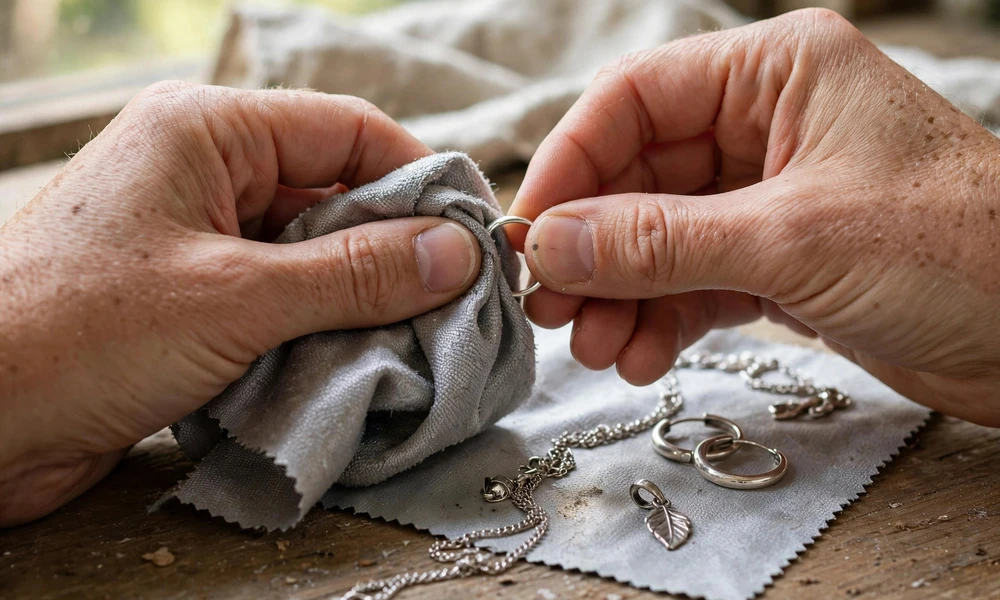
Look at the piece before you begin. Check the stones by pressing each one gently with a fingertip. If a stone moves, do not soak the piece. Check the clasp and the links of a chain by holding them up to the light. If a link is stretched open or a clasp is loose, cleaning can wait until a jeweller has looked at it. Check the finish too. If the silver has dark grooves that look deliberate, as on an engraved ring or an antique-style bracelet, that is an oxidised finish, and you should clean around it gently rather than polishing it away. Our guide to cleaning gold jewellery follows the same check-first approach, because the risks are the same even though the metals behave differently.
What you do not need is a silver dip, a home remedy paste, or a ultrasonic cleaner. Silver dips are fast, but they are harsh, they smell of chemicals, and they can damage pearls, turquoise, opals, and other soft stones. An ultrasonic cleaner can loosen stones. Keep the kit simple and the method gentle.
The 9 steps to clean silver jewellery properly
Look at the piece before it touches water
What to do: Hold the piece up to the light and check every stone, clasp, link, and setting. Note any damage before you start, so you do not blame the cleaning later. What to avoid: Do not skip this step, and do not clean a piece with a loose stone or a damaged clasp. Best for: Every piece, every time. Time needed: 2 minutes. Standout tip: Work over a tray or a towel, so a dropped earring or a loose stone does not roll away or fall down a drain.
Wash your hands and lay out a soft cloth
What to do: Wash your hands with soap and dry them, then lay a clean, soft, lint-free cloth on a flat surface. What to avoid: Do not work on a hard surface such as a bare countertop, where a piece can be scratched or chipped. Best for: Rings, earrings, and small pieces that are easy to drop. Time needed: 2 minutes. Standout tip: A white or pale cloth helps, because you can see the tarnish coming off and you can see a small stone if it falls.
Mix a gentle soap solution
What to do: Fill a small bowl with warm, not hot, water and add two or three drops of mild, fragrance-free washing-up liquid or hand soap. Stir gently. What to avoid: Do not use hot water, which can loosen glue in settings, and do not use a soap with moisturisers, fragrance, or antibacterial agents. Best for: All silver jewellery, including pieces with stones. Time needed: 2 minutes. Standout tip: If the water feels hot on the inside of your wrist, let it cool before you put the jewellery in.
Soak solid silver for ten minutes
What to do: Place solid sterling silver pieces in the solution and leave them for up to ten minutes. What to avoid: Do not soak silver-plated jewellery, and do not soak pieces with pearls, opals, turquoise, or glued-in stones. Those should be wiped with a damp cloth only. Best for: Solid sterling silver chains, rings, and bracelets. Time needed: 10 minutes. Standout tip: Set a timer, because a long soak does not clean better and it gives water more time to reach into settings and under stones.
Clean the details with a soft brush
What to do: Lift the piece out of the water and brush the details gently with a soft-bristled brush, using light, short strokes along the grooves and around the settings. What to avoid: Do not press hard, do not use a stiff brush, and do not brush across a stone. Best for: Engraved pieces, chains with textured links, and rings with detailed settings. Time needed: 3 minutes per piece. Standout tip: A baby toothbrush is ideal, because the bristles are soft and the head is small enough to reach into details without catching on prongs.
Polish with a silver cloth
What to do: Rub the piece gently with a silver polishing cloth, using long, straight strokes in one direction. What to avoid: Do not rub in circles, do not use a cloth that has been washed, and do not polish a deliberately darkened antique finish. Best for: Solid sterling silver with visible tarnish. Time needed: 3 to 5 minutes per piece. Standout tip: Work in sections and turn the cloth as it darkens, so you are always polishing with a clean part of the cloth.
Rinse under lukewarm running water
What to do: Rinse the piece under slow, lukewarm running water, holding it firmly, and put the plug in the sink first. What to avoid: Do not rinse under a strong jet of water, and never rinse over an open drain. Best for: Every piece that has been soaked or brushed. Time needed: 1 minute. Standout tip: A small sieve or a colander in the sink is a good safety net if a piece slips from your fingers.
Dry it completely, never leave it damp
What to do: Pat the piece dry with a soft, lint-free cloth, then leave it on a clean cloth for a few minutes so the air can reach into the settings and the chain links. What to avoid: Do not rub it dry, do not use a hairdryer, and do not put it away while it is still damp. Best for: Every piece, especially chains and pieces with hollow settings. Time needed: 5 minutes. Standout tip: Hold a chain up and let the links separate so the water trapped between them can dry, rather than sitting inside the links and causing fresh tarnish.
Store it clean, dry and separate
What to do: Store each piece in its own soft pouch or compartment, with the clasp fastened, away from light, heat, and humidity. What to avoid: Do not throw silver into a drawer with other jewellery, where it will be scratched and tangled, and do not store it in a bathroom. Best for: Every piece, and especially pieces you wear only occasionally. Time needed: 2 minutes. Standout tip: An anti-tarnish strip or a small silica gel packet in the pouch slows tarnishing noticeably, and it costs very little.
Which cleaning method is right for your silver
The right method depends on what the piece is made of and what is set into it. Solid sterling silver is the most forgiving. It can be soaked, brushed, and polished with a silver cloth, and it will come back bright. Silver-plated jewellery needs a lighter touch. Wipe it with a damp, soapy cloth, rinse it gently, and dry it at once. Do not polish it hard, because the silver layer is thin and it will wear through to the metal underneath.
Pieces with stones need a different approach again. Hard stones such as diamonds, sapphires, and rubies can be washed and brushed gently. Soft and porous stones such as pearls, opals, turquoise, and malachite should never be soaked, and they should never meet a silver dip or an ultrasonic cleaner. Wipe them with a damp cloth and dry them at once. If you are unsure what a stone is, treat it as soft. Our guide to storing jewellery properly explains how to keep different pieces separate, which matters just as much for cleaning, because a hard stone can scratch a soft one while they sit together in a box.
Antiqued or oxidised silver is a special case. The dark finish in the grooves is deliberate, and it is part of the design. Clean the raised surfaces with a soft cloth, leave the grooves alone.
The caveats that matter
Silver cleaning is straightforward, but there are limits. A home clean cannot fix a bent prong, a loose stone, a broken clasp, or a plating that has worn away. It cannot restore a piece that has been scratched by years of hard polishing, and it cannot bring back the shine on silver that has been thinned by repeated dipping. If a piece has real damage, or if it is valuable, take it to a jeweller and ask for a professional clean. It is a small cost, and it avoids turning a small problem into a lost stone.
| Detail | What is known |
|---|---|
| What tarnish is | A surface layer of silver sulphide, caused by sulphur in the air, skin, and lotions |
| Safest home method | Warm water, mild soap, a soft brush, and a silver polishing cloth |
| Soak time | Up to ten minutes for solid sterling silver; never soak plated silver or soft stones |
| What never to use | Toothpaste, baking soda paste, silver dip, stiff brushes, and ultrasonic cleaners on set stones |
| Plated silver | Wipe only, with a damp soapy cloth, and dry at once; the silver layer is thin and wears away |
| Soft stones | Pearls, opals, turquoise, and malachite should never be soaked or dipped |
| Antiqued finish | Clean the raised surfaces only; polishing or dipping removes the deliberate dark finish |
| What cleaning cannot fix | Bent prongs, loose stones, broken clasps, worn plating, and deep scratches |
If a piece is valuable, inherited, or set with stones you cannot identify, ask a jeweller before you clean it.
Checklist: cleaning silver jewellery honestly
Use these checks before you clean, and again before you put a piece away.
- Check the piece first: press each stone gently, check the clasp and the links, and note any damage before it touches water.
- Check the finish: solid sterling silver can be polished, plated silver should only be wiped, and an antiqued finish should be left in the grooves.
- Check your kit: warm water, mild soap, a soft cloth, a soft brush, and a silver polishing cloth, nothing harsher.
- Check the stones: never soak pearls, opals, turquoise, or malachite, and never put a set piece in an ultrasonic cleaner.
- Check the drying: pat dry, then leave the piece out for a few minutes so water can escape from settings and chain links.
- Check the storage: each piece in its own pouch or compartment, clasp fastened, away from light, heat, and humidity.
Frequently asked questions
How often should I clean silver jewellery?
Clean it when it looks dull or tarnished, rather than on a fixed schedule. A piece worn daily may need a light clean every few weeks, while a piece worn rarely may need cleaning only once or twice a year. Regular wear actually slows tarnishing, because the friction of wearing it keeps the surface bright.
Can I use a silver dip on my jewellery?
You can, but it is best avoided. A dip dissolves tarnish quickly, but it also dissolves a little silver, it strips antiqued finishes, and it can damage soft stones. A gentle wash and a silver polishing cloth take a few minutes longer and are much safer for the piece.
Why does my silver tarnish so quickly?
Tarnish comes from sulphur in the air, in skin, in perfume, and in creams and lotions. Humidity speeds it up, which is why silver stored in a bathroom tarnishes faster.
Can I clean silver jewellery with toothpaste?
No. Toothpaste is an abrasive, and it leaves fine scratches on the silver. Those scratches dull the surface and give tarnish more places to take hold, so the piece tarnishes faster after cleaning than it did before. Warm soapy water and a silver cloth are safer and work better.
How do I clean silver jewellery with stones?
Hard stones such as diamonds and sapphires can be washed and brushed gently. Soft stones such as pearls, opals, and turquoise should only be wiped with a damp cloth and dried at once, never soaked. If you are unsure what a stone is, treat it as soft. A guide to silver nose studs shows how small set pieces are made, which is a useful reminder of how delicate a setting can be.
Does wearing silver jewellery stop it tarnishing?
It slows it down. The gentle friction of wearing keeps the surface bright, which is why a ring worn every day often stays shinier than one left in a drawer. It does not stop tarnishing completely, because skin, perfume, and lotions all contribute, so a regular light clean is still worth doing.
The bottom line
The best way to clean silver jewellery in 2027 is the simplest one. Check the piece first, wash it in warm water with a mild soap, brush the details gently, polish it with a silver cloth, rinse it, dry it completely, and store it separately. That routine handles most tarnish, it is safe for most pieces, and it does not risk the damage that harsher methods cause.
Keep the kit small and the method gentle, and take anything valuable, damaged, or set with a stone you cannot identify to a jeweller. Silver is a forgiving metal when it is treated well, and a few careful minutes every few weeks will keep it bright for years.