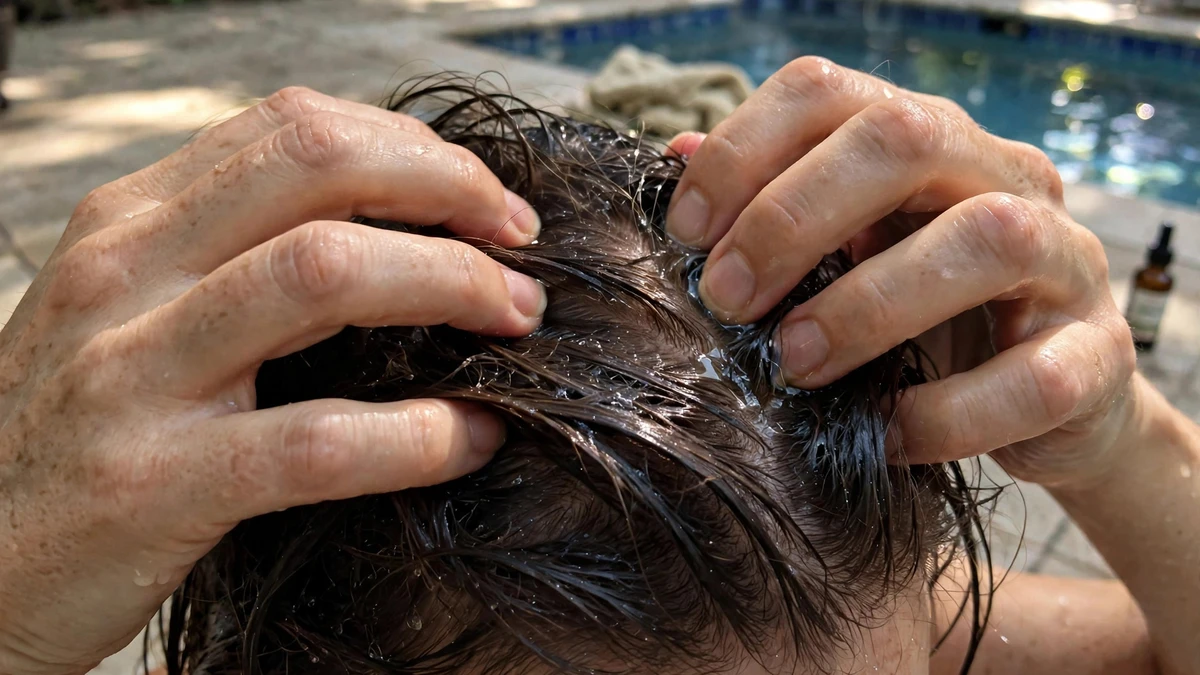

Most swimmers know the feeling. You get out of the pool, rinse off, and your hair feels rough, tangled and strangely light, as if something has been taken out of it. That something is moisture and natural oil, stripped away by chlorine, and the damage builds up with every swim. The fix is simple, cheap and takes less than a minute, yet most swimmers skip it: a few drops of hair oil, applied before you get in the water.
Hair oil works because it fills the gaps in the hair shaft before the pool water can. A coated strand absorbs far less chlorine and salt, the cuticle stays flatter, and the hair comes out softer and easier to comb. It is the same logic as putting on sunscreen before going out in the sun, a small step beforehand that saves a much bigger repair job afterwards.
This guide walks through the whole routine, from choosing the right oil to applying it, capping up, and washing it out properly afterwards. Each step is short, practical and written for real swim bags and real changing rooms, so you can start using it at your very next swim. No special equipment is needed, and the whole routine costs less than a single salon treatment.
Key takeaways
- Apply hair oil to damp hair before swimming, not dry hair, so it spreads evenly and stays put.
- Two to five drops is enough for most hair; thick or curly hair needs more, worked through in sections.
- A swim cap plus oil protects far better than either one alone.
- Rinse and shampoo after every swim, because oil traps some chlorine and salt against the hair.
- No routine makes hair completely waterproof, and oil alone cannot repair hair that is already badly damaged.
Why oil before swimming works
Hair is porous, which means it soaks up whatever it sits in. In a pool, that is chlorinated water, and chlorine lifts the cuticle and oxidises the oils and pigments inside the strand. In the sea, it is salt water, which draws moisture out as it dries and leaves salt crystals behind. Both leave hair dry, rough and prone to tangling, and both get worse the more often you swim.
Oil changes that equation. A thin layer of oil on the hair shaft repels water, so less of it soaks in, and it smooths the cuticle, so strands slide past each other instead of catching and snapping. The effect is not dramatic on the first swim, but over a season of regular swimming it is the difference between hair that needs a trim and hair that needs a rescue.
The science is simple enough that you do not need to take it on trust. Wet a strand of hair, coat it in oil, and put it in a glass of water next to an uncoated strand. The oiled strand stays lighter and drier for far longer. That is exactly what happens on your head, just on a smaller scale and with more at stake.
What you need before you start
You do not need much. A small bottle of hair oil, a wide-tooth comb, a swim cap, and a gentle shampoo for afterwards. Keep the oil in a small travel bottle if your usual bottle is large, because swim bags get knocked around and a leak will ruin everything else in the bag. A pump or dropper bottle is easier to use with wet hands than a jar.

Choose the oil for your hair, not for the prettiest bottle. Fine hair needs a light oil, such as camellia or moringa, while thick or curly hair can take a richer blend, such as argan or coconut. Colour-treated hair benefits from a bonding oil, and beach swimmers should look for a reef-friendly formula. If you are unsure where to start, our guide to how to use hair oil covers the basics of weight, amount and application for everyday use.
Finally, check your swim cap. A silicone cap grips better over oiled hair than a latex one, and a cap that fits well keeps more water out than a loose one, whatever the oil. If your cap is old and stretched, replace it before blaming the oil for slipping.
How to use hair oil before swimming: 9 steps
Step 1: Wet your hair with fresh water
What to do: Run your hair under a shower or tap before you apply anything, and squeeze out the excess water. What to avoid: Applying oil to bone-dry hair, where it sits on the surface and washes off fast. Best For: Every swimmer, every time. Time Needed: 30 seconds. Standout Tip: Hair that is already wet absorbs far less pool water than dry hair.
This is the step most people skip, and it matters more than the oil itself. Wet hair is already full of clean water, so there is less room for chlorinated water to soak in. Think of it as filling the sponge before the pool can.
Step 2: Warm a few drops of oil in your hands
What to do: Put two to five drops in your palms and rub them together for a few seconds until the oil feels warm and thin. What to avoid: Pouring oil straight onto your head, which leaves heavy patches and dry spots. Best For: Even coverage on all hair types. Time Needed: 10 seconds. Standout Tip: Warm oil spreads further, so you use less of it.
Oil straight from the bottle is thick and hard to spread. Warmed between your palms, it thins out and coats the hair evenly, which is exactly what a barrier needs to do.
Step 3: Work the oil through the lengths and ends
What to do: Smooth the oil over the mid-lengths and ends, where hair is oldest and most porous. What to avoid: Piling oil onto the roots, which makes the scalp greasy and the cap slip. Best For: Long, thick or curly hair. Time Needed: 20 seconds. Standout Tip: The ends need the most protection, because they have been through the most.
Roots are new growth and naturally oiled by the scalp, so they need the least help. Ends are years old, weathered and porous, so they need the most. Spend your oil where it counts.
Step 4: Comb it through with a wide-tooth comb
What to do: Run a wide-tooth comb from mid-length to ends, so the oil reaches every strand. What to avoid: Using a fine brush, which pulls and snaps wet hair. Best For: Tangle-prone and curly hair. Time Needed: 20 seconds. Standout Tip: A comb also detangles, so you start the swim with smooth hair.
Hands alone leave dry patches, and dry patches are where chlorine gets in. A wide-tooth comb spreads the oil evenly and gently, and it takes less time than fixing tangles afterwards.
Step 5: Add a little extra to the most exposed areas
What to do: Add one more drop to the hairline, the nape and any highlighted or bleached sections. What to avoid: Coating the whole head again, which wastes oil and weighs hair down. Best For: Colour-treated and highlighted hair. Time Needed: 10 seconds. Standout Tip: The hairline and nape sit closest to the waterline, so they take the most chlorine.
Not all hair is equally exposed. The strands at the edges of the cap and the lightest, most processed sections absorb the most water, so a small extra dose there is money well spent.
Step 6: Twist or braid long hair up
What to do: Twist long hair into a low bun or a loose braid before capping up. What to avoid: Leaving long hair loose under the cap, where it tangles and snags. Best For: Long hair, open-water swimmers. Time Needed: 20 seconds. Standout Tip: A braid keeps oiled hair contained and makes the post-swim comb-out far easier.
Loose hair under a cap moves around, rubs and tangles, and the oil cannot protect strands that are constantly shifting. A simple twist or braid keeps everything still and coated.
Step 7: Put on your swim cap
What to do: Hold the cap wide, pull it over the front of your head first, then smooth it back over the bun or braid. What to avoid: Yanking the cap on from the back, which pulls hair and lets water in at the front. Best For: Pool swimmers, daily swimmers. Time Needed: 15 seconds. Standout Tip: Wet the inside of the cap lightly first, and it slides on without dragging.
A cap is the second half of the protection. Oil keeps water out of the strand, and the cap keeps water off the hair in the first place. Together they do far more than either one alone.
Step 8: Swim, and reapply if you take a long break
What to do: Swim as normal, and if you stop for a long break, smooth another drop through the ends before getting back in. What to avoid: Rinsing your hair mid-session, which washes the oil away and leaves hair unprotected. Best For: Long sessions, open-water swims. Time Needed: 10 seconds. Standout Tip: Oil wears off gradually, so a long swim benefits from a small top-up.
For a normal 30 to 45 minute swim, one application is enough. For a two-hour session or a long open-water swim, the barrier thins over time, so a quick top-up during a break is worth the effort.
Step 9: Rinse and shampoo as soon as you get out
What to do: Rinse with fresh water immediately, then shampoo gently and condition as usual. What to avoid: Leaving oiled, chlorinated hair to dry, which traps chlorine against the strand. Best For: Every swimmer, every time. Time Needed: 5 minutes. Standout Tip: The rinse matters as much as the oil, so do not skip it.
Oil does its job by trapping some chlorine and salt against the hair instead of letting it soak in. That only works if you wash it all out afterwards. A quick rinse, a gentle shampoo and a conditioner close the routine properly.
After the swim: the rinse that matters
The post-swim wash is half the routine, and it is the half most swimmers rush. Rinse with fresh water for at least a minute, longer if your hair is thick, and let the water run through the lengths rather than just over the top. Then shampoo once, gently, with a sulphate-free formula if your hair is colour-treated. A second shampoo is rarely needed and can strip the moisture you are trying to keep.
Condition every time, even if you are in a hurry. A light conditioner on the lengths for two minutes replaces what the swim took out, and it makes the next comb-out far easier. If you swim in the sea, a clarifying shampoo once a week helps remove salt and mineral build-up, and our guide to shampoos for hard water covers formulas that handle mineral residue well.
Once a week, if you swim three or more times a week, add a deeper treatment. A hair mask, left on for ten minutes while you do something else, replaces the moisture that daily swimming slowly removes. It is the cheapest insurance against the straw-like texture that creeps up on regular swimmers.
The caveats that matter
Oil is a barrier, not a shield. It slows water absorption, but it does not stop it, and a long swim in a heavily chlorinated pool will still leave its mark. A swim cap does more than oil alone, and the two together do more than either on its own. Do not expect one product to carry the whole routine, and do not skip the post-swim rinse, because oil left on the hair after a swim traps chlorine and salt against the strand.
| Detail | What is known |
|---|---|
| First step | Wet hair with fresh water, then apply oil to damp lengths and ends |
| How much oil | Two to five drops for most hair, more for thick or curly hair |
| Where to apply | Mid-lengths and ends first, extra on the hairline and nape |
| Comb or not | Always comb through with a wide-tooth comb for even coverage |
| Swim cap | Essential, and it grips better if kept off oiled roots |
| After the swim | Rinse immediately, shampoo gently, condition every time |
| Weekly care | A deep mask once a week if you swim three or more times a week |
| What oil cannot do | It cannot make hair waterproof or repair existing damage |
If your hair is already breaking, snapping or thinning, see a professional before adding new products to your routine. Oil helps healthy hair stay healthy, but it cannot fix hair that needs cutting back or a proper repair programme, and a stylist can tell you which it is. Our guide to repairing damaged hair covers the signs that mean it is time to get expert help.
Checklist: oiling your hair before a swim
Use these checks before every swim, and again after your first week of oiling.
- Wet your hair with fresh water first, and squeeze out the excess.
- Warm two to five drops of oil in your palms before applying it.
- Work the oil through the lengths and ends, and comb it through evenly.
- Twist or braid long hair up, then put on a well-fitting swim cap.
- Rinse with fresh water as soon as you get out, then shampoo gently.
- Use a deep mask once a week if you swim three or more times a week.
Frequently asked questions
How long before swimming should I apply hair oil?
Just before you get in is fine. Apply it in the changing room, comb it through, put your cap on, and swim. There is no need to leave it on for hours beforehand, and applying it too early means it can rub off on your towel or clothes.
Can I use hair oil if I wear a swim cap?
Yes, and you should. Oil and a cap work better together than either one alone. Keep the oil off the roots so the cap grips, and use a silicone cap, which holds better over oiled hair than a latex one.
Will hair oil stain my swim cap or towel?
It can leave marks on light-coloured fabric if you use too much. Use a modest amount, keep it off the roots, and rinse your cap and towel after swimming. Dark towels and caps hide any residue far better than white ones.
Is it safe to use hair oil in a public pool?
Yes, in the small amounts used for hair protection. A few drops on your hair is not the same as pouring oil into the pool, and it washes out with your post-swim shampoo. If your pool has a rule about products, check it first, and keep the amount small.
Can children use hair oil before swimming?
Yes, with a gentle, fragrance-free oil and a small amount. Keep it away from the eyes and the roots, and use a swim cap as well. If a child has sensitive skin or a scalp condition, check with a doctor or pharmacist first.
What if my hair still feels dry after oiling?
Try a richer oil, use a little more, or add a weekly mask to your routine. If the dryness does not improve after two weeks, your hair may need more than a pre-swim barrier, such as a repair treatment or a trim, and a stylist can advise.
The bottom line
Using hair oil before swimming is the simplest habit a swimmer can build. Wet your hair, warm a few drops in your hands, work them through the lengths, comb it through, cap up, and rinse properly afterwards. The whole routine takes less than a minute, costs very little, and saves your hair from the slow damage that chlorine and salt water cause swim after swim.
Start at your next swim, use the same oil for two weeks, and judge it on how your hair feels when it dries. If it is softer, smoother and easier to comb, the routine is working, and it is one worth keeping for as long as you keep swimming.