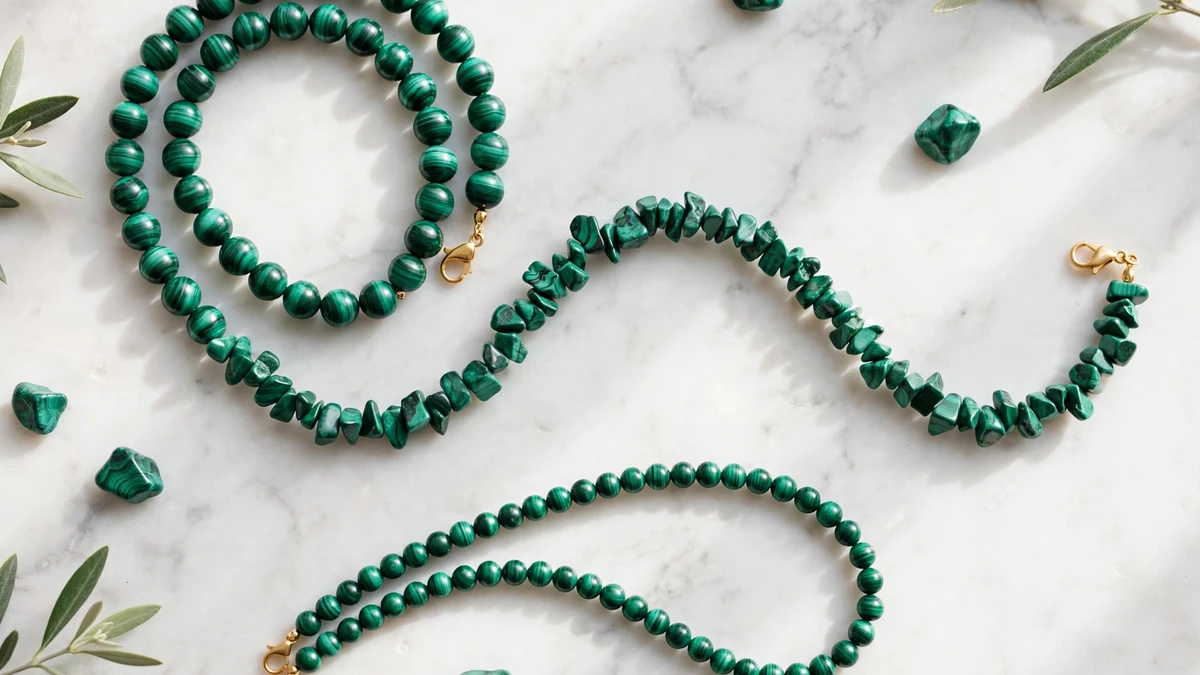
Malachite is the most dramatic green in the jewellery box. Its deep, swirling bands of light and dark green look almost painted, and no two stones are ever alike. A malachite necklace can be a bold beaded strand, a polished pendant, or a sculptural centrepiece, and it always draws the eye. That drama comes with a warning, though: malachite is a soft stone, Mohs 3.5 to 4, and it needs more care than most of the green stones it is compared with.
The problem is not finding a malachite necklace. It is finding one made from real stone, cut and set well, and knowing how to look after it. Much of the malachite sold at low prices is plastic or resin with printed stripes, and even genuine malachite can be damaged by water, perfume, and ultrasonic cleaners. A necklace bought without understanding the stone can scratch, dull, or crack within months.
Below are nine malachite necklaces worth considering in 2027, from a classic beaded strand to polished pendants in gold and silver. Each one is described by what it does well, what to watch for, and who it suits best, so you can choose with the stone in mind, not just the photograph.
Key takeaways
- Malachite is a copper carbonate mineral, Mohs 3.5 to 4, soft and easy to scratch, so it needs gentle handling and careful storage.
- Real malachite has irregular, flowing bands of light and dark green; unnaturally regular stripes usually mean plastic or resin imitation.
- Keep malachite away from water, perfume, sunscreen, and ultrasonic or steam cleaners, and clean it only with a soft, dry or barely damp cloth.
- Choose a protective setting, such as a bezel or a beaded strand, and a clasp that can take the weight of the stone.
- Malachite has no proven healing properties and is not an investment stone, and its dust is toxic if inhaled, so never cut or polish it yourself.
What malachite actually is
Malachite is a copper carbonate mineral, formed in the oxidised zones of copper deposits, and its colour comes from copper itself. The stone is famous for its banding: concentric rings, swirls and waves of light green, dark green and almost black, laid down in layers as the mineral grew. Because the banding is natural and irregular, every piece is unique, and that uniqueness is a large part of its appeal.
At Mohs 3.5 to 4, malachite is one of the softest stones used in jewellery. It scratches easily, chips if knocked, and can be damaged by acids, including the acids in perfume, sweat and some cleaning products. It is also sensitive to heat and to water, which can dull its polish over time. These are not reasons to avoid malachite, but they are reasons to choose the setting carefully and to treat the necklace gently.
Malachite has been used as an ornament for thousands of years, from ancient Egyptian jewellery and eye paint to the great malachite columns and tabletops of Russian palaces, where the stone was cut from the vast deposits of the Ural Mountains. Today most gem-quality malachite comes from the Democratic Republic of Congo, with smaller amounts from Zambia, Australia, Mexico and the Urals. The finest material has bold, contrasting bands and a high polish, while paler or weakly banded material is usually cut into beads or carved pieces rather than fine jewellery.
Imitations are common. Plastic and resin copies often have stripes that are too regular, too perfectly parallel, or too brightly coloured, and they feel lighter and warmer than real stone. Glass imitations exist too, usually with a flat, even colour and no real banding. A genuine malachite bead or pendant should show irregular, flowing bands, and it should feel cool and substantial in the hand.
How we chose these necklaces and what to look for
Look first at the banding. Real malachite has irregular, flowing bands that vary in width and direction, with soft transitions between light and dark green. If the stripes are perfectly even, sharply defined, or repeated identically across beads, the piece is probably plastic or resin. Look at the polish too: a good malachite stone has a smooth, glossy surface, while a dull or pitted surface suggests poor cutting or a soft imitation.

Look next at the setting. Malachite is best protected in a bezel setting, which covers the edges of the stone, or as a beaded strand, where each bead is supported by its neighbours. Prong settings leave the edges exposed and are a poor choice for a stone this soft. The chain or cord should suit the weight of the stone, and the clasp should close firmly. Our guide to the best malachite bracelets uses the same checks, because the stone and the setting matter just as much in a bracelet as they do around your neck.
Finally, look at the seller. A reputable jeweller will name the stone, state that it is natural malachite, and warn you about water and chemicals. They will also offer a clear returns policy. A seller who describes malachite as hard, waterproof, or suitable for everyday rough wear is either mistaken or misleading, and the necklace is best avoided.
The 9 best malachite necklaces of 2027
Tiffany & Co. Malachite Bead Pendant
What we like: A single polished malachite bead on a fine silver chain, with strong banding, reliable finishing, and a secure clasp. What to consider: Premium price for a simple design, and the bead needs gentle handling. Stone: Malachite. Setting: Sterling silver. Best for: Occasions and careful everyday wear. Price range: Premium.
A quiet, well-made piece that lets the stone speak. The bead is large enough to show the banding clearly, and the silver chain suits the deep green.
Cartier Malachite Beaded Necklace
What we like: Evenly matched malachite beads with strong, natural banding, knotted on a strong cord, with a polished gold clasp. What to consider: Luxury price, and the strand needs to be kept dry. Stone: Malachite. Setting: 18k gold clasp. Best for: Polished looks and special occasions. Price range: Luxury.
The bead matching is the point here. Each bead shows a different swirl of green, yet the strand reads as a single, deliberate piece.
David Yurman Malachite Cable Pendant
What we like: A polished malachite cabochon set in the brand’s signature cable design, with a sturdy chain and a balanced, wearable weight. What to consider: Premium price, and the cable setting adds visual weight. Stone: Malachite. Setting: Sterling silver and 14k gold. Best for: A signature pendant for occasions. Price range: Premium.
The cable work protects the edges of the stone, which matters for malachite, and the cabochon cut shows the banding at its best.
Mejuri Malachite Beaded Necklace
What we like: Small malachite beads on a delicate gold vermeil chain, light to wear, fairly priced, and with a secure clasp. What to consider: The beads are small, so the banding is subtle at a distance. Stone: Malachite. Setting: Gold vermeil. Best for: Layering and occasions. Price range: Mid-range.
A good entry point if you want to try malachite without a large outlay. It layers well with a plain gold chain, but keep it away from perfume and water.
Monica Vinader Malachite Tennis Necklace
What we like: A line of matched malachite stones in a clean tennis setting, with a secure box clasp and a comfortable, even drape. What to consider: The setting covers much of each stone, so the banding is partly hidden. Stone: Malachite. Setting: Gold vermeil. Best for: Evenings and dressed-up days. Price range: Mid-range to premium.
The tennis format gives malachite a formal, structured look, and the setting protects the stones well. It is a necklace for occasions rather than daily wear.
Missoma Malachite Chain Necklace
What we like: A single malachite pendant on a fine gold chain, with a relaxed, modern feel and a clasp that is easy to fasten. What to consider: The pendant is small, and the chain is fine, so it suits lighter outfits best. Stone: Malachite. Setting: Gold vermeil. Best for: Occasions and careful everyday wear. Price range: Mid-range.
Simple and easy to wear, this is a necklace for people who want a touch of malachite green without a statement piece.
Maria Black Malachite Sculptural Pendant
What we like: An irregular, sculptural malachite pendant in a modern silver setting, with a distinctive shape and a strong, contemporary look. What to consider: The shape is bold, so it suits confident styling rather than quiet outfits. Stone: Malachite. Setting: Sterling silver. Best for: Statement styling. Price range: Mid-range to premium.
The irregular cut follows the stone’s natural banding, so the pendant looks like a piece of the earth rather than a manufactured shape.
Astrid & Miyu Malachite Beaded Necklace
What we like: Malachite beads in mixed sizes on a gold chain, playful and relaxed, with a secure clasp and a fair price. What to consider: The mixed sizes make it less formal than a matched strand. Stone: Malachite. Setting: Gold-plated. Best for: Casual and holiday wear. Price range: Affordable to mid-range.
The varied beads give this necklace an easy, handmade feel, and the green works well against summer skin and light fabrics. Keep it dry and store it carefully.
Thomas Sabo Malachite Link Necklace
What we like: Malachite beads set between polished silver links, with a sturdy chain, a reliable clasp, and a balanced weight. What to consider: The links add weight, so it sits best on its own rather than layered. Stone: Malachite. Setting: Sterling silver. Best for: Occasions with character. Price range: Mid-range.
The link design gives the necklace structure, and the silver cools the green nicely. It is a practical, well-made piece for careful, regular wear.
Which malachite necklace is right for you
If you want a necklace for occasions, choose a beaded strand or a pendant in a bezel setting, which protects the soft stone. Malachite is at its best when it is worn deliberately, put on last, after perfume and hairspray, and taken off before swimming, showering, or exercise. A knotted strand is a good choice, because the knots protect the beads and stop the whole strand scattering if the cord breaks.
If you want a necklace for evenings, a tennis necklace or a larger pendant in a gold setting gives more presence, and the deep green pairs well with black, cream, and gold. Keep the rest of your jewellery simple, so the malachite stays the focus. Our malachite earrings for spring are a useful guide if you want a matching pair, but a single green accent is often enough, and two malachite pieces can easily look too much.
If you are buying a gift, a small pendant on a gold or silver chain is the safest choice, because it suits most necklines and most styles. Include a care note, or choose a seller who provides one, because malachite is a stone that rewards a little knowledge. Avoid very large or very dark stones for a first piece, and choose a seller with a clear returns policy.
Malachite’s deep green suits most skin tones, because it is rich rather than bright. Against warm skin, a gold setting warms the stone further, while against cool skin, silver gives it a crisp, modern edge. It pairs best with plain, solid colours: black, cream, navy, and charcoal all let the banding stand out, while busy patterns compete with the stone. Because malachite is a statement on its own, keep the rest of your jewellery quiet, and let the necklace carry the outfit.
The caveats that matter
Malachite’s softness is the caveat that matters most. At Mohs 3.5 to 4, it scratches easily, chips if knocked against a hard surface, and can be dulled by water, acids, and chemicals. Never wear a malachite necklace swimming, in the shower, or while cleaning, and never spray perfume or hairspray directly onto it. Put it on last, and take it off first.
| Detail | What is known |
|---|---|
| What it is | Copper carbonate mineral, Mohs 3.5 to 4 |
| Its pattern | Irregular, flowing bands of light and dark green |
| Common imitations | Plastic and resin with unnaturally regular stripes; glass |
| Durability | Soft and easy to scratch or chip; needs gentle handling |
| Care | Soft, dry or barely damp cloth only; never soak or use chemicals |
| What to avoid | Water, perfume, sunscreen, ultrasonic and steam cleaners |
| Safety note | Malachite dust is toxic if inhaled; never cut or polish it yourself |
| What it does not do | It has no proven healing properties and is not an investment stone |
Malachite dust is toxic if inhaled, which matters if a stone ever chips or breaks. Do not attempt to polish, reshape, or repair a malachite stone yourself, and if a bead cracks, take it to a professional jeweller. Store the necklace in a soft pouch, away from harder stones such as diamonds and sapphires, which can scratch it, and clean it only with a soft, dry or barely damp cloth.
Checklist: choosing a malachite necklace honestly
Use these checks before you buy, and again when the necklace arrives.
- Check the banding in daylight: irregular, flowing bands, not perfectly even or repeated stripes.
- Check the feel: real malachite is cool and substantial; plastic feels light and warm.
- Check the setting: a bezel or a beaded strand protects the soft stone; exposed prongs do not.
- Check the chain or cord: strong enough for the weight, with a clasp that closes firmly.
- Check the seller: the stone should be named as natural malachite, with care advice and clear returns.
- Check the length: measure against a necklace you already like, because a pendant sits differently at 40 cm than at 50 cm.
Frequently asked questions
Can I wear a malachite necklace every day?
It is better as an occasional piece. Malachite is soft, Mohs 3.5 to 4, and it scratches and chips easily. If you do wear it daily, put it on last, take it off first, and keep it away from water, perfume, and hard surfaces.
Can malachite get wet?
It should not be soaked, worn swimming, or worn in the shower. Brief contact with a damp cloth during cleaning is fine, but water can dull the polish over time, and soaps and chemicals can damage the surface.
How do I tell real malachite from plastic?
Real malachite has irregular, flowing bands that vary in width and direction, and it feels cool and substantial. Plastic copies usually have stripes that are too regular, too parallel, or too bright, and they feel lighter and warmer. Glass copies tend to have a flat, even colour with no real banding.
How should I clean a malachite necklace?
With a soft, dry or barely damp cloth, and nothing else. Never use an ultrasonic or steam cleaner, never soak it, and never use chemical jewellery cleaners. Let it dry fully before storing it in a soft pouch.
Is malachite safe to wear?
Yes, as finished jewellery. The safety concern is with malachite dust, which is toxic if inhaled during cutting or polishing, so never cut, grind, or repair a malachite stone yourself. A finished, polished necklace is safe to wear against the skin.
Is malachite a good gift?
Yes, for someone who enjoys bold, distinctive jewellery and will look after it. A small pendant on a gold or silver chain is the safest choice, and a care note matters more than the price. Our guide to statement necklaces can help you judge whether a bold malachite piece suits the recipient’s style.
The bottom line
The best malachite necklace in 2027 is a genuine stone with irregular, flowing bands, set in a bezel or a beaded strand that protects it, on a chain or cord that suits its weight. A beaded strand or a small pendant is the easiest place to start, and a deeper green in a gold setting is the most versatile choice for evenings.
Choose real stone over regular-striped imitations, keep it dry and away from perfume and chemicals, and store it in a soft pouch. Done well, a malachite necklace is a striking, one-of-a-kind piece, and that is the honest measure of a good buy.